Austria country guide Places and experiences
What should a first-time traveler see in Austria beyond the obvious highlights?
The short answer
Go for the landscapes and the engineering rather than the city cores — Austria holds 12 properties on the UNESCO World Heritage List, and the ones most first-timers skip are a mountain railway, a salt-mining valley and a stretch of Danube terraces.
The answer, with local context
The twelve break into recognizable families. Two are Vienna's: the Historic Centre of Vienna, which UNESCO has kept on the List of World Heritage in Danger, and the Palace and Gardens of Schönbrunn. Salzburg's historic center and Graz, paired with Schloss Eggenberg, cover the other two cities. Then come the properties that reward a traveler who leaves the train line between them: the Hallstatt-Dachstein/Salzkammergut cultural landscape, the Wachau cultural landscape, the Semmering Railway, and the Fertö/Neusiedlersee landscape that Austria shares with Hungary. Four more are transnational and barely read as destinations at all — prehistoric pile dwellings around the Alps, ancient and primeval beech forests, the Great Spa Towns of Europe, and the western segment of the Danube Limes frontier of the Roman Empire.
The Semmering Railway is the outlier worth understanding. It is inscribed not as scenery but as a work of civil engineering, and it is still a scheduled line — you ride it rather than visit it. The Wachau works the opposite way: a river corridor of terraced vineyards and small market towns where the designation covers the whole worked landscape, not a monument inside it.
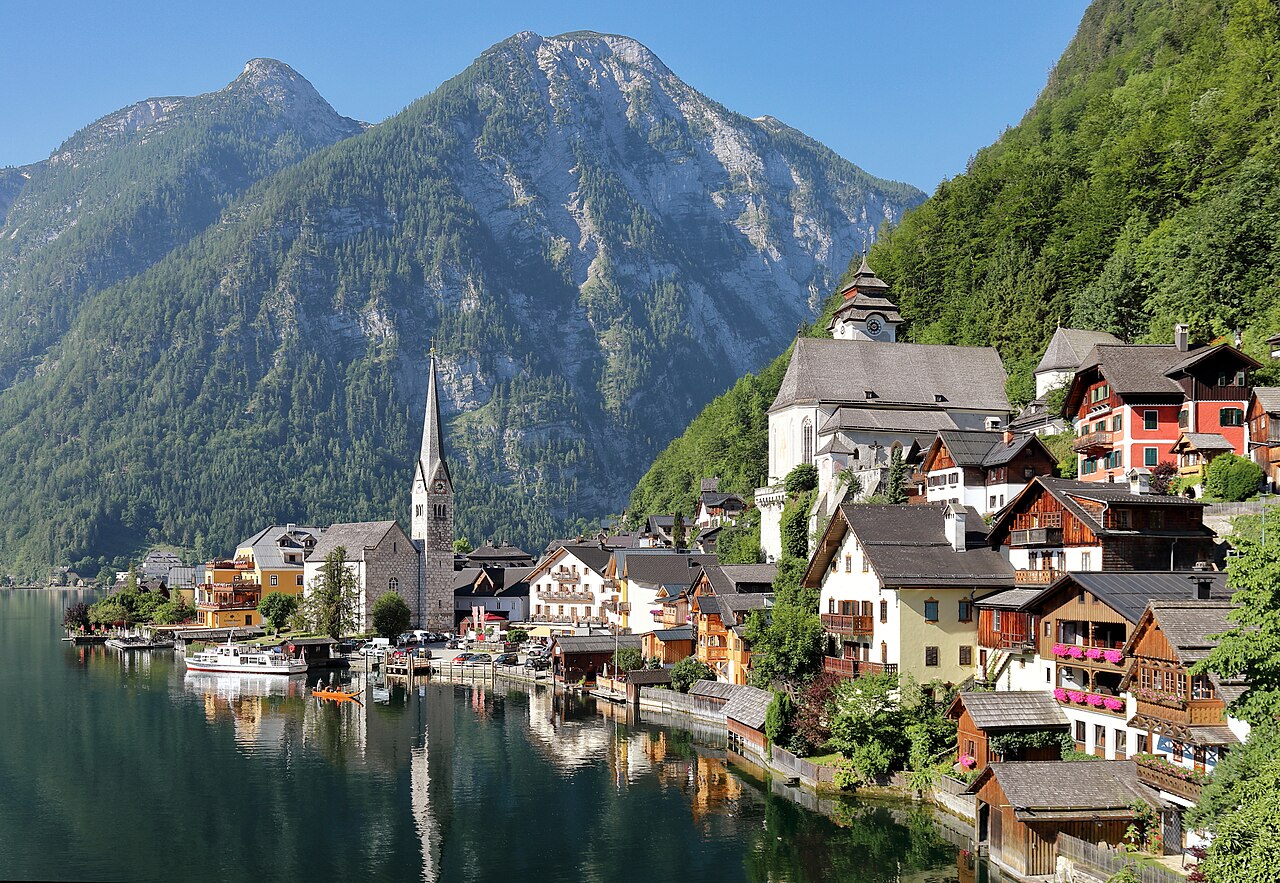
Hallstatt sits in the third category, a village so compressed between a lake and a mountain wall that its scale is itself the attraction. UNESCO inscribed the valley for the salt extraction that funded it from prehistory onward, not for the lakefront that now draws the photographs.
Picture the place
In the Salzkammergut the mountain shadow arrives early and from the west, so Hallstatt's lakefront loses direct sun while the opposite shore across the water is still lit — the gap between the two can be an hour or more in autumn.
The easily missed detail
Austria shares four of its twelve properties with other countries, and one of them, Fertö/Neusiedlersee, straddles the Hungarian border about an hour southeast of Vienna. That makes it the single easiest World Heritage landscape to reach from the capital, and it is a shallow steppe lake rather than anything alpine — a completely different Austria from the one on the postcards, and the one almost nobody plans for.
A practical rhythm
- East of Vienna — Fertö/Neusiedlersee for flat water, reed beds and birds, reachable and returnable in a day.
- The river — The Wachau for terraced slopes above the Danube, where the designation is the farmland itself.
- The mountains — Hallstatt-Dachstein/Salzkammergut for the salt valleys, with the Semmering Railway ridden rather than visited on the way.
What could complicate the plan
These are dispersed, and Austria's twelve properties sit in eight different federal states, so a route that strings three together is a driving or rail itinerary, not a set of day trips from one base. Alpine properties carry seasonal access limits that city centers do not. US citizens enter without a visa for stays of 90 days or less, and the State Department's Austria advisory, issued 21 August 2026, remains at Level 1, exercise normal precautions. Hungary and Austria are both Schengen states, so crossing to Fertö/Neusiedlersee involves no separate entry process, though the 90-day Schengen clock covers both sides of the lake.
What to do next
The when-to-visit question in this chapter sets the seasonal frame for these landscapes; the food question covers the Wachau's wine terraces from the table end.
Sources
- UNESCO World Heritage Centre, States Parties: Austria — number of inscribed properties
- US Department of State, Austria — advisory level and date, visa-free stay
- European Commission, Migration and Home Affairs — Schengen 90-in-180 short-stay rule