Belarus country guide Places and experiences
What should a first-time traveler see in Belarus beyond the obvious highlights?
The short answer
Belovezhskaya Pushcha, the lowland forest on the Polish border — inscribed by UNESCO in 1992 under Decision 16COM XA and extended in 1999 under Decision 23COM VIIIA.2, and the property whose Belarusian side a UNESCO state-of-conservation report records as enlarged from 88,700 to 152,200 hectares.
The answer, with local context
The forest is the country's most substantial natural designation and the least like a city sightseeing stop. UNESCO's state-of-conservation record for the property documents a joint IUCN and UNESCO mission that visited from 15 to 20 March 2004, a Committee decision adopted in 2005 as 29 COM 7B.15, and a report due by 1 February 2006 for the Committee's 30th session in Vilnius. It also records that the Belarusian core area rose from 15,600 to 30,000 hectares, and lists protection, regulation and restoration of the European bison population among 3 priority activities in the planned forest management plan. The property is transboundary, with Belovezhskaya Pushcha on the Belarusian side and Bialowieza Forest on the Polish side.
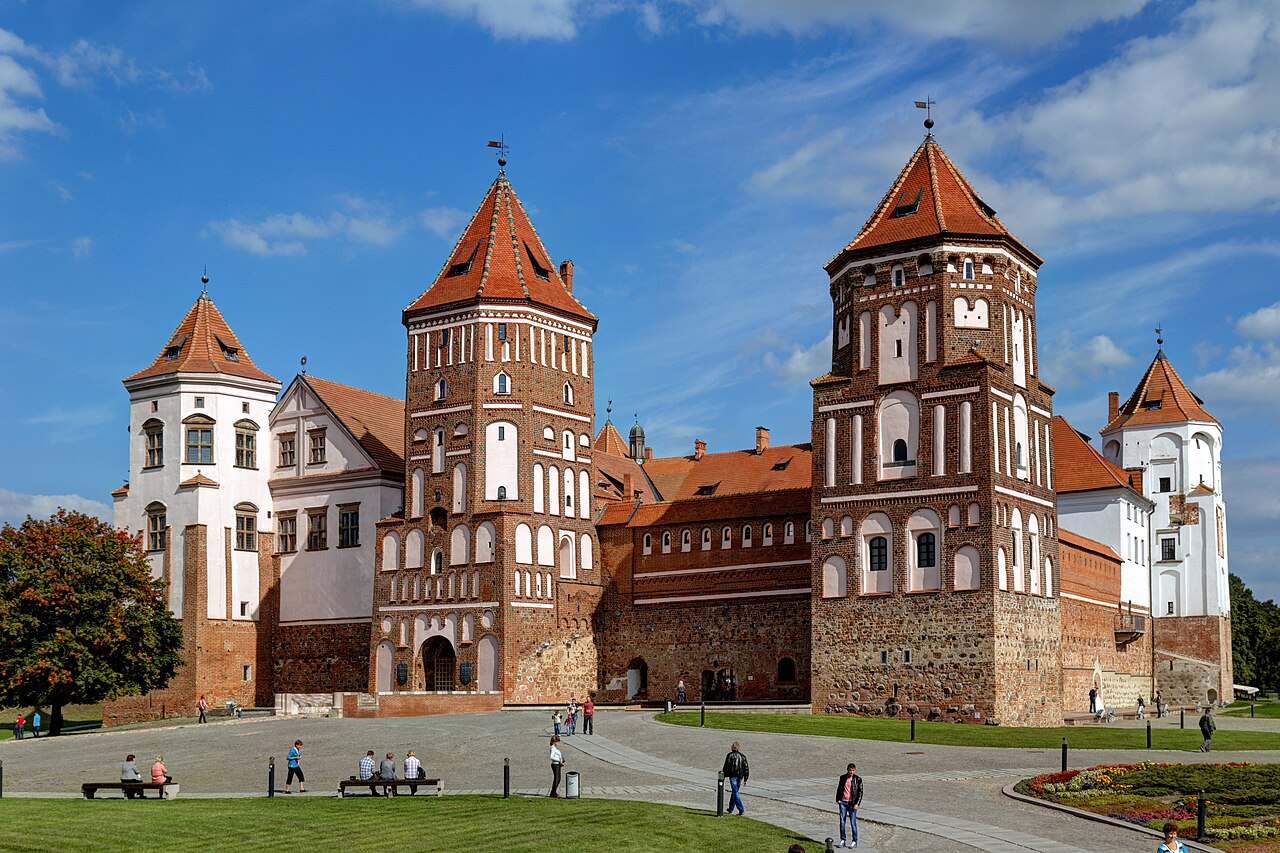
The built heritage sits away from the capital too. The Mir Castle Complex was inscribed in 2000 at the Committee's 24th session in Cairns, 27 November to 2 December 2000, under criteria (ii) and (iv), by Decision 24 COM X.C.1, in document WHC-2000/CONF.204/21. UNESCO's statement describes it as an exceptional example of a central European castle whose design and layout combine Gothic, Renaissance and Baroque influences into a harmonious whole, and notes under criterion (iv) that the surrounding region's long history of political and cultural conflict and merging is reflected in the ensemble's form and appearance.
Two more properties fill out the list. UNESCO's Belarus documents record the Architectural, Residential and Cultural Complex of the Radziwill Family at Nesvizh under Decision 29COM 8B.34 in 2005, with later decisions in 2009, 2010 and 2011, and the Struve Geodetic Arc under Decision 29COM 8B.35 in the same year. The same listing shows Berezinsky Biosphere Reserve was considered in 1992 and not inscribed, under Decision 16COM XB, and that the Augustowski Canal, a Belarus and Poland nomination, appears under Decision 34COM 8B.26 in 2010.
The easily missed detail
Nesvizh's connection runs into the kitchen as well as the architecture. The official website of the Republic of Belarus lists Pike Perch à la Radziwill among the country's named dishes, alongside machanka, vereshchaka, draniki and kolduny — the same Radziwill family whose Nesvizh complex UNESCO took up in 2005. River fish, chiefly pike, perch and carp, are among the staple ingredients the same source names.
A practical rhythm
- Southwest — The transboundary forest, where the Belarusian side runs to 152,200 hectares with a 30,000-hectare core.
- West — Mir Castle, the 2000 inscription, with Nesvizh's Radziwill complex on the same axis.
- Border points — The Struve Geodetic Arc markers, listed in 2005, which run across several countries rather than clustering in one.
What could complicate the plan
The advisory status overrides the itinerary. The State Department's Belarus advisory of 29 December 2025 is Level 4, "Do not travel," and records that US Embassy Minsk has suspended operations with all consular services suspended, that the FAA bans US carriers, pilots and US-registered aircraft from the Minsk Flight Information Region, that commercial flights are limited and border crossings can close with little notice, and that an E-visa permits 30 days but only with entry and exit at Minsk International Airport. The FCDO advises against all travel, notes the Ukraine land border is closed to British nationals while the Poland border reopened on 25 September 2025, and requires medical insurance worth EUR 10,000 plus funds of EUR 25 per day. Reaching a forest on the Polish frontier under those conditions is a serious logistical problem rather than a scenic drive.
What to do next
The Belarus when-to-visit answer in this chapter explains why the advisory, not the season, is the governing factor; the food answer takes up the dishes the state portal names.
Sources
- UNESCO World Heritage Centre, state of conservation record for Belovezhskaya Pushcha / Bialowieza Forest — area enlargements, mission dates, decision code, bison priority
- UNESCO World Heritage Committee decision record for Mir Castle Complex — year, criteria, decision code, session dates, statement of value
- UNESCO World Heritage Centre, Belarus documents listing — decision codes and years for Nesvizh, Struve Geodetic Arc, Berezinsky and the Augustowski Canal
- Official website of the Republic of Belarus, national cuisine — named dishes and staple ingredients
- US Department of State, Belarus travel advisory, issued 29 December 2025 — advisory level, embassy and FAA status, E-visa conditions
- UK Foreign, Commonwealth and Development Office, Belarus entry requirements — travel advice, border status, insurance and funds