Bordeaux / France Things to do
What are the most worthwhile things to do in Bordeaux on a first visit?
The short answer
Paddle in the Miroir d'eau before the Place de la Bourse, spend half a day inside the Cité du Vin, climb the Pey-Berland tower, and take the train to Saint-Émilion — one day in wine country is part of a first visit, not an extra.
The answer, with local context
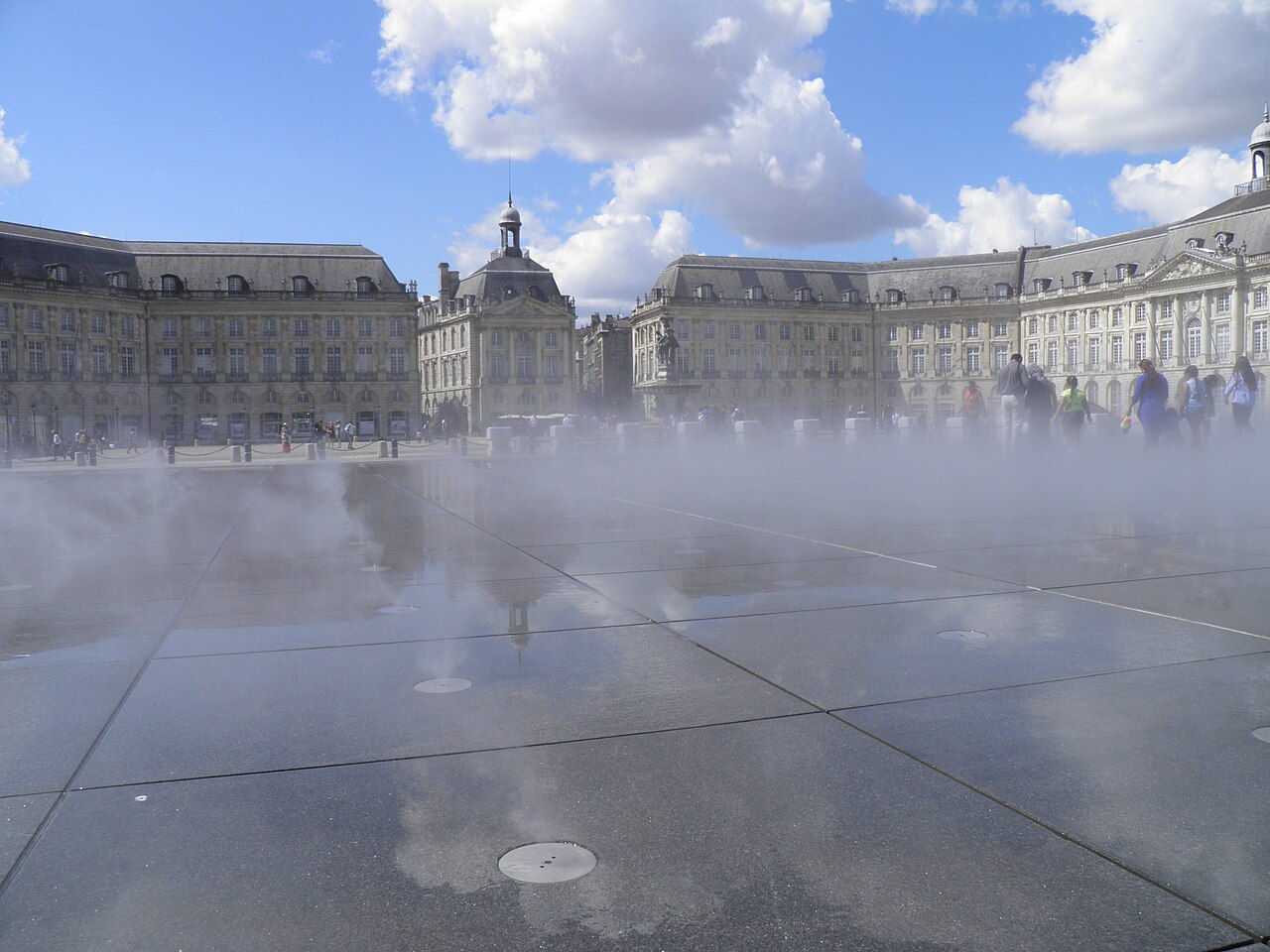
The city explains itself along the Garonne, so walk the crescent first. The Port de la Lune — the moon-shaped bend that gives the UNESCO site its name — strings together the whole 18th-century program: the Place de la Bourse (1730–1755), where the stock exchange and the customs house face the river across the Miroir d'eau, a 3,450 m² sheet of granite that cycles between mist and a two-centimeter mirror — at 37,137 square feet the largest reflecting pool in the world, completed in 2006 and now the city's living room. Cross the Pont Saint-Pierre (Napoleon's bridge, 1822) to the right bank for the return view, then walk upriver through the old wine merchants' quarter of the Chartrons, where the négociants' houses and chai warehouses ran the trade, to the quarter's museums of wine and commerce.
The Cité du Vin, opened in June 2016 at the top of the quays in Bacalan, is the modern temple: a 180-foot (55 m) swirl of gold-toned panels containing some 19 interactive modules on the world's wine cultures across 8,000 years, finished on the 8th-floor Belvédère, where the ticket (about €22 for adults) includes a glass chosen from a rotating list of world wines with a 360° view over the port. Budget three hours, go at opening, and pair it with lunch at the Halles de Bacalan food hall across the street. Then do the old stones: Bordeaux Cathedral, where Eleanor of Aquitaine married the future Louis VII in 1137, and its free-standing Pey-Berland tower (built 1440–1466; 229 steps to a view over every spire), the Grosse Cloche gate-belfry, and the Porte Cailhau, the little triumphal gate of 1495 in the Saint-Pierre lanes.
Give day two or three to the vines, because Bordeaux without them is a prologue. Saint-Émilion, 40 minutes by train, is a medieval village carved into limestone — a monolithic church hollowed from a single rock, cloisters, ramparts — set in the first vineyard landscape UNESCO ever listed (1999), and its châteaux (book one visit underground, into the limestone aging cellars) pour within walking distance of the station. The Médoc is the other pilgrimage: the D2 "Route des Châteaux" past Margaux, Pauillac and Saint-Julien, where the 1855 classification — drawn up for Napoleon III's Paris Exposition — still ranks the great estates, and many (unlike their reputation) run bookable tours and tastings. Drivers should know the taste-and-spit etiquette; everyone else should know a guided day tour or the train to Pauillac solves the problem.
Picture the place
At the Miroir d'eau on a warm afternoon the whole city performs: suits with trousers rolled, toddlers in the mist cycle, a bride posing on the mirror as the Bourse doubles itself in two centimeters of water.
The easily missed detail
The city's second-best panorama is industrial: the Bassins des Lumières, opened in 2020 inside the vast concrete pens of the wartime German submarine base at Bacalan, is among the world's largest digital-art venues — Klimt or Dalí projected wall-to-wall across black water where U-boats once berthed. It is five minutes from the Cité du Vin and unknown to most first-timers, who walk past the bunkers without a glance.
A practical rhythm
- Cité du Vin at opening — Book the first entry slot, finish at the Belvédère by noon, and lunch at the Halles de Bacalan
- Saint-Pierre in the evening — The old town's lanes and wine bars come alive after 7 p.m.; do the cathedral and Pey-Berland in the late afternoon
- Train to Saint-Émilion — Take a morning train, one château visit and the monolithic church, and be back on the quays for dinner
What could complicate the plan
Château visits are appointment-only almost everywhere and the famous first growths (Lafite, Latour, Margaux, Mouton, Haut-Brion) take bookings weeks to months out — or not at all. The Cité du Vin sells timed entry and fills on rainy weekends; Pey-Berland's 229 steps are a single-file medieval stair with a cap on numbers. Many city museums close on Mondays or Tuesdays, and August empties local-run Bordeaux even as visitor numbers peak.
What to do next
Book the Cité du Vin and one Saint-Émilion château before anything else, then let the quays organize the rest of the days by walking.
Sources
- UNESCO World Heritage Centre — Bordeaux, Port of the Moon (2007) and the Jurisdiction of Saint-Émilion (1999), the first listed vineyard cultural landscape
- La Cité du Vin — opened June 2016; the Belvédère tasting included in the adult ticket (about €22); 19 permanent-tour modules
- Ville de Bordeaux — the Miroir d'eau (2006), 3,450 m², the world's largest reflecting pool; the Pey-Berland tower, 1440–1466, with 229 steps
- CIVB (Bordeaux wine bureau) — the 1855 classification and the Médoc château route (D2)