Brunei country guide Trip planning
How can I plan a memorable first trip to Brunei without rushing?
The short answer
US passport holders need no visa for visits of up to 90 days, which is far longer than anyone needs for a country this compact — the planning problem in Brunei is pacing a short list, not fitting a long one.
The answer, with local context
The 90-day allowance comes from the International Trade Administration's Brunei guide, which also describes renewals and residency permits as routine. For a first trip that figure mainly removes a worry: there is no entry window to engineer the itinerary around.
What does need engineering is the working week. Private offices run 8 a.m. to 5 p.m. on weekdays and 8 a.m. to 12 noon on Saturdays, so anything requiring an office — a permit, a booking desk, a travel agency — is a weekday-morning errand. The same guide reports the Brunei dollar pegged to the Singapore dollar and international Visa and Mastercard widely accepted, which keeps day-to-day spending simple.
Health planning deserves more attention than the trip length suggests. The guide names RIPAS Hospital in Bandar Seri Begawan and identifies Jerudong Park Medical Center as the largest private hospital, and it notes that certain elective or complex care may mean referral to Singapore. It also flags that dengue fever cases have surged regionally with no vaccine available, advising covered skin and DEET-based repellent, and warns that import laws on controlled substances are strict and that some common medications — decongestants among them — may be hard to find. Bring what you need, with the prescription.
On the security picture, the US State Department places Brunei at Level 1, Exercise Normal Precautions, in an advisory dated 14 May 2026. That is the lowest of the department's 4 levels and the reason a first trip here can be planned loosely.
Picture the place
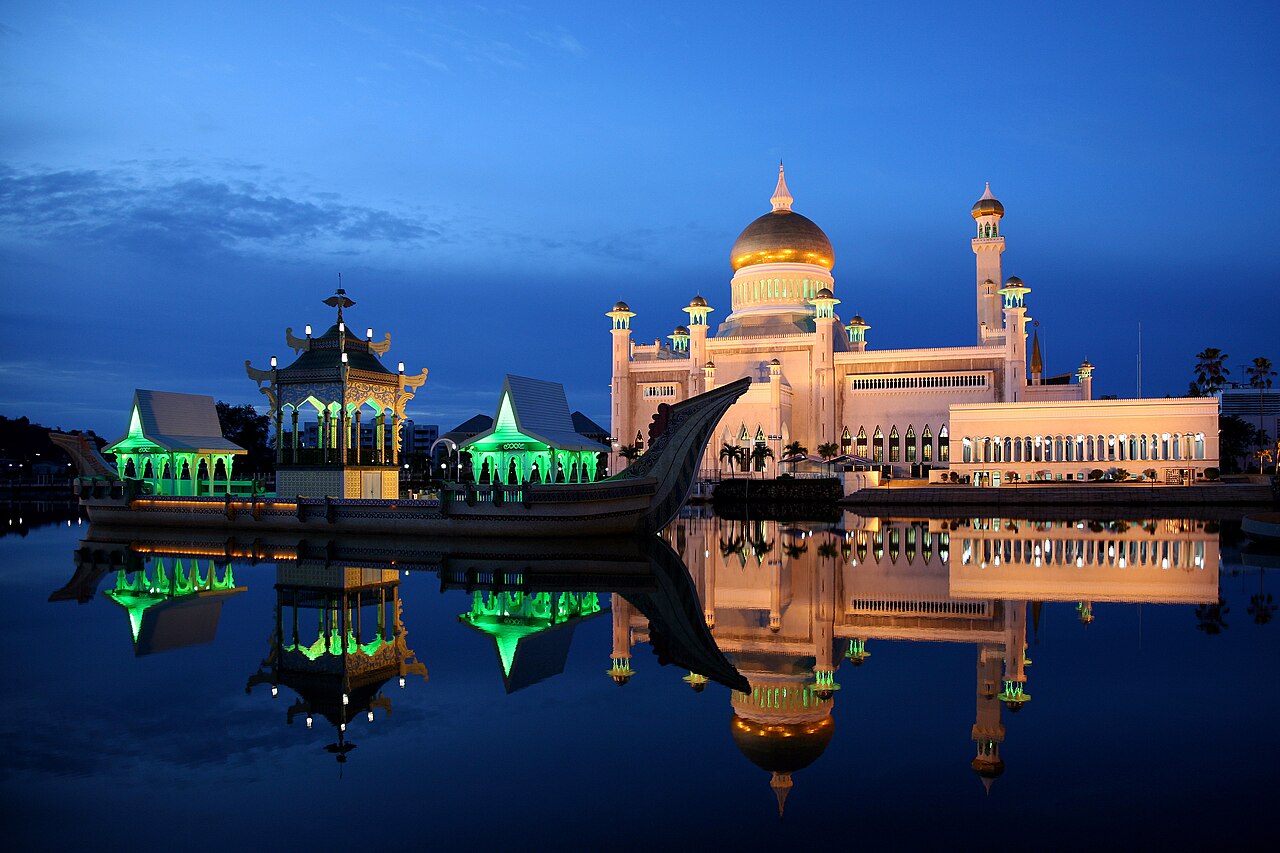
Brunei Tourism describes Kampong Ayer as one of the largest water settlements in Southeast Asia, a community it says has flourished for over 1,000 years — which means the country's defining sight is a neighborhood you walk through and a river you cross, not a monument you queue for.
The easily missed detail
The medication rule is the one that catches people. Strict controlled-substance import law plus limited local availability of ordinary pharmacy items means a traveler should arrive carrying a full course of anything they take, in original packaging, with documentation. That is a pre-departure task, not something to solve on arrival.
A practical rhythm
- Weekday mornings — The only reliable window for offices, which close at 12 noon on Saturdays and do not open Sundays.
- Any evening — Brunei Tourism points visitors without a car to the Dart ride-hailing app, which covers the gap left when public transport stops.
- Buffer day — Keep one, because referral care for anything complicated runs to Singapore rather than staying in-country.
What could complicate the plan
Dengue has no vaccine, so repellent and covered skin are the only countermeasures available. The medical picture is adequate for basic care but will route serious cases out of the country, which is an argument for insurance that covers evacuation. And while 90 days of visa-free entry sounds generous, the Trade Administration's guide carries its own last-published date of 22 February 2024, so entry rules are worth confirming close to departure rather than taken as fixed.
What to do next
Start with the Kampong Ayer timing question in this group — it sets out the Friday closure rule that governs almost every day of a Brunei itinerary.
Sources
- US International Trade Administration, Brunei Country Commercial Guide — 90-day visa-free entry, private office hours, currency and card acceptance, named hospitals, Singapore referral, dengue advice, medication import rules, page date
- US Department of State, Brunei Travel Advisory — advisory level and date
- Brunei Tourism, Kampong Ayer — settlement scale and longevity, Dart ride-hailing