China country guide Places and experiences
What should a first-time traveler see in China beyond the obvious highlights?
The short answer
Pick from the breadth of the World Heritage List itself — UNESCO's States Parties statistics credit China with 60 inscribed properties, and the great majority are nowhere near Beijing, Xi'an or Shanghai.
The answer, with local context
China ratified the World Heritage Convention on December 12, 1985, and has been inscribing properties steadily ever since. Sixty are on the List. A further 60 sit on its Tentative List, waiting. Taken together that is an inventory far larger than any first trip can touch, which is the useful way to think about a second itinerary: not as a set of famous names, but as a list to cut into.
The properties that reward a traveler already past the headline sites tend to be landscapes and vernacular architecture rather than imperial monuments. UNESCO's own conservation reporting for China names the Cultural Landscape of Honghe Hani Rice Terraces, the Three Parallel Rivers of Yunnan Protected Areas, South China Karst, the Wulingyuan Scenic and Historic Interest Area, the Zuojiang Huashan Rock Art Cultural Landscape, the West Lake Cultural Landscape of Hangzhou, the Grand Canal, the Ancient Building Complex in the Wudang Mountains, the Historic Centre of Macao and the Old Town of Lijiang. Not one of those is in the standard two-week first-timer loop.
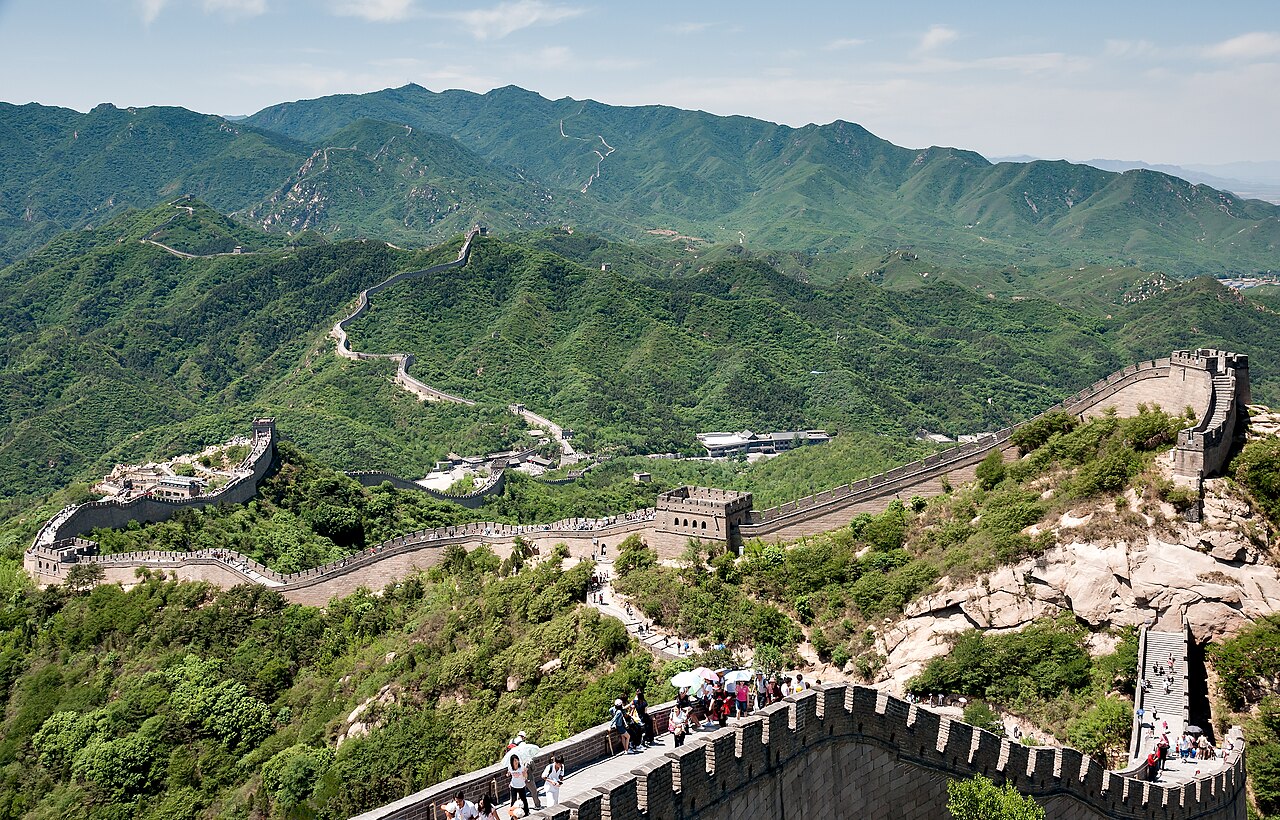
Even the single most famous property has unfamiliar parts. The inscribed Great Wall runs more than 20,000 kilometers from Shanhaiguan in Hebei to Jiayuguan in Gansu, so the restored, ticketed sections near the capital represent a fraction of a percent of the property. Sections further out are unreconstructed, unstaffed and considerably harder to reach — and considerably emptier.
Beijing's weather is a useful proxy for planning any of this in the north. The municipal government reports an annual average of 11°C to 14°C, 52°F to 57°F, with about 75 percent of rainfall in summer and the heaviest falls in July and August. Southern karst and terrace landscapes run on a different and wetter calendar, which is the first reason a China itinerary cannot be timed as a single trip.
Picture the place
The Hani terraces in southern Yunnan are not a viewpoint but a worked hillside, flooded in sequence, so what you see depends entirely on which stage of the rice year you arrive in — bare mud, sheet water reflecting sky, or green. The same slope photographs as three different places across one season.
The easily missed detail
UNESCO also recognizes Chinese cities through its Creative Cities Network, and the gastronomy designations in particular read as a travel route almost nobody uses: Chengdu from 2010, Shunde from 2014, Macao from 2017, Yangzhou from 2019 and Huai'an from 2021. Five cities, each formally designated for its food, and only one of them on the usual circuit.
A practical rhythm
- Pick one region, not one country — With 60 inscribed properties spread across a continental landmass, a single trip covering several is mostly spent in transit.
- Match the region to the month — Beijing concentrates about three-quarters of its rain in summer; the southern landscape properties do not share that pattern.
- Use the designations as a filter — The Creative Cities gastronomy list and the landscape inscriptions both point away from the saturated sites.
What could complicate the plan
A tourist visa must generally be obtained before arrival, and the ten-year multiple-entry option available to most US citizens is what makes a two-trip approach to China practical. The State Department's Level 2 advisory, issued November 27, 2024, cites arbitrary enforcement of local laws, including exit bans, which bears on independent travel to less-visited areas more than to major cities. Several of the properties listed above are at altitude or on steep worked terrain, and access can be seasonal.
What to do next
Take the food question in this group next — the gastronomy designations mentioned here are unpacked there, with the regional cooking traditions behind them.
Sources
- UNESCO World Heritage Centre, States Parties statistics — count of inscribed properties for China
- UNESCO World Heritage Centre, China — Convention ratification date, Tentative List count, named properties
- UNESCO World Heritage Centre, The Great Wall — stated length and east–west limits
- UNESCO Creative Cities Network — City of Gastronomy designation years for Chengdu, Shunde, Macao, Yangzhou and Huai'an
- Beijing Municipal Government (English portal) — annual temperature range and rainfall distribution
- US Department of State — advisory level and date, visa validity options