Iran country guide When to visit
When is the best time to visit Iran for Isfahan?
The short answer
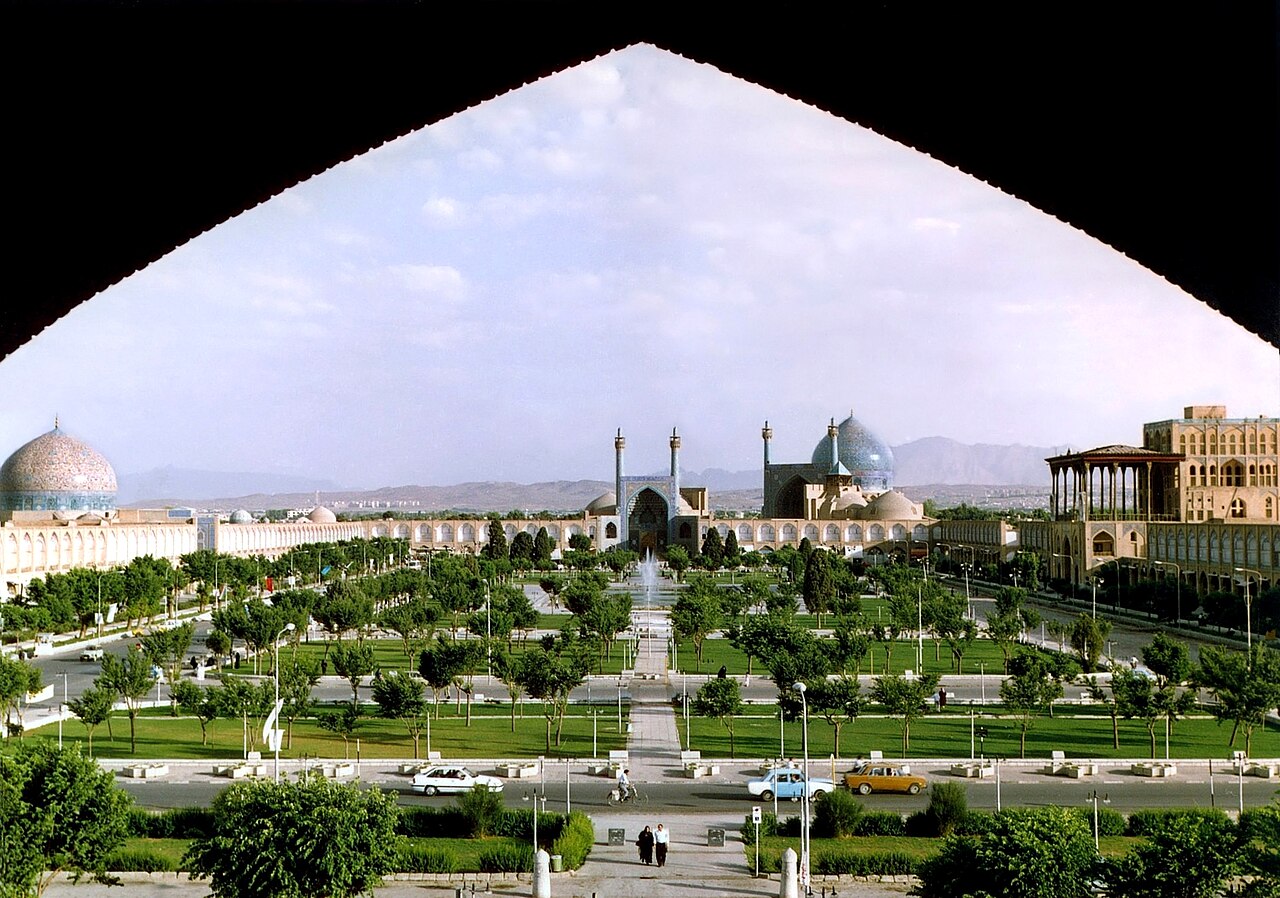
Isfahan's centerpiece, Meidan Emam, was inscribed on the World Heritage List in 1979, at the Committee's 3rd session, under decision 03COM XII.46 — and it is a square whose two-storeyed arcades make it a place to walk at the ends of the day rather than the middle of it.
The answer, with local context
UNESCO records Meidan Emam as built under Shah Abbas I at the beginning of the 17th century, bordered on all sides by monumental buildings linked by a series of two-storeyed arcades, with the Royal Mosque among them. That architecture is the timing argument. An enclosed square ringed by arcades is a shaded perimeter and an unshaded center, so the usable hours shift with the sun rather than with an opening schedule.
The square has also been under continuous international scrutiny. The World Heritage Centre's State of Conservation archive holds reports on Meidan Emam running from 1995 through 2025 — an unusually long run that reflects how much attention the property's setting has drawn over 3 decades. Iran as a whole has 30 properties inscribed on the World Heritage List, so Isfahan is one node in a dense cultural network rather than a standalone stop.
Nationally, the country does not behave as one climate or one season. The IUCN's World Heritage Outlook assessment of the Hyrcanian Forests, the humid belt along Iran's northern edge, rates changes in temperature and precipitation regimes as a High threat affecting throughout the site — more than 50 percent of it. A country where the northern forests are being assessed for climate stress and the central plateau cities sit on high arid ground is a country where "the best month" depends on which Iran you are visiting. Isfahan sits on the plateau; the Caspian north is a different proposition in the same week.
Picture the place
An arcaded square works like a cloister turned inside out: the colonnades hold cool air and deep shade while the open ground between them takes the full sun, which is why the perimeter fills first and the middle of the square empties out in the hours either side of noon.
The easily missed detail
A 1979 inscription predates almost every modern visitor-management convention, so Meidan Emam is managed as urban fabric rather than as a ticketed enclosure. The buildings around it have their own hours; the square itself does not close. That makes early morning and late afternoon genuinely available, and it means the planning question is which monuments on the perimeter are open, not whether you can enter the space.
A practical rhythm
- Early morning — The arcades are in shade and the square is a working public space before the monuments on its edges open.
- Midday — Move indoors or into the arcades; the open ground is the least comfortable part of the site.
- Late afternoon — Low light rakes across the two-storeyed facades, which is when the square reads most clearly as a single designed composition.
What could complicate the plan
This is the beat that decides the trip. Iran does not recognize dual nationality: the US State Department reports that Iranian authorities treat US-Iranian dual nationals solely as Iranian citizens, that dual nationals must enter and exit Iran on Iranian passports, and that authorities may treat some US citizens without Iranian passports as Iranian nationals as well. For anyone with Iranian family background, that single rule outweighs every seasonal consideration, because it changes which laws apply to you on arrival.
What to do next
The Iran trip-planning question in this group sets out the entry documents, the consular situation and the military-service rules that follow from the nationality point above.
Sources
- UNESCO World Heritage Centre, Meidan Emam, Esfahan (property 115) — inscribed property count
- IUCN World Heritage Outlook, Hyrcanian Forests — temperature and precipitation threat rating and extent
- US Department of State, Iran country information — dual nationality treatment and passport requirements