Kazakhstan country guide When to visit
When is the best time to visit Kazakhstan for Almaty mountains?
The short answer
June through September is the principal hiking and lake-viewing season for the Almaty mountains, but a Kazakhstan-wide itinerary must also account for the country’s very different steppe, desert and northern-city climates.
The answer, with local context
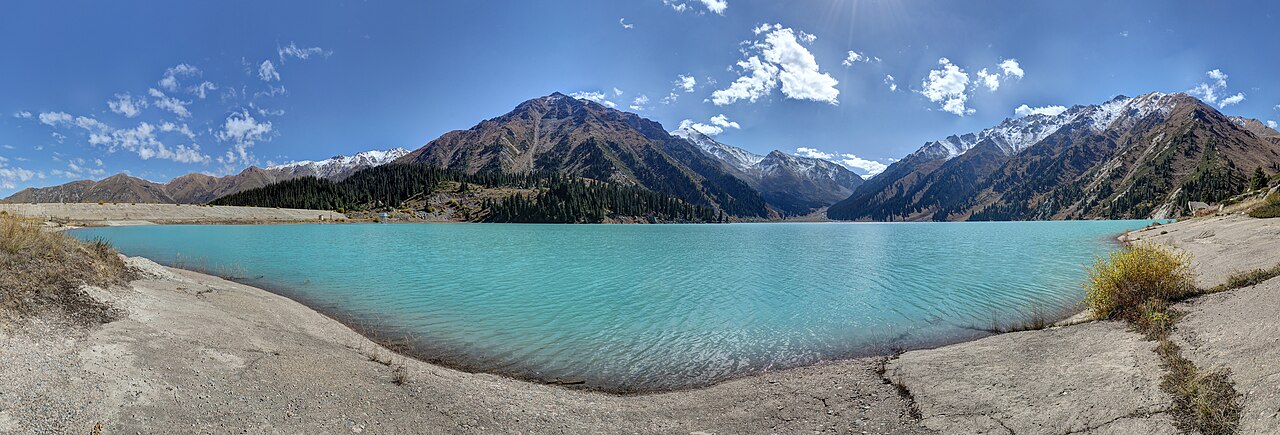
The mountains immediately south of Almaty belong to the Trans-Ili Alatau system. Government tourism materials locate Big Almaty Lake at about 2,500 meters above sea level, high enough for substantially cooler conditions than the city. The lake serves as a drinking-water source, so swimming and independent access may be restricted. Nearby mountain recreation areas include Medeu and Shymbulak, while longer trips reach Kolsai Lakes and Kaindy Lake, noted for submerged tree trunks, or Charyn Canyon in southeastern Kazakhstan.
The national perspective is much broader. Kazakhstan is vast, and conditions around the northern capital Astana or the western Caspian side differ from the high mountains of Almaty. Summer is an inviting period for established mountain routes but can be hot in lower, more arid regions. Winter is far colder in the northern steppe and becomes the season for activities such as skiing near Almaty, not for expecting ordinary access to every high lake trail.
At the country level, UNESCO lists the Mausoleum of Khoja Ahmed Yasawi in Turkestan, inscribed in 2003. Construction was begun in 1389 in the era of Timur, and the building is not an attraction in Almaty. Kazakhstan’s historic southern cities and mountain recreation belt need distinct travel legs. For U.S. passport holders, Kazakhstan’s State Department information describes visa-free tourist entry for stays of up to 30 days per entry, subject to applicable stay limits.
Picture the place
Big Almaty Lake occupies a high basin beneath steep mountain ridges, while the city’s parks and boulevards lie far lower at the foot of the range.
The easily missed detail
Big Almaty Lake is a water-supply resource as well as a landmark. Its scenic popularity does not imply unrestricted access to the shoreline or permission to swim.
A practical rhythm
- Morning — Choose an authorized mountain excursion from Almaty while conditions are cooler.
- Midday — Use established viewpoints or trails rather than approaching closed water-protection zones.
- Additional days — Build a separate southeastern loop for Kolsai, Kaindy and Charyn rather than calling them short downtown walks.
What could complicate the plan
Weather changes with altitude, trail access can be seasonal, and water-source restrictions apply at Big Almaty Lake. Some remote outings need experienced transport and proper route planning. U.S. visitors must stay within visa-free limits or obtain the relevant authorization.
What to do next
broadens the trip beyond the mountain anchor; shows how to combine regions without excessive travel.
Sources
- Government of Kazakhstan, Almaty investment and tourism — Big Almaty Lake, Kolsai and Charyn
- Government of Kazakhstan, cultural heritage — Kazakh cuisine and nomadic history
- UNESCO World Heritage Centre — Turkestan mausoleum designation and Timurid history
- U.S. State Department — U.S.-passport entry and stay limits