La Paz / Bolivia Things to do
What are the most worthwhile things to do in La Paz on a first visit?
The short answer
See the city as a working ritual landscape rather than a sightseeing list — 2 of Bolivia's 10 UNESCO-inscribed intangible heritage elements belong specifically to La Paz, and both are street practices rather than museums.
The answer, with local context
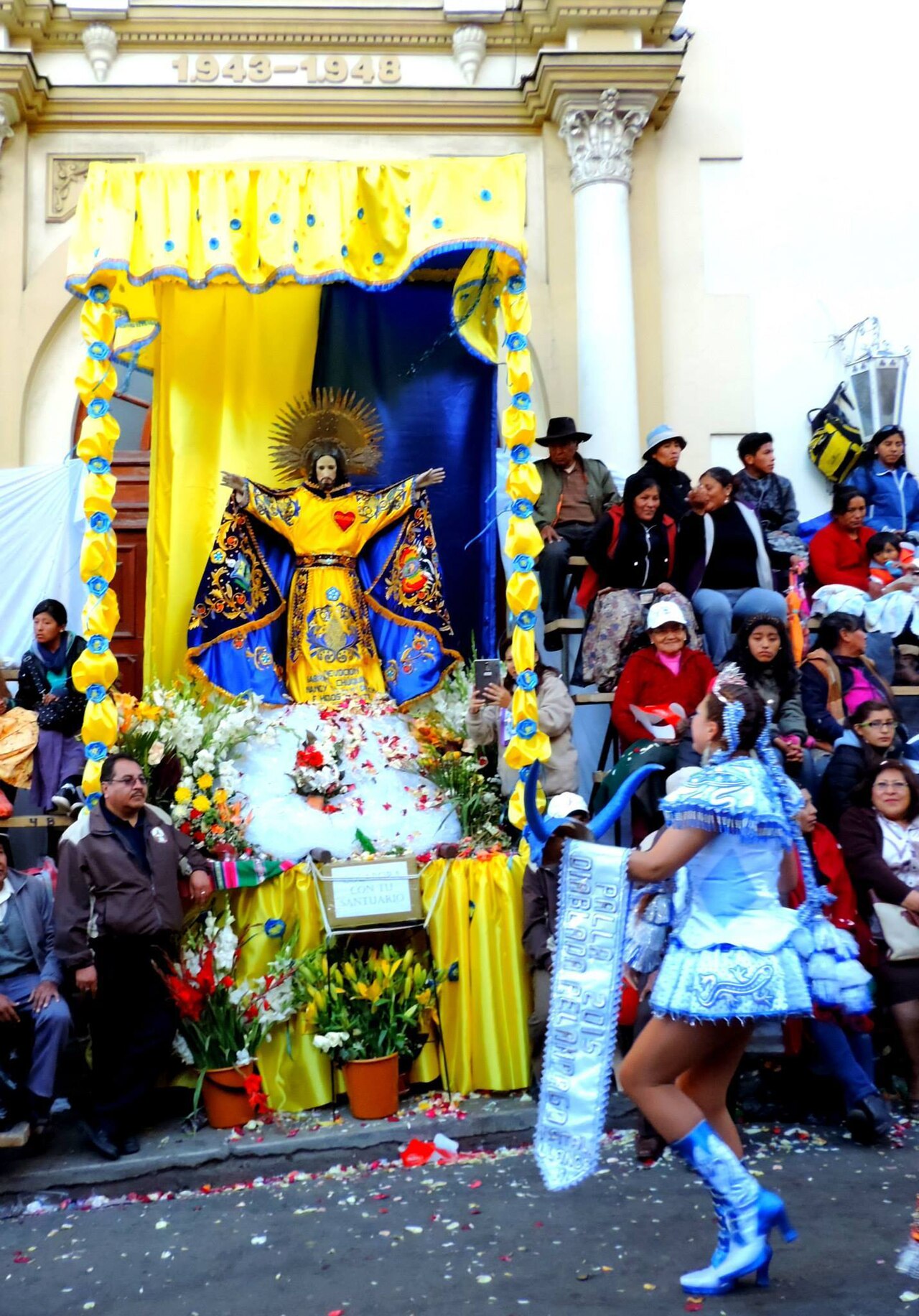
The Gran Poder festival is the bigger of the two and the more revealing about how the city is organized. UNESCO inscribed it in 2019 and records 69 fraternities, about 40,000 devotees dancing and singing, and 7,000 musicians. The parade begins with a procession through the western part of the city, and on the following day procession members carry the patron saint through the Gran Poder district itself. The Morenos are the festival's iconic dance, performed alongside lighter dances and the Sikuris and Qhantus native dances, which UNESCO links back to the origins of the Ch'ijini festival. A district that lends its name to an inscribed element of the Representative List is a district worth walking in the other 51 weeks of the year.
Alasita, inscribed in 2017 as element 01182, is the other, and it is structural rather than theatrical. The practice runs in 3 stages — searching for and acquiring miniatures, having them consecrated by Andean ritualists or blessed by the Catholic Church, and then using them — organized around the Ekeko. Miniatures also change hands to settle debts symbolically. Both traditions are built on the coexistence of Andean ritual practice and Catholic liturgy in the same event, which is the single most useful thing to understand before walking into a La Paz market.
Beyond the city, the Department of La Paz holds Tiwanaku: Spiritual and Political Centre of the Tiwanaku Culture, inscribed on the World Heritage List in 2000 under decision 24COM XC.1. It is a separate day's travel from the city, not a neighborhood attraction, and it is the reason the department rather than the city is the right unit for planning a first visit.
Picture the place
La Paz sits at about 3,650 m (12,000 ft) — the figure the CDC uses for it — which is high enough that walking uphill is the city's defining physical sensation and the reason the Gran Poder parade's route through the western districts reads as an act of endurance as much as devotion.
The easily missed detail
Bolivia ratified the 2003 Convention on 28 February 2006, and its 10 inscribed elements span 2008 to 2025 — Carnival of Oruro and the Andean cosmovision of the Kallawaya in 2008, the Aymara communities element shared with Chile and Peru in 2009, Ichapekene Piesta in 2012, Pujllay and Ayarichi in 2014, Alasita in 2017, Gran Poder in 2019, the Grand Festival of Tarija in 2021, Ch'utillos in 2023 and the Festivity of the Virgen of Guadalupe in Sucre in 2025. That means the national festival calendar is dense and documented, and a trip built around La Paz can be extended to Oruro, Potosí, Tarija or Sucre on inscribed dates rather than guessed ones.
A practical rhythm
- The Gran Poder district — Named in an inscribed element with 69 participating fraternities; walkable outside festival days.
- Markets and miniatures — Alasita's 3 stages explain what is being sold and why, including the role of Andean ritualists alongside Catholic blessing.
- A day to Tiwanaku — Inscribed in 2000 under decision 24COM XC.1 and located in the Department of La Paz, not the city.
What could complicate the plan
Altitude limits how much a first day can hold, and the CDC's guidance is built on ascent rate rather than willpower. Above 3,000 m (9,850 ft) it advises raising sleeping altitude by no more than 500 m (1,650 ft) a day, and adding an acclimatization day for every 1,000 m (3,300 ft) gained; acetazolamide prophylaxis is given as 125 mg every 12 hours, rising to 250 mg twice daily for body weight over 100 kg. It also notes that acclimatization to moderate hypoxia is achievable up to about 5,200 m (17,000 ft) but takes time, and that high-altitude pulmonary edema affects roughly 1 in 100 travelers or fewer above 4,300 m (14,000 ft) — a figure that matters if a La Paz trip grows into trekking. On the ground, the State Department's Bolivia information notes that some areas carry higher risk than the national advisory implies and that emergency care in rural areas and national parks is inadequate, which is the relevant caution for a day out to Tiwanaku rather than for the city itself.
What to do next
The La Paz when-to-visit question in this group gives the Alasita and Gran Poder dates and the acclimatization timetable; the La Paz food question covers singani, Bolivia's protected grape spirit.
Sources
- UNESCO Intangible Cultural Heritage — Gran Poder participant, musician and fraternity counts, route, dances, Alasita's 3 stages and the Ekeko, Bolivia's 10 elements with years, ratification date
- UNESCO World Heritage Centre, Tiwanaku: Spiritual and Political Centre of the Tiwanaku Culture — inscription year and decision code
- US Centers for Disease Control and Prevention, CDC Yellow Book 2026, High-Altitude Travel and Altitude Illness — La Paz elevation, ascent-rate and acclimatization-day rules, acetazolamide prophylaxis doses, upper limit of achievable acclimatization, HAPE incidence above 4,300 m
- US Department of State, Bolivia country information — higher-risk areas, inadequate emergency care in rural areas and national parks