London / United Kingdom Food and drink
Where should I eat in London, and which local food or drink is worth trying?
The short answer
Smoked salmon is the one London food with its own legal protection — London Cure Smoked Salmon holds Protected Geographical Indication status, entered on the UK register on 31 December 2020 after an original EU registration on 12 April 2017, under product category 1.7, fresh fish, molluscs and crustaceans and products derived therefrom.
The answer, with local context
A PGI is not a quality medal; it is a legal link between a name and a place and a method. London Cure is the only such designation tied specifically to the capital, which makes it the most defensible answer to "what should I eat here" in a city whose food culture is overwhelmingly borrowed. Find it on a bagel, on brown bread, or as part of a breakfast plate — the protection attaches to the curing and smoking, not to the way it is served.
Behind the plate sits an institution most visitors never register. Billingsgate, the City of London's wholesale fish market, turns over around 25,000 tonnes of fish and fish products a year, of which about 40 per cent is imported. More than 40 merchants trade there across 98 stands, 30 shops and 14 lock-up shops, and the City of London Corporation runs the site, down to the cleaning and maintenance. The Corporation's Court of Common Council decided to end the long-planned relocation of the market to Dagenham Docks — a decision that matters to anyone curious about how long this trade stays where it is.
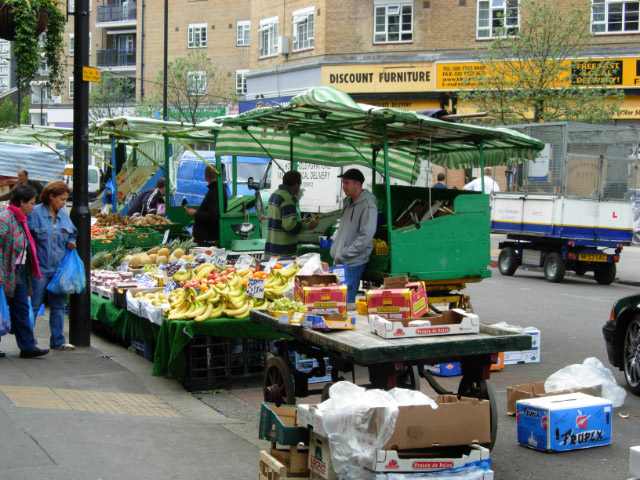
The street-market layer is the one that actually feeds visitors, and it is distributed across the whole city rather than concentrated in a single food quarter. Each London market keeps its own trading days and its own balance of produce stalls against prepared-food stalls, so the one nearest your hotel on a Tuesday and the one worth crossing town for on a Saturday are rarely the same place. Checking a market's own trading days before you build a meal around it is the difference between a great London lunch and a row of shuttered pitches.
The easily missed detail
Billingsgate is a wholesale market serving buyers and trade customers; the City of London Corporation's own description of it addresses merchants and stands rather than general public access. Treat it as the supply chain behind your breakfast rather than as an attraction with an entrance, and plan your eating around the retail markets instead. The 40 per cent import share also tells you something useful: much of what is excellent on a London fish menu arrived from elsewhere and was handled here, which is precisely the tradition London Cure sits inside.
A practical rhythm
- Breakfast — This is when the PGI product makes most sense, cured and sliced rather than cooked.
- Market hours — Check the individual market's trading days first; across 98 stands and 30 shops, Billingsgate shows how much of London's fish trade happens before most visitors are awake.
- Evening — Fish cooked rather than cured, drawn from a wholesale trade of around 25,000 tonnes a year of which about 40 per cent arrives from abroad.
What could complicate the plan
The State Department's advisory for the United Kingdom stands at Level 2: Exercise Increased Caution, citing terrorism, and crowded markets are the kind of place where that general guidance has practical bite — keep bags in front of you and watch your pockets. On the food side, the main complication is that PGI status protects a name, not a price: "smoked salmon" on a menu is not necessarily London Cure, and you have to see the protected name itself to know what you are buying.
What to do next
The London things-to-do question in this group explains how to budget a day around one paid historic site and the free national museums, which is the frame a market lunch slots into.
Sources
- UK Government, protected food and drink names register — PGI status, UK and EU registration dates, product category
- City of London Corporation, about Billingsgate Market — annual tonnage, import share, merchant and stand numbers, Dagenham Docks decision
- U.S. Department of State — advisory level and stated reason