Prague / Czechia When to visit
When should I visit Prague, Czechia, for the best experience?
The short answer
May, June and September — the Prague–Clementinum record puts July's mean at 70.7°F (21.5°C) and January's at 34.9°F (1.6°C), so the shoulder months sit either side of the city's short, warm core without touching the freeze.
The answer, with local context
Prague has one of the longest continuous weather records in Europe, and it is worth using. The Czech Hydrometeorological Institute's Clementinum station, at 191 meters in the old city, has been under regular observation since 1752. Its 1991–2020 normals give an annual mean of 52.3°F (11.3°C), a January mean of 34.9°F (1.6°C) and a July mean of 70.7°F (21.5°C). Annual precipitation across the same period averages 17.9 inches (453.9 mm), which is modest by European standards — Prague is a dry-ish inland city, not a rainy one.
The extremes in that series tell you what the tails look like. The station's absolute highest reading is 100.0°F (37.8°C), set on 27 July 1983; its lowest is −17.7°F (−27.6°C), on 1 March 1785. The wettest single day on record delivered 3.5 inches (90.0 mm) on 19 July 1981, and the warmest year in the whole 250-year-plus series was 2018, at an annual mean of 55.0°F (12.8°C). Summer in Prague is not reliably mild; it is reliably variable.
Opening patterns matter as much as weather here, because the city's headline site runs on two clocks. The Prague Castle complex is open daily from 06:00 to 22:00, while St Vitus Cathedral inside it opens Monday to Saturday from 09:00 to 17:00 and only from 12:00 to 17:00 on Sundays. A Sunday morning in Prague is a morning in the castle grounds, not in the cathedral.
Picture the place
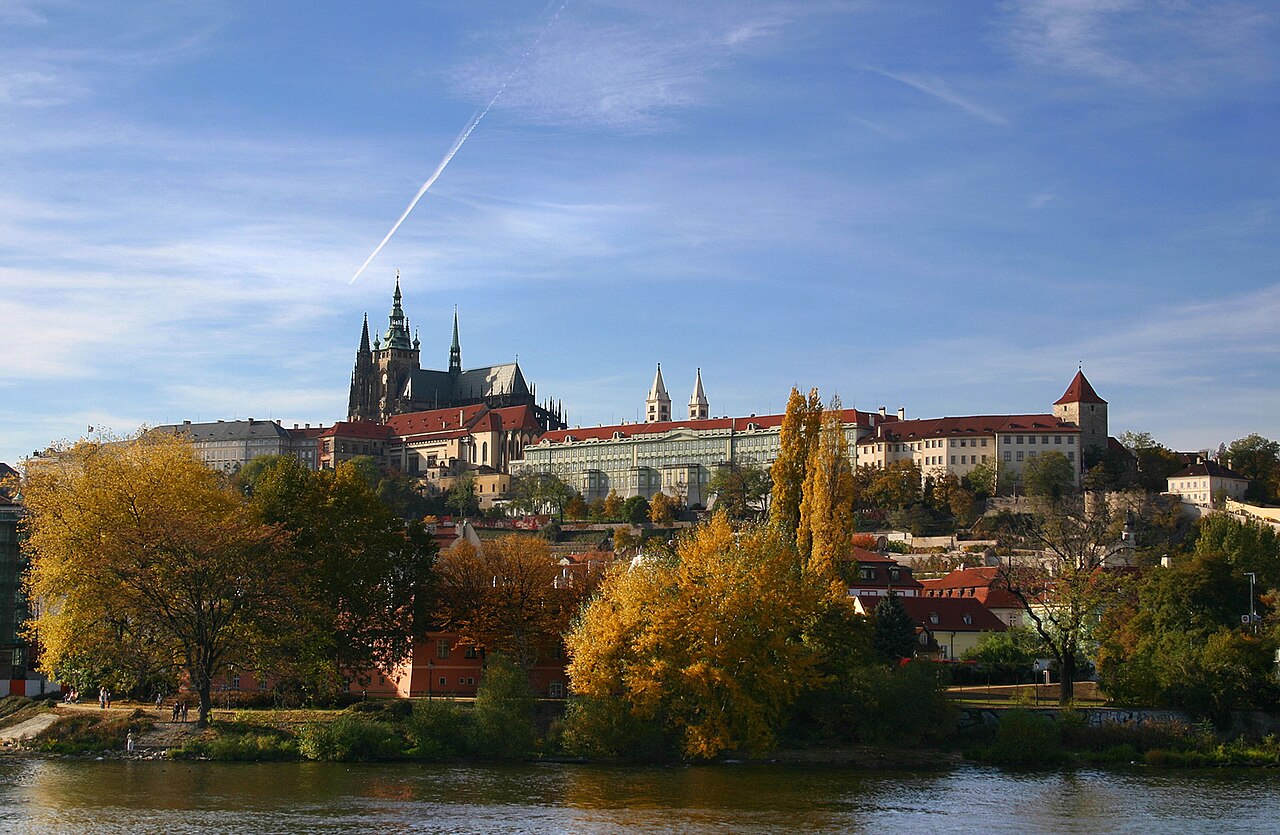
The castle precinct sits high on the left bank, and because the grounds open at six in the morning while the cathedral stays shut for three more hours, the earliest part of a Prague day is a walk through an empty hilltop enclosure with the city still below in shadow.
The easily missed detail
The Clementinum figures are explicitly station figures, not national ones — the Institute says so on the record itself. Prague sits in a river basin and reads warmer than the Czech countryside around it, so a forecast for Czechia is not a forecast for the Old Town. The practical effect is that spring arrives in the city before it arrives in Bohemia, and the difference shows up on a day trip.
A practical rhythm
- May and June — Climbing toward the July mean of 70.7°F (21.5°C) without reaching it, and the castle grounds are open from 06:00 for anyone willing to be early.
- September — The post-summer decline on a record whose annual mean is 52.3°F (11.3°C), with the cathedral on full Monday-to-Saturday hours.
- January — A mean of 34.9°F (1.6°C) means a city hovering around freezing rather than deep in it, and the Clementinum's 17.9 inches of annual precipitation is spread thin.
What could complicate the plan
The US Department of State places Czechia at Level 1, Exercise Normal Precautions, in an advisory issued on 8 January 2026 — the lowest of its four levels, so the constraints here are practical rather than political. The real one is the Sunday cathedral schedule: arriving on a Sunday morning expecting St Vitus means waiting until midday. And the 1981 record of 3.5 inches of rain in a day is a reminder that the dry annual average conceals some very wet individual days in high summer.
What to do next
The Prague things-to-do question in this group covers castle admission prices and the rules that govern when tours of the cathedral can actually run.
Sources
- Czech Hydrometeorological Institute — Clementinum normals 1991–2020, record extremes, station altitude and series start
- Metropolitan Cathedral of St Vitus, St Wenceslas and St Adalbert — cathedral and castle complex opening hours
- US Department of State — travel advisory level and issue date