Provence / France Things to do
What are the most worthwhile things to do in Provence on a first visit?
The short answer
In interior Provence — the Vaucluse, the Luberon and the Rhône corridor — take Avignon's papal palace, Arles' Roman arena and Van Gogh streets, the Luberon's perched villages and ochre hills, and Aix's Cézanne mountain: four days, four Provences.
The answer, with local context
Provence is too plural for one list, so this one stays in the interior and names its four poles. Pole one is Avignon, the papal city: from 1309 to 1377 seven popes ruled from here, and the Palais des Papes they built — the largest Gothic palace in Europe — still fills its square with fortress walls and frescoed chapels; below it, the Pont Saint-Bénézet (begun 1177), the half-bridge of the song, ends mid-Rhône where the current took the rest. Pole two is Arles, an hour south: Rome's river port preserved in the amphitheatre (c. AD 80, UNESCO-listed with the Alyscamps and the theater) and doubled by Van Gogh, who painted some 200 canvases in fifteen incandescent months here in 1888–89 — the Café Terrace, the Langlois bridge, the hospital garden — before the asylum year at Saint-Rémy, where the Saint-Paul-de-Mausole cloister and the Alpilles lanes he painted still stand twenty minutes north.
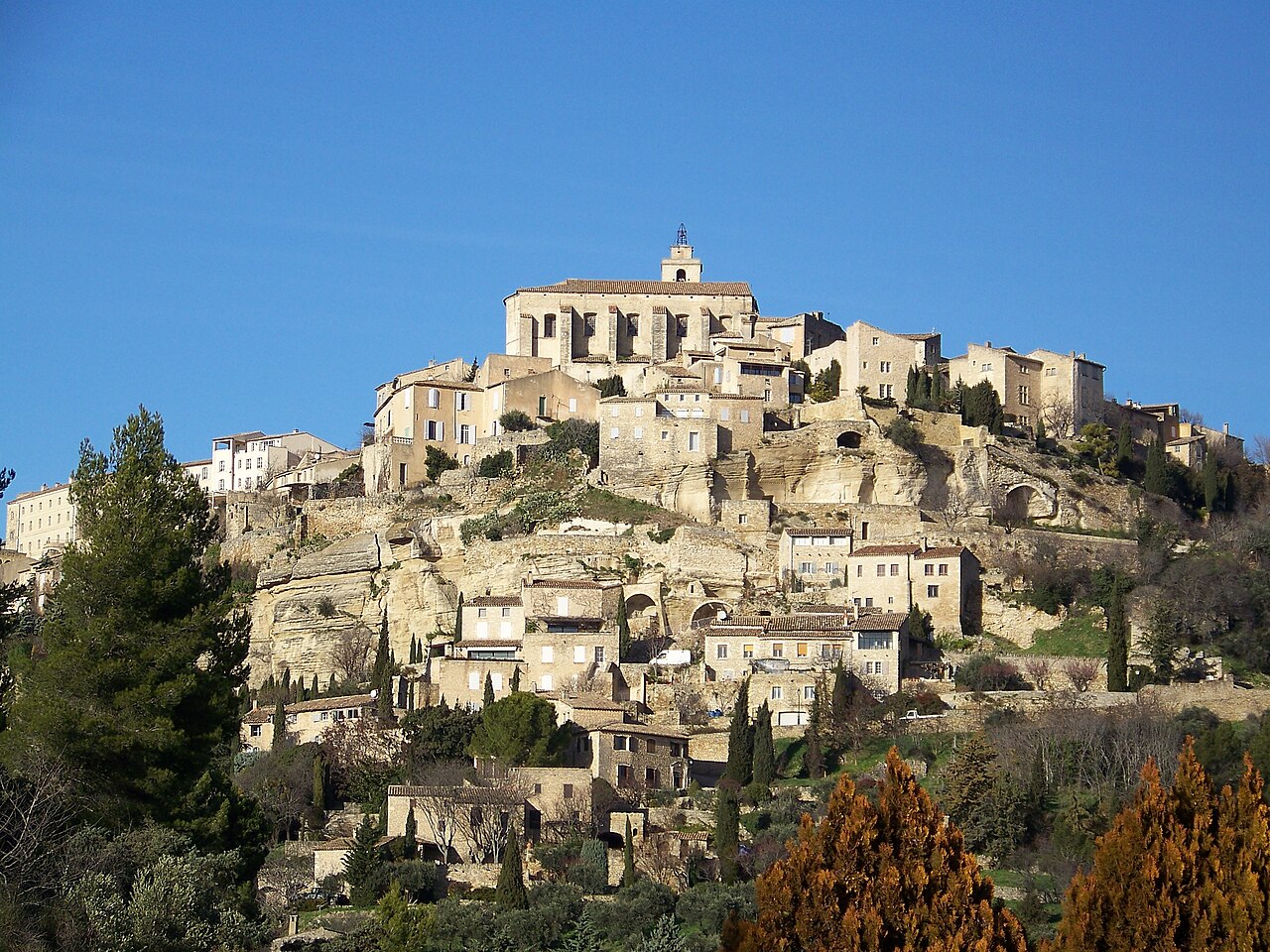
Pole three is the Luberon, the region's postcard and its substance. The perched villages (villages perchés) string along the massif: Gordes, all dry-stone and castle above its valley; Roussillon, built of its own ochre — the Sentier des Ocres walks a canyon of red, orange and gold earth where pigment was mined into the 20th century; Bonnieux, Lourmarin (Camus is buried in its cemetery) and Ménerbes between. Between them stands the Sénanque Abbey (founded 1148), the Cistercian church in its lavender hollow, still inhabited by monks, and the bories — the dry-stone huts of the Village des Bories near Gordes — that are Provence's oldest architecture of all. The markets stitch the pole together: L'Isle-sur-la-Sorgue (antiques capital, Sunday), Apt (Saturday), each village on its own morning, all running 8 to 1 sharp.
Pole four is Aix-en-Provence, the region's drawing room: Cours Mirabeau's plane-tree vault and fountains (the city of a thousand fountains, the Romans' Aquae Sextiae of 122 BC), the Atelier Cézanne where the painter worked 1902–06, and above it all Mont Sainte-Victoire, the limestone ridge Cézanne painted more than 80 times — walk the ridge's trails or simply take the Aix–Pertuis road at evening and watch it change color as he did. Beyond the four poles, one extension earns its fuel: the Pont du Gard, the Roman aqueduct bridge of the 1st century AD (UNESCO 1985), 49 meters over the Gardon — technically over the Gard border, spiritually Provence's, and swimmable from its banks. Five days covers the poles at a stroll; the hire car is not optional in the Luberon, where the villages string along lanes the buses visit twice a day.
Picture the place
Roussillon at 6 p.m.: the village the color of its own cliffs, swallows over the ochre roofs, and a café terrace pouring Tavel while the Sentier's last walkers come down dusted red.
The easily missed detail
In Arles, buy the combined ticket's smallest print: the Alyscamps. The Roman necropolis avenue — lined with sarcophagi, painted by Van Gogh and Gauguin side by side in 1888 — sits at the edge of town and receives a tenth of the arena's visitors, and it is the more affecting place: a poplar avenue of the dead that was famous across medieval Europe (Dante names it; pilgrims on the road to Compostela detoured for it). Then, in Saint-Rémy, the asylum's garden still grows the irises. Provence's best sights specialise in being the second one in their own town.
A practical rhythm
- One pole per day — Avignon, Arles (+Saint-Rémy), Luberon villages, Aix: the interior punishes zigzagging, rewards depth
- Markets by the calendar — Plan the Luberon day around its village's market morning (before 1 p.m.); the stalls pack up with siesta discipline
- Book Sénanque ahead — The abbey limits visitors and keeps monastic hours; guided visits run on its timetable, not yours
What could complicate the plan
Distances deceive on the map: the Luberon's lanes are beautiful and slow (Gordes to Roussillon is 10 km and half an hour of everyone's holiday), and July–August traffic weaponises them. The great monuments ration by season — the Palais des Papes rewards the day's first entry (and its tablet guide), Van Gogh's Arles sites are mostly exterior (the Yellow House is gone; the Fondation Van Gogh shows works on loan, not a permanent collection) — and the mistral closes exposed sites and empties tempers three days at a time. Village parking is the daily tax: arrive before 10 or after 4, or walk in from the lower lots like a local.
What to do next
Draw the four poles on the map, give each a day, and start at the Palais des Papes on the first morning before the Rhône heats up.
Sources
- UNESCO World Heritage List — Arles, Roman and Romanesque Monuments (1981): the amphitheatre of c. AD 80 and the Alyscamps; the Pont du Gard (1985)
- Palais des Papes, Avignon — the papal residence 1309–1377 and Europe's largest Gothic palace; the Pont Saint-Bénézet (1177)
- Fondation Vincent van Gogh Arles / Saint-Paul-de-Mausole, Saint-Rémy — Van Gogh's Arles period (1888–89, some 200 works) and the asylum year
- Parc naturel régional du Luberon — the perched villages, the Sénanque Abbey (1148) and the Roussillon ochre trail; Cézanne's Sainte-Victoire above Aix (founded as Aquae Sextiae, 122 BC)