San Juan / Puerto Rico When to visit
When should I visit San Juan, Puerto Rico, for the best experience?
The short answer
Mid-December through April — the months that sit entirely outside the Atlantic hurricane season, which NOAA's National Hurricane Center defines as June 1 to November 30, while the two Spanish forts that anchor Old San Juan are open 9:00 a.m. to 5:00 p.m. daily.
The answer, with local context
San Juan is not a city with a cold season to avoid; it has a storm season to work around. The National Hurricane Center's official Atlantic window covers half the calendar, June 1 through November 30, and in San Juan the tail of it bites hardest. The National Weather Service office in San Juan keeps climate records for the city reaching back to 1898, and its monthly extremes show what the late season can deliver: the wettest September in that whole record fell in 2017, at 15.79 inches.
Winter is the other half of the argument. The same San Juan record shows February's coolest month on record still averaged 73.3°F (22.9°C), set in 1951 — which is to say that even the coldest February anyone has measured here was shirtsleeve weather. At the other end, the warmest September on record averaged 86.1°F (30.1°C), in 2024. There is no winter to dress for, only a difference in humidity and in how much of the afternoon belongs to rain.
The forts set the shape of the day whatever month you pick. The National Park Service restricts public use of Castillo San Felipe del Morro and Castillo San Cristóbal to 9:00 a.m. to 5:00 p.m., with later access only during special evening programs, and closes the site on Thanksgiving, Christmas and New Year's Day. A single entrance pass costs $10 per person, covers both fortifications, and stays valid for 24 hours — so arriving on a December 24 and planning the forts for the 25th leaves you locked out of the thing you came for.
Picture the place
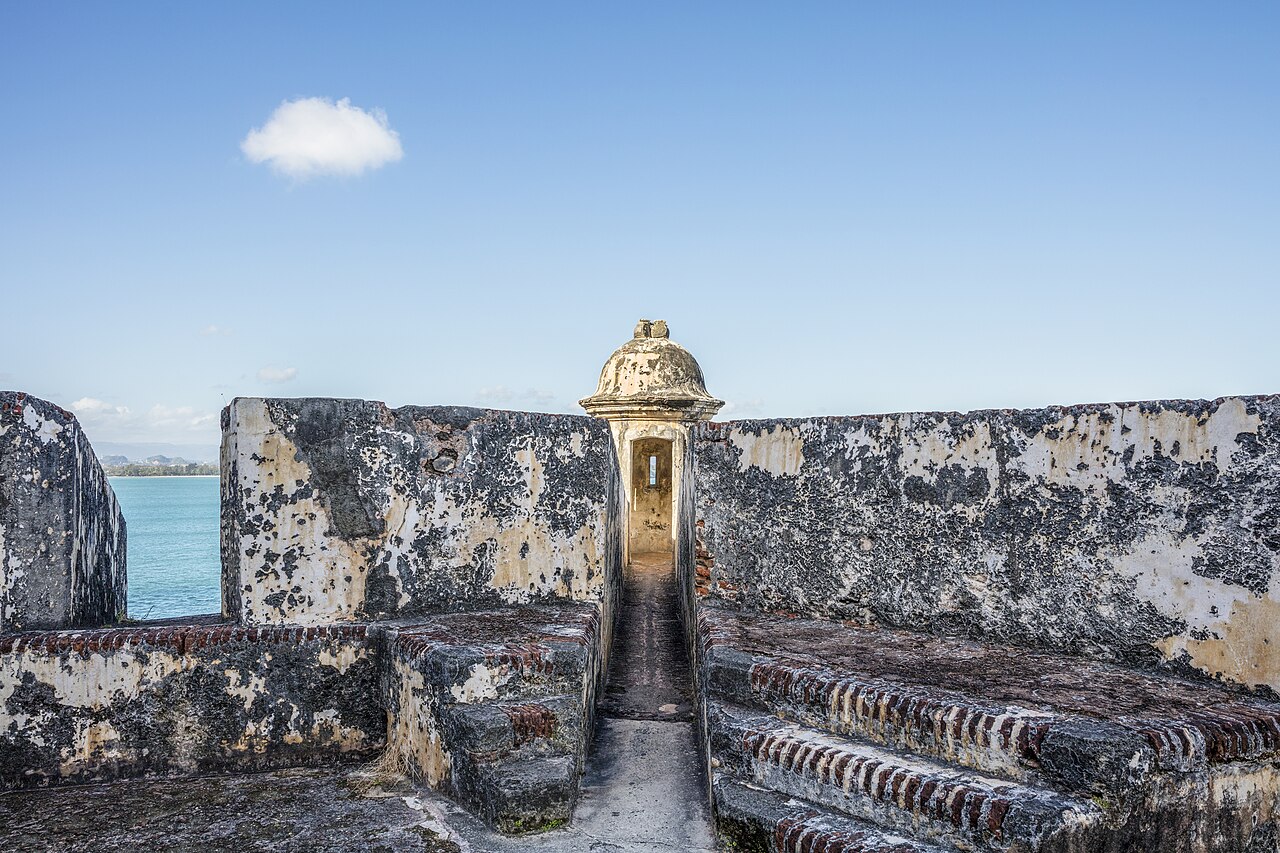
El Morro's outer field is a bare green headland with nothing between it and the Atlantic, and the trade wind crosses it without obstruction — which is why the lawn in front of the fort is a kite field on winter afternoons rather than a picnic lawn. The light drops fast on this latitude; by five, when the gates close, the sandstone walls have gone from pale gold to gray.
The easily missed detail
The World Heritage property here is called La Fortaleza and San Juan National Historic Site in Puerto Rico, inscribed in 1983 and listed as reference 266, and UNESCO cited only cultural criterion (vi) for it. That single criterion is the key to planning: the inscription rests on the significance of these defenses in the Spanish Atlantic system, not on architectural spectacle alone. La Fortaleza is named first in the title, and it is not part of the National Park Service site — it remains the governor's official residence, with its own access arrangements, so the $10 pass does not open it.
A practical rhythm
- Early morning — The forts do not open until nine, so the first hour belongs to the streets. The blue-glazed paving of the old town takes the low sun without glare.
- Late morning to midday — Go through San Cristóbal and El Morro while the pass is fresh. The 24-hour window means a second fort can wait until tomorrow morning without a second payment.
- Late afternoon — The headland at El Morro is the windiest open ground in the old city, and the best of it comes in the last two hours before the 5:00 p.m. close.
What could complicate the plan
Three dates will shut the forts outright: Thanksgiving, Christmas and New Year's Day. Anyone over the age of 16 needs the $10 pass; those 15 and under are admitted free, which changes the arithmetic for families less than people expect. If your dates fall between June and November, the National Hurricane Center's season is the governing fact, and the risk is not rain but disruption to flights and ferries. The ramparts and ramps are stone, uneven and exposed, with little shade on the upper levels.
What to do next
Read the things-to-do answer in this group for how to use a single 24-hour pass across both fortifications, and the food answer for where the eating sits relative to the forts' nine-to-five day.
Sources
- NOAA National Hurricane Center — Atlantic hurricane season dates
- National Park Service, San Juan National Historic Site, Fees — entrance fee, 24-hour validity, age exemption
- National Park Service, San Juan National Historic Site Superintendent's Compendium, June 2024 — public use hours, holiday closures
- UNESCO World Heritage Centre, La Fortaleza and San Juan National Historic Site in Puerto Rico — official property name, inscription year, criterion
- NOAA National Weather Service, San Juan, monthly climate statistics — period of record and monthly temperature and rainfall extremes