Seville / Spain Things to do
What are the most worthwhile things to do in Seville on a first visit?
The short answer
Work through the three buildings UNESCO inscribed as a single property — the Cathedral, the Alcázar and the Archivo de Indias — because they were listed together, under four criteria, for the way they explain one another.
The answer, with local context
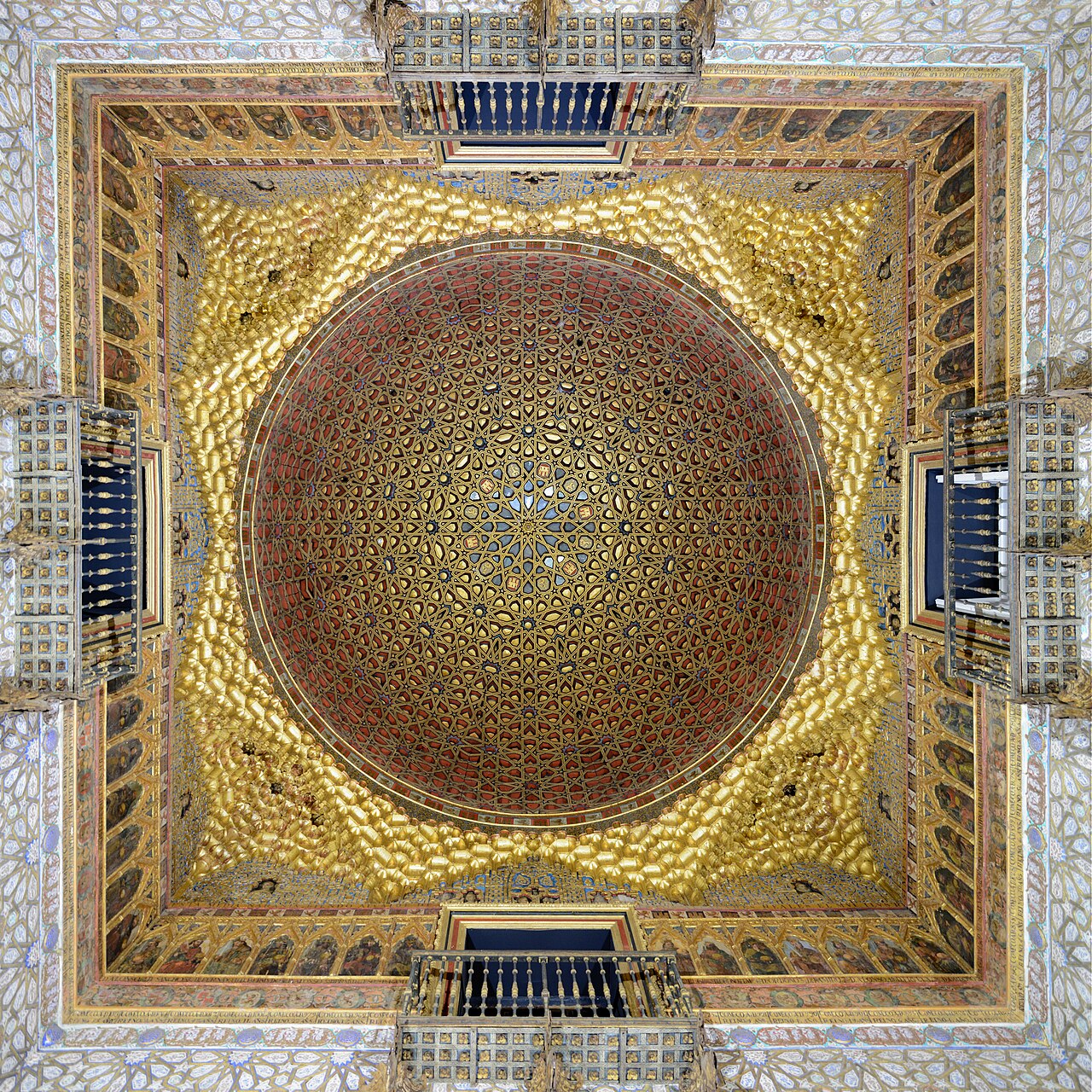
The inscribed property is formally "Cathedral, Alcázar and Archivo de Indias in Seville," and the Committee cited criteria (i), (ii), (iii) and (vi). Criterion (i) rests on three separate claims: the Giralda as a masterpiece of Almohad architecture, the Cathedral as a major Gothic work, and the Cabildo's elliptical interior as a notable Renaissance design. The Cathedral was founded in 1403 on the site of a former mosque, and UNESCO describes it as the largest Gothic building in Europe. Columbus's tomb is inside it.
Criterion (ii) is about influence traveling outward. UNESCO's citation credits the Giralda — built as the mosque's minaret — with shaping tower-building across Spain and, after the conquest, in the Americas. Criterion (iii) frames the Cathedral and Alcázar as testimony to the Almohad and Christian Andalusian civilizations shaped by Moorish influence between 1248, the year of the Reconquest, and the 16th century. Criterion (vi) is the Atlantic one: Columbus's tomb, the planning of expeditions in the Admirals' Hall, and the colonial archives held in the Lonja.
The Alcázar's ticket structure tells you how to plan your hours there. General admission is €15.50 and covers the ground floor of the palaces plus the gardens. The Cuarto Real Alto is sold separately at €5.50 and is a partial guided visit to the upper floor of the Palacio del Rey Don Pedro — a different experience, not an add-on view. Holders of a youth or student card aged 13 to 30 pay €8.00, as do visitors over 65 on proof of age.
The easily missed detail
The Patronato's ordinance lists a long set of free-admission categories for the general entrance, and they are worth reading before you buy: people born in or resident in the municipality of Seville; children up to 13 when accompanied by an adult; people with a disability above 33% plus a companion, on production of documentation; unemployed people from the province of Seville holding a valid unemployment card; and ICOMOS members with accreditation. The Cuarto Real Alto is not covered by any of them, so the €5.50 ticket is payable regardless.
A practical rhythm
- The Cathedral first — It was founded in 1403 over a mosque, and the Giralda you climb was that mosque's minaret. Seeing the tower before the Gothic interior makes the layering legible.
- The Alcázar second — €15.50 gets you the palace ground floor and the gardens; decide at the ticket desk whether the €5.50 Cuarto Real Alto guided slot fits your day.
- The Archivo last — The Lonja holds the colonial archives that earned criterion (vi). It is the quietest of the three and the one that explains the other two.
What could complicate the plan
US citizens need no visa for a short stay, and the EU Delegation to the United States states plainly that there is no visa obligation for US citizens traveling to the 30 European countries covered, with a passport all that is currently required. The limit is the one that catches people: the European Commission's short-stay rule allows a maximum of 90 days within any 180-day period across the Schengen Area, and Spain is a Schengen state. The Entry/Exit System has been fully operational across all Schengen countries since 10 April 2026, and ETIAS is scheduled to begin in the last quarter of 2026, with the exact start date still to be officially communicated.
What to do next
The Seville when-to-visit answer in this group covers the Holy Week date that moves demand, plus the Alcázar's night-visit terms; the food answer takes up the protected olive designation defined across the province.
Sources
- UNESCO World Heritage Centre, Cathedral, Alcázar and Archivo de Indias in Seville — property name, criteria (i), (ii), (iii) and (vi), 1403 Cathedral founding, 1248 Reconquest, Giralda's origin as a minaret, Columbus's tomb, Admirals' Hall, Cabildo's elliptical space
- Patronato del Real Alcázar de Sevilla, fiscal ordinance 2025 — general admission €15.50, Cuarto Real Alto €5.50, reduced €8.00, free-admission categories
- European Commission, Migration and Home Affairs, short-stay calculator — the 90-days-in-180 rule
- European Commission, Migration and Home Affairs — EES operational date and ETIAS timing
- European External Action Service, EU Delegation to the United States — no visa obligation for US citizens