Seychelles islands / Seychelles When to visit
When should I visit Seychelles islands, Seychelles, for the best experience?
The short answer
April and October offer an excellent balance for exploring the inner Seychelles islands, particularly Mahé, Praslin and La Digue, when lighter winds often make beach visits and boat excursions more comfortable.
The answer, with local context
The inner Seychelles islands include mountainous Mahé, forested Praslin and granite-lined La Digue. Although they share a tropical maritime climate, their coastlines do not experience identical conditions.
According to the Seychelles Meteorological Authority, April marks the transition from the northwest monsoon toward the southeast trade winds. Maximum temperatures can occasionally exceed 90°F (32°C). May brings stronger southeasterly breezes, which generally continue through September. October is another transition month, with winds weakening before the wetter northwest-monsoon period.
There is a longer observational baseline behind those seasonal labels. NOAA's engineering weather archive records the Seychelles reference station, WMO 639800, at 4.67 degrees south and 55.52 degrees east, with a period of record running from 1973 to 1996. At that latitude the sun's daily arc changes very little between January and July, which is why wind and swell, rather than light, decide what a beach day on these islands actually feels like.
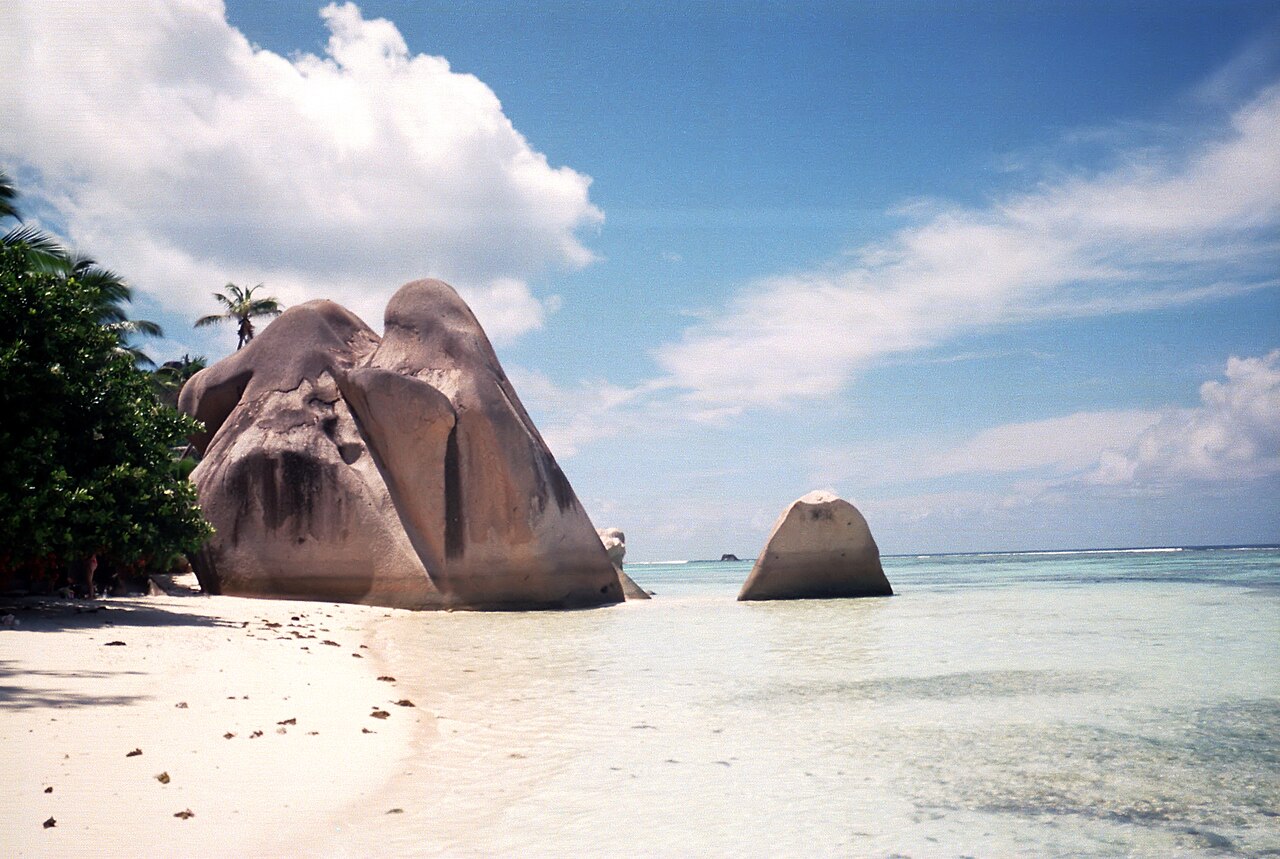
For a beach-focused visit, the distinction between sheltered and exposed coastlines matters. Beau Vallon on northwestern Mahé has a different coastal orientation from more exposed eastern beaches. On La Digue, Anse Source d'Argent is famous for granite formations and shallow water, while Grande Anse can have dangerous surf.
Praslin offers both coastal attractions and Vallée de Mai, whose palm forest provides an inland alternative to beach activities.
Vallée de Mai is also the smallest headline act in the archipelago. UNESCO inscribed the reserve — 19.5 hectares in all — under criteria (vii), (viii), (ix) and (x), describing it as the only area in Seychelles where all six of its palm species occur together, and it holds the world's largest population of Lodoicea maldivica, the coco de mer, whose double nut is the largest seed in the plant kingdom. A breezy or showery morning is no argument against going, because the canopy absorbs the weather that spoils a beach day.
Picture the place
The inner islands combine forested hillsides, granite cliffs, small coves and pale sandy beaches. The coastline changes considerably within a relatively short journey.
The easily missed detail
A windy day is not necessarily unsuitable for every beach. A shoreline sheltered from the prevailing wind may offer much better conditions than a nearby exposed bay.
A practical rhythm
Morning — La Digue: Explore Anse Source d'Argent.
Afternoon — Praslin: Visit a forest trail or sheltered beach.
Evening — Mahé: Enjoy the coast around Beau Vallon.
What could complicate the plan
Southeast trade winds may produce rougher seas between islands, particularly from June through September. Boat excursions and snorkeling trips can be affected even when conditions on land appear favorable.
What to do next
identifies the most rewarding beaches, nature reserves and excursions across the inner islands.
Sources
- Seychelles Meteorological Authority — monthly wind and rainfall patterns.
- Tourism Seychelles — island geography and coastal distinctions.
- NOAA National Centers for Environmental Information, Engineering Weather Data, Seychelles — station number, coordinates and period of record.
- UNESCO World Heritage Centre, Vallée de Mai Nature Reserve — inscription criteria (vii), (viii), (ix) and (x), the 19.5-hectare area, the six palm species and the coco de mer.