Singapore country guide When to visit
When is the best time to visit Singapore for Gardens by the Bay?
The short answer
February, Singapore's driest month at 105.1 mm of rain — about 4.1 inches — against December's 331.9 mm, or 13.1 inches, which is the difference between a walkable outdoor garden and a sheltered one.
The answer, with local context
Singapore has no cool season, so the national picture is a rainfall picture rather than a temperature one. The Meteorological Service Singapore's 1991–2020 normals put the 24-hour mean between 80.2°F (26.8°C) in December and January and 83.5°F (28.6°C) in May. Mean daily maximums move only from 86.9°F (30.5°C) in December to 90.3°F (32.4°C) in April. Annual rainfall totals 2,113.3 mm, or 83.2 inches, spread over roughly 171 rain days.
What does change is which monsoon you are standing in. The northeast monsoon runs from December to early March, the southwest monsoon from June to September, with inter-monsoon periods from late March to May and again in October and November. December's rain belongs to the first of those; February sits at the dry tail of it.
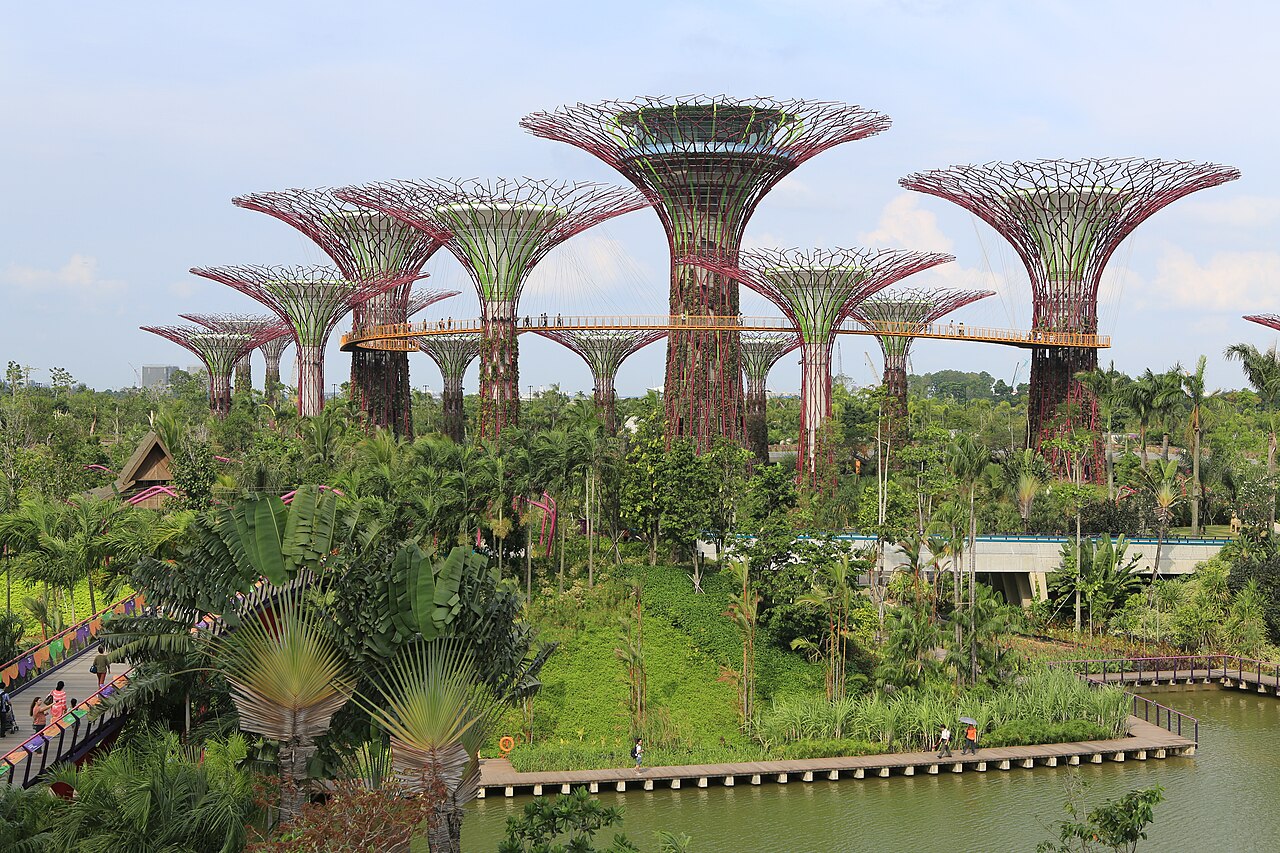
Gardens by the Bay is unusual in giving you a rain-proof option on the same site. The Flower Dome and Cloud Forest are both open 9:00 a.m. to 9:00 p.m. daily, with last admission at 8:30 p.m. for the Flower Dome and 8:00 p.m. for the Cloud Forest. The Supertree Observatory and the OCBC Skyway keep the same 9:00 a.m. to 9:00 p.m. hours with last admission at 8:30 p.m., and Floral Fantasy opens an hour later at 10:00 a.m. The Outdoor Gardens run from 5:00 a.m. to 2:00 a.m., which is a twenty-one-hour window and the longest access on the site.
Picture the place
Humidity, not heat, is what you feel. The monthly 24-hour mean relative humidity sits between 80.7% in August and September and 85.5% in December, and the mean daily maximum reaches between 93.0% and 96.5% — which is why the air-conditioned conservatories read as relief rather than as an attraction.
The easily missed detail
Each of the ticketed attractions at Gardens by the Bay closes one day a month for maintenance, and the dates differ between attractions — the Supertree Observatory and the OCBC Skyway, for instance, fall on different days. A visit planned around a single evening can lose its centerpiece to a closure that has nothing to do with weather or season.
A practical rhythm
- Early morning — The Outdoor Gardens open at 5:00 a.m., hours before the conservatories, and before the daily maximum humidity builds.
- Afternoon — Move indoors. Both conservatories run to 9:00 p.m., so heat and afternoon downpours cost you nothing.
- Evening — The Skyway and Observatory take their last admissions at 8:30 p.m., which is the latest high view on the site.
What could complicate the plan
Singapore's travel advisory is Level 1, Exercise Normal Precautions. US citizens need no visa for tourist or business visits of up to 90 days, but a passport valid for at least six months beyond the intended stay and two blank pages for the entry stamp. The inter-monsoon months of April, May, October and November bring the most convective afternoon thunderstorms, which arrive fast and pass fast — a factor in when you schedule the outdoor half of the day rather than whether you come at all.
What to do next
The trip-planning question in this group covers how the monsoon calendar and the entry rules fit together over a week.
Sources
- Meteorological Service Singapore, Climate of Singapore — monsoon periods, 1991–2020 temperature, rainfall and humidity normals
- Gardens by the Bay — opening hours, last admission times, monthly maintenance closures
- US Department of State, Singapore — advisory level, visa-free stay, passport requirements