Sossusvlei / Namibia When to visit
When should I visit Sossusvlei, Namibia, for the best experience?
The short answer
May through September is an excellent period for visiting Sossusvlei, with early morning the most rewarding time to explore the dunes before strong daytime heat develops.
The answer, with local context
Sossusvlei lies within Namib-Naukluft National Park, reached through the Sesriem entrance. The destination includes vast sand dunes, dry pans and the nearby Deadvlei landscape.
Scale is worth establishing first. The Namibia Tourism Board puts the Namib-Naukluft Park at 49,768 square kilometers and dates its proclamation in the present form to 1979, so the dune corridor behind Sesriem is one corner of a very large protected area rather than the whole of it.
The dunes also carry a designation of their own. UNESCO inscribed the Namib Sand Sea under criteria (vii), (viii), (ix) and (x), across 3,077,700 hectares with a further 899,500 hectares of buffer zone, and the citation rests on something a midday visit never reveals: fog, not rain, is the primary source of water across the site, and the sand sea carries an older semi-consolidated dune system with a younger, constantly mobile one riding on top of it. The ridge climbed at dawn belongs to the young system.
Namibia Wildlife Resorts places Sossusvlei approximately 60 kilometers from Sesriem. Visitors typically approach on the park road, passing Dune 45 before reaching the deeper dune landscape.
Winter in the Namib Desert generally brings cooler daytime walking conditions, although early mornings and nights can be cold. Summer can be extremely hot, especially during exposed walks across sand or into Deadvlei.
Entry formalities shape the first hour as much as the light does. Namibia's Ministry of Environment, Forestry and Tourism states that the country's national parks issue their permits at the park gates on arrival, and that the office at Sesriem covers the Namib-Naukluft Park alone.
Picture the place
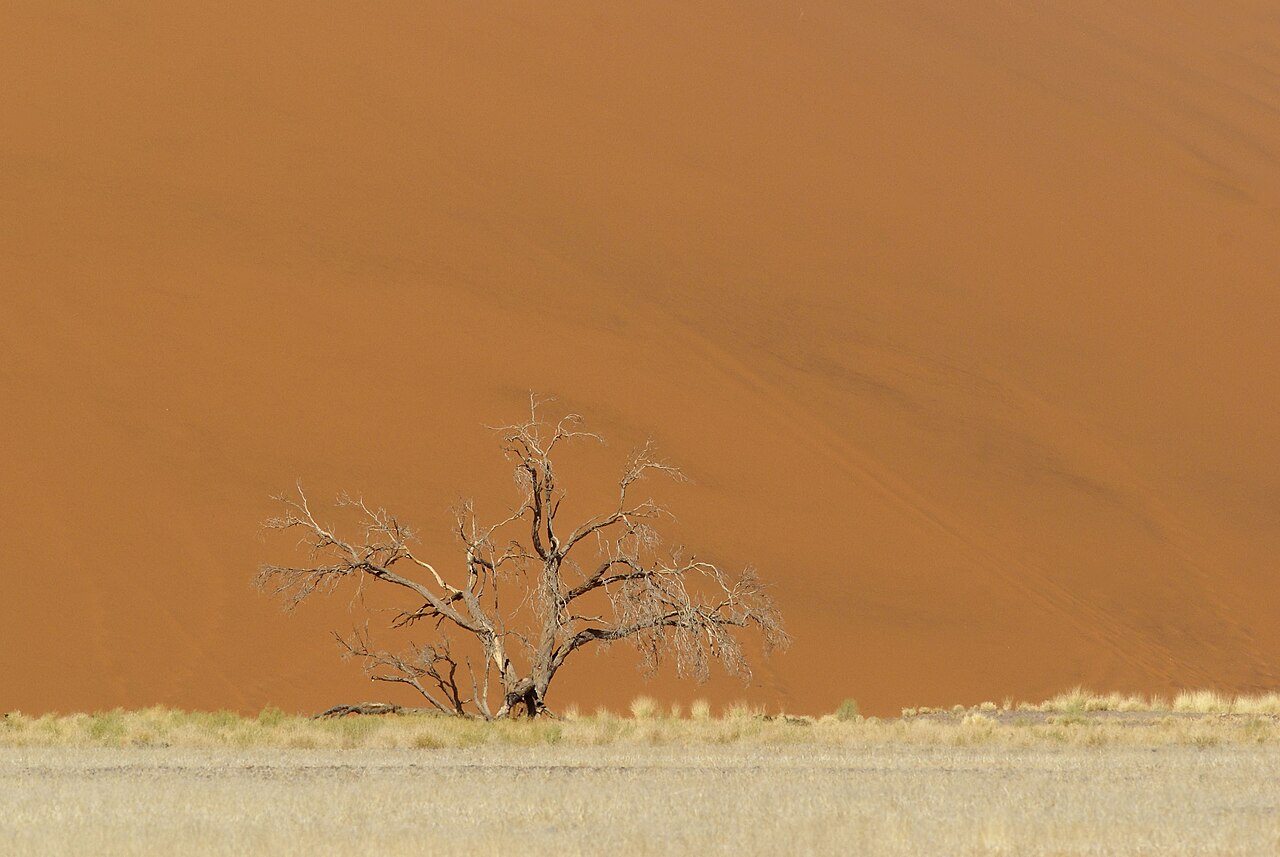
High reddish-orange dunes stand above white clay pans. At Deadvlei, dark skeletal trees remain on a dry pan surrounded by steep sand slopes.
The easily missed detail
Not every corner of this park is entered the same way. The environment ministry lists Welwitschia Drive and Sandwich Harbour among the areas needing a permit obtained in advance from the ministry, so a plan that wanders beyond the Sesriem dune corridor cannot be settled at a gate on the morning itself.
A practical rhythm
First task of the day: Collect the Namib-Naukluft permit at the Sesriem gate and allow for the 60-kilometer drive in.
Early morning: Explore Dune 45 or continue toward Deadvlei.
Later morning: Return toward Sesriem before peak heat.
What could complicate the plan
The ministry lists leaving the indicated roads, and leaving the vehicle, among the activities strictly prohibited in every Namibian park, so a route across open sand is not a visitor's decision to make. Soft sand and a rising thermometer are the other reasons a late start costs more here than it would on a graded trail.
What to do next
explains the dunes, dry pans and nearby canyon that deserve time during a first visit.
Sources
- Namibia Ministry of Environment, Forestry and Tourism — park permits and restrictions.
- Namibia Wildlife Resorts — Sesriem facilities and distance information.
- Namibia Tourism Board, Namib-Naukluft Park — park area and year of proclamation.
- UNESCO World Heritage Centre, Namib Sand Sea — inscription criteria (vii), (viii), (ix) and (x), the 3,077,700-hectare property with its 899,500-hectare buffer zone, fog as the primary water source and the two superimposed dune systems.