Torres del Paine / Chile When to visit
When should I visit Torres del Paine, Chile, for the best experience?
The short answer
October to December or January to February, when the park's own gates run 07:00 to 21:00 — against 08:30 to 18:00 from May through September, a difference of 8 hours of access a day.
The answer, with local context
The park publishes its gate hours month by month, and they step down steeply through autumn: 07:00 to 21:00 in January and February, 07:00 to 20:00 in March, 08:00 to 19:00 in April, then 08:30 to 18:00 for the five months from May to September, before returning to 07:00 to 21:00 from October to December. Those hours are the practical boundary of a day in the park, because visitors have to be out by closing.
What changes on 1 May is more than daylight. From that date the Base Torres trail may be entered only with a specialized authorized guide, and each guide may take a maximum of 4 clients under Chilean standard 2985. The same guide requirement applies in winter to the Sendero W, to the Sarmiento–Laguna Amarga section and to the Laguna Verde–Puente Weber route. Regular tourist passenger transport inside the park stops running after 30 April, so a winter visit is a different trip with a different cost base, not the same trip in colder weather.
Wind, not temperature, is the thing that actually cancels plans here. The park states that trails may be closed when winds exceed 80 km/h, roughly 50 mph. That is a routine Patagonian figure rather than an exceptional one, and it is the reason a fine forecast is not the same as an open trail.
Picture the place
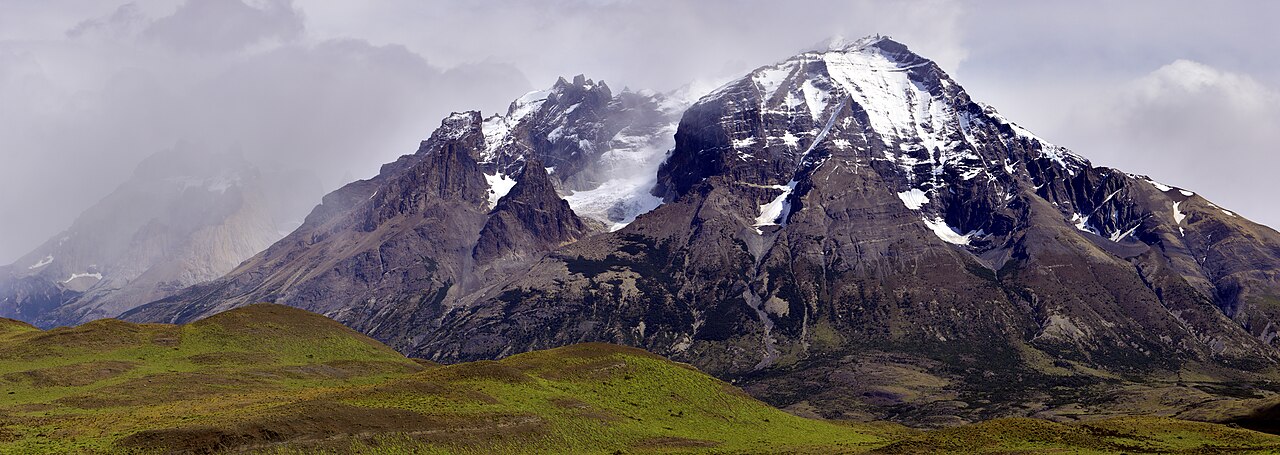
UNESCO's biosphere reserve record describes four ecological zones stacked across the same massif — pre-Andean scrubland, deciduous Magellan forest, Patagonian steppe and Andean desert — so a single day's walk can take you from grassland to forest to bare rock where vegetation cover falls away to nothing.
The easily missed detail
Torres del Paine has been a UNESCO Biosphere Reserve since 1978, which is a separate designation from national park status and comes with its own zoning. That matters to timing in a quiet way: the reserve's transition zone includes a marine component, and tourist services inside it are delivered by private concessions whose own seasons close before the park's do. The gates can be open while the thing you wanted to use is shut.
A practical rhythm
- High summer — January and February give the longest gate day at 14 hours, and the most competition for beds.
- Shoulder — March still runs 07:00 to 20:00, and April holds 08:00 to 19:00, with transport inside the park operating until 30 April.
- Winter — May to September means an 08:30 to 18:00 gate day, a guide requirement, and 4 clients per guide at most.
What could complicate the plan
US citizens receive a Tourist Card valid for up to 90 days on arrival in Chile, and must hand it back on departure; losing it means replacing it at an International Police office or at the airport before you fly. Overstaying brings a fine that has to be paid before you can leave. On the ground, the 80 km/h wind rule and the May guide requirement are the two constraints most likely to rewrite an itinerary, and the park's published timetables are issued per season — an hour read off last year's bulletin is not an hour you can plan around.
What to do next
The things-to-do question in this group sets out the reservation rule and the trail cutoff times that govern the circuits; the food question covers what is actually open to eat in and around the park.
Sources
- Corporación Nacional Forestal (CONAF), Parque Nacional Torres del Paine Boletín Informativo, April 2024 — monthly gate hours, winter guide requirement and client ratio, transport end dates, wind closure threshold
- UNESCO Man and the Biosphere Programme, Torres del Paine Biosphere Reserve — designation year, ecological zones, concessions, zonation
- US Department of State, Chile country information — Tourist Card validity, return and overstay rules