Valparaiso / Chile Things to do
What are the most worthwhile things to do in Valparaiso on a first visit?
The short answer
Ride the hillside funicular lifts and walk the inscribed historic quarter, which covers just 23.2 hectares — UNESCO added it to the World Heritage List in 2003 under criterion (iii), by Decision 27 COM 8C.41, calling the city "an exceptional testimony to the early phase of globalisation in the late 19th century."
The answer, with local context
The listing is small and precise: 23.2 hectares of inscribed property wrapped in a 44.5-hectare buffer zone. UNESCO's statement of Outstanding Universal Value names the pieces that make it up, and they double as a walking route — the single neighborhood of Cerro Alegre and Cerro Concepción, planned largely by German and English immigrants; La Matriz Church with Santo Domingo Square; Echaurren Square and Serrano Street; Prat Pier with Sotomayor and Justicia squares; and the Prat Street and Turri Square area at the foot of the slopes.
The reason it exists at all is shipping. UNESCO records Valparaíso as the first and most important merchant port on the Pacific coast of the sea routes that joined the Atlantic and Pacific through the Strait of Magellan, with its heaviest commercial weight from the 1880s until the Panama Canal opened in 1914, after which, in UNESCO's words, the city's development slowed. The customs and naval service buildings and Prat Pier are what the listing points to as the surviving port fabric.
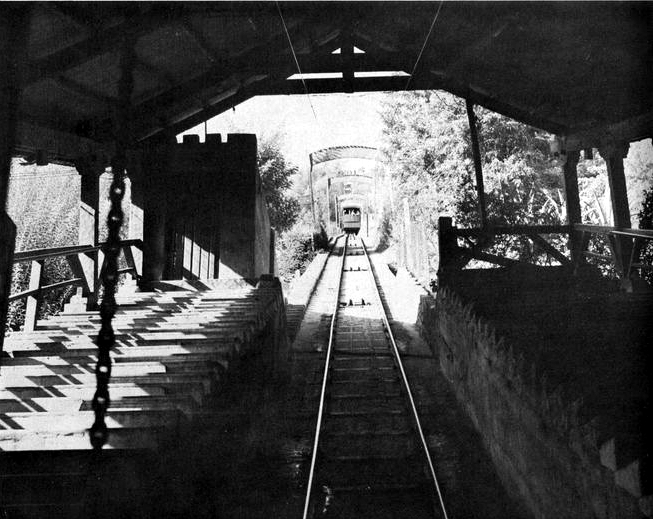
The lifts matter as much as the streets they connect, and they carry a legal status of their own. Chile's Consejo de Monumentos Nacionales records that the city's ascensores have been Monumentos Nacionales since 1998, that the first opened in 1883 on Cerro Concepción, and that the Barón began running in 1906 as the first with an electric motor. 3 of the lifts stand inside the World Heritage boundary. The national tourism service publishes the engineering: Artillería was inaugurated on 29 December 1892, runs 574 feet (175 meters) up a 27.5-degree slope for a rise of 262 feet (80 meters), and carries cabins of 12 people; Cordillera dates from 1886, with its present structure rebuilt in 1894 after a fire, climbing 197 feet (60 meters) at a startling 70 degrees; Reina Victoria was built in 1902 and inaugurated in 1903 at 52 degrees; El Peral, from 1901, runs at almost exactly 45 degrees between Plaza de la Justicia and Paseo Yugoslavo; and Polanco is not an incline at all but a vertical rise of 197 feet (60 meters), reached through a 492-foot (150-meter) tunnel and crossed by a 157-foot (48-meter) bridge.
One rebuilt landmark is worth the climb to Cerro Barón. The Iglesia San Francisco, a Monumento Histórico built in 1846, burned out completely in 2013 after earlier fires in 1983 and 2010. Chile's Ministry of the Interior reported that restoration began in September 2021 at a cost of close to 7 billion Chilean pesos, funded 80 percent by the Valparaíso Regional Government and 20 percent by the Public Works Ministry's architecture directorate, and that the church was due to reopen to the public on 25 May 2024, with a consecration mass following on 13 June.
Picture the place
UNESCO's own description explains the shape of a day here: a bay, a narrow coastal plain that is largely artificial, and steep hills cut through by multiple ravines, which together forced the city into an amphitheatre. Walking it means crossing those ravines rather than following a grid, and the lifts exist because the alternative is stairs.
The easily missed detail
The World Heritage area is far smaller than the city people picture — 23.2 hectares of core and 44.5 hectares of buffer, a handful of blocks and the Alegre-Concepción neighborhood rather than a whole district. Chile protects a wider area by its own instrument: the Consejo de Monumentos Nacionales counts 8 zonas típicas making up the Área Histórica, which is a national designation and does not share the UNESCO line. Knowing which boundary a building sits inside explains why conservation standards shift sharply from one street to the next.
A practical rhythm
- Start low — Plaza Sotomayor, Prat Pier and the customs and naval buildings sit on the flat, and UNESCO treats them as one element of the listing.
- Go up once — Take a single lift to the Cerro Alegre and Cerro Concepción neighborhood, where UNESCO places the top stations of some of the funiculars.
- Come down elsewhere — Descend by a different machine; Polanco's vertical shaft and Cordillera's 70-degree incline are entirely different rides.
What could complicate the plan
How many lifts are actually running changes, and Chile's own official pages do not agree on the figure, so treat any published total as provisional and check on the day. Fire is the recurring threat rather than a freak event: UNESCO's 2017 state of conservation report for the property describes the massive April 2014 fire as an emergency, and the same report records that the Committee approved 1 international assistance request in 2010 totaling 140,688 US dollars and that the National Monuments Council approved an Archaeological Heritage Management Plan in April 2016. Gradients are the other constraint — a 70-degree incline and a city built on ravines are hard going if stairs are difficult. The State Department also warns that carjackings and vehicle thefts are a serious problem in Valparaíso and that street crime such as muggings and pickpocketing is common.
What to do next
For the months when the lifts and the ridge walks are driest, read the Valparaíso when-to-visit question alongside this one, and the Valparaíso food and drink question for lunch in the port quarter around Echaurren Square.
Sources
- UNESCO World Heritage Centre, Historic Quarter of the Seaport City of Valparaíso — criterion, inscribed and buffer areas, Outstanding Universal Value text, port history, 2017 conservation report and assistance figure
- Consejo de Monumentos Nacionales, Apuntes sobre Valparaíso (2022) — national monument status of the ascensores, 1883 and 1906 dates, lifts inside the property, zonas típicas count
- Chile Travel, national tourism service — funicular inauguration dates, lengths, gradients, height differences and cabin capacity
- Ministerio del Interior y Seguridad Pública de Chile — Iglesia San Francisco construction year, fire dates, restoration cost, funding split and reopening date
- US Department of State, Chile International Travel Information — crime warnings naming Valparaíso