Yellowstone / United States When to visit
When should I visit Yellowstone, United States, for the best experience?
The short answer
September, after Labor Day — every park road is still open, the summer crowds have gone, the elk rut is underway, and entry costs the standard $35 per private vehicle for a seven-day pass.
The answer, with local context
Yellowstone's visiting season is written by its road crews, not its thermometer. The National Park Service opens the park in stages each spring, because most of its 2.2 million acres sit near 8,000 feet and hold snow into May. That schedule is the gatekeeper to a World Heritage property of nearly 900,000 hectares, which UNESCO inscribed under all four of its natural criteria — (vii), (viii), (ix) and (x). In the published 2026 schedule, the first interior roads — West Entrance to Madison, Old Faithful, Norris and Canyon — opened to cars on April 17; the East Entrance over Sylvan Pass followed on May 1; the South Entrance and Craig Pass on May 8; and Dunraven Pass, the highest road in the park, completed the Grand Loop on May 22. Closures run in reverse: Dunraven and the Beartooth Highway shut on October 12, and nearly every remaining road closes to cars after October 31.
That staircase defines the real choices. June through August gives full access and every service running, at the price of the year's crowds. September keeps the full road network intact — Dunraven Pass stays open into mid-October — while visitation falls sharply after Labor Day, the elk rut fills the northern valleys with bugling, and cold mornings make the geyser basins steam at their most theatrical. Spring's compensations are water and newborns: the park's 290 waterfalls run at snowmelt peak in May and June, and bison calves appear in the Lamar Valley from April onward.
Winter is a separate park altogether. Only one road stays open to cars all year — the corridor from the North Entrance at Gardiner through Mammoth Hot Springs and the Lamar Valley to Cooke City — and the interior is reached solely by guided snowcoach and snowmobile during the oversnow season, December 15 to March 15 in the 2026–27 schedule. It is a serious expedition climate: the park's record low is −66°F (−54°C).
Picture the place
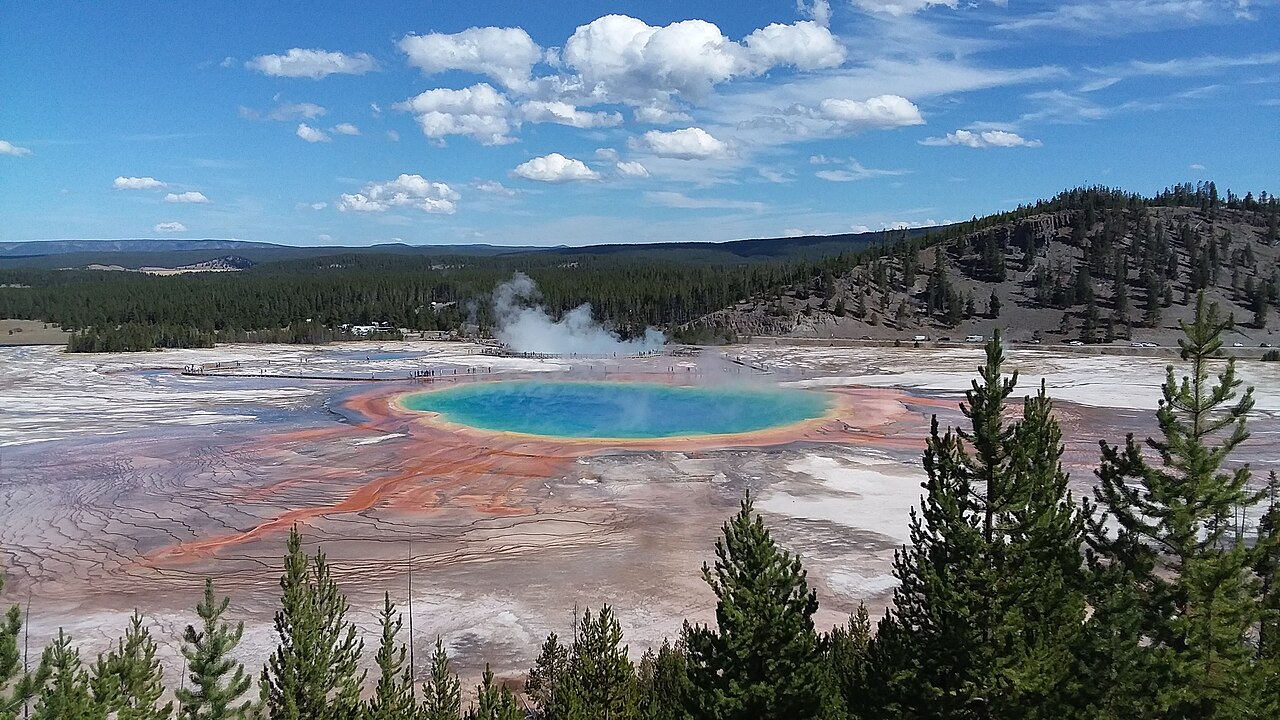
On a September morning in the Upper Geyser Basin the boardwalks stand empty in air near freezing, and every vent and pool throws a tall white column of steam into the still air, so the whole basin looks twice its summer size.
The easily missed detail
The park itself never closes — Yellowstone is open 24 hours a day, 365 days a year. What closes is the roads. Visitors who read "the park is open" in April as an invitation discover a park they mostly cannot drive into, with only the northern corridor plowed.
A practical rhythm
- Morning — Be in the Lamar Valley at dawn for wolves and bears, whatever the month; wildlife keeps crepuscular hours all year.
- Midday — Walk the geyser basins late morning in September, when the steam shows against cold air and day-trip crowds have not yet peaked.
- Evening — Stay inside the park if you can: lodging guests get the basins and valleys in the quiet hour after the gate traffic leaves.
What could complicate the plan
From January 1, 2026, non-US residents aged 16 and over pay an additional $100 per-person surcharge on top of the standard entrance pass at Yellowstone — a material change for international visitors to budget for. Weather can also overrule the calendar at any point: the Park Service warns that every published opening date is subject to snow, and Dunraven Pass can close temporarily for a storm even in its short season. Early summer carries a rarer hazard, the rain-on-snow flood. Between June 10 and 13, 2022, 0.8 to more than 5 inches of rain fell onto 2 to nearly 5 inches of melting snowpack in the Beartooths and Absarokas; the Yellowstone River crested at 13.88 feet at Corwin Springs, north of Gardiner, breaking an 11.5-foot record that had stood since June 14, 1918, and water and rock closed the Gardiner-to-Mammoth road — the one stretch the park cannot reroute around.
What to do next
Choose the month by the road schedule, then hold it against this group's things-to-do route — the full Grand Loop only exists between late May and mid-October.
Sources
- National Park Service — Yellowstone Park Roads: the published 2026 opening and closing schedule by road segment, the year-round Gardiner–Cooke City corridor and the oversnow season dates
- National Park Service — Yellowstone entrance fees: $35 per private vehicle for a seven-day pass, $20 per person on foot or bicycle
- National Park Service — Yellowstone facts: 2.2 million acres, 290 waterfalls and the record low of −66°F
- UNESCO World Heritage Centre, Yellowstone National Park — a property of nearly 900,000 hectares, inscribed under natural criteria (vii), (viii), (ix) and (x)
- NOAA National Weather Service, Billings — the June 10–13, 2022 rain-on-snow flood: 0.8 to over 5 inches of rain on 2 to nearly 5 inches of snow-water equivalent, the 13.88-foot Yellowstone River crest at Corwin Springs against the 11.5-foot record of June 14, 1918, and the Gardiner-to-Mammoth road closure