Amalfi Coast / Italy When to visit
When should I visit Amalfi Coast, Italy, for the best experience?
The short answer
Late April to mid-June, or September into early October — and which end of the coast you choose matters as much as the month, because the inscribed property spans 15 municipalities and about 11,231 hectares from Vietri sul Mare in the east to Positano in the west.
The answer, with local context
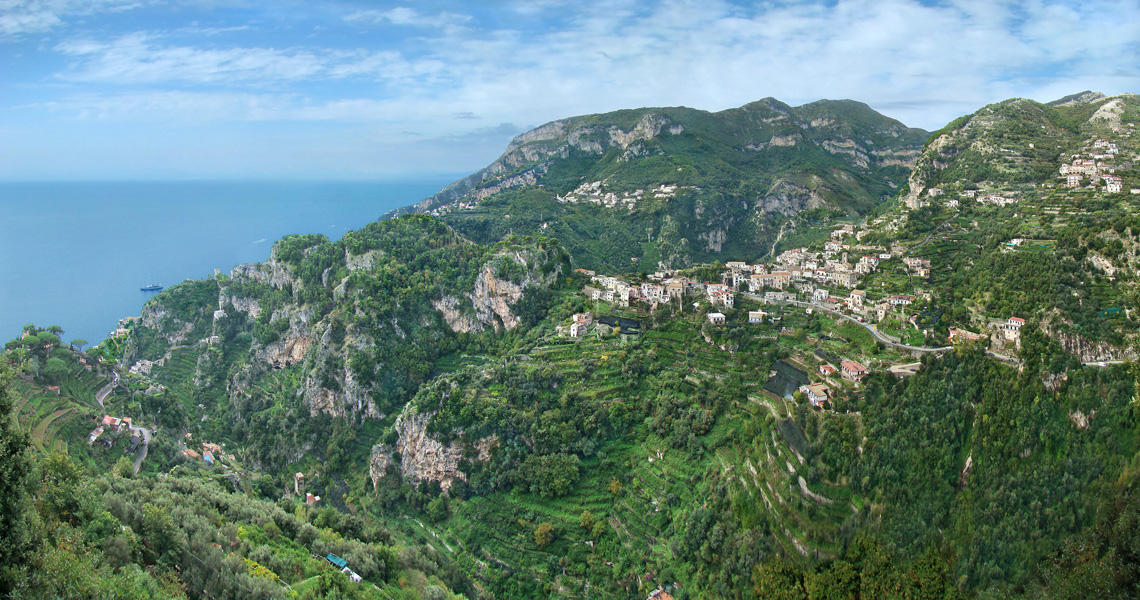
The Costiera Amalfitana was inscribed on the World Heritage List in 1997 by Decision 21 COM VIII.C, under cultural criteria (ii), (iv) and (v). UNESCO describes it as a landscape of outstanding cultural value running along the southern coast of the Sorrentine Peninsula in the province of Salerno, taking in farmland and three natural reserves, with terraced vineyards and citrus groves on the lower slopes and sheep farming on the higher ground. Fifteen municipalities fall inside it. The protected lemon liqueur specification registered with the European Commission names thirteen of the coastal communes by name — Amalfi, Atrani, Cetara, Conca dei Marini, Furore, Maiori, Minori, Positano, Praiano, Ravello, Scala, Tramonti and Vietri sul Mare — which is a useful map of what people actually mean by "the Amalfi Coast."
That list is the reason the question needs splitting. Positano, at the western end, faces southwest into afternoon sun and is built down a single ravine to the water. Amalfi and Atrani sit at the mouths of gorges in the middle of the coast and lose direct sun earlier. Ravello is not on the shoreline at all — it sits high above it, on the ridge behind Amalfi, which is why its gardens and its views are the draw rather than its beaches. Scala and Tramonti are inland and upland. A forecast for the coast is three or four different afternoons depending on which of those you booked.
The shoulder months work because the terraces are productive and the coast is not yet at summer load. Late April into June catches the citrus and vine growing season on the lower slopes that UNESCO identifies as the defining agricultural layer of the landscape; September and early October catch the harvest end of it.
Picture the place
The terracing is the landscape's actual structure — dry-stone walls stacked up slopes steep enough that the cultivated ground is horizontal only because someone built it that way. Above the terrace line the slopes turn to rough pasture, and the transition is visible as a clean band partway up the mountainside.
The easily missed detail
Amalfi's own civic calendar fixes two dates worth planning around or avoiding, depending on your taste for crowds. The Corsa del Santo takes place on 27 June and again on 30 November, when a silver bust of Sant'Andrea is carried through the town and devotees run it up the cathedral staircase. Italy's national tourism agency lists the Cathedral of Sant'Andrea as open Monday to Sunday, 09:00 to 18:30, which is the single most reliable fixed opening on the coast. A late-November visit, usually written off as off-season, catches one of the two processions.
A practical rhythm
- Late April to mid-June — Terraced groves and vineyards in growth, before the peak load on a coast with 15 municipalities and one coastal road.
- 27 June or 30 November — The two Corsa del Santo dates in Amalfi.
- September to early October — Harvest on the lower slopes, warm sea, and the cathedral still on its 09:00 to 18:30 schedule.
What could complicate the plan
UNESCO records that the property has no buffer zone, and notes that one would be beneficial — in practice development pressure sits directly against the boundary. The coast is served by a single coastal road threaded along cliffs, and summer traffic on it is the defining constraint of a high-season visit; towns in the middle of the coast are the hardest to reach and leave. Gradient is a genuine access issue: Positano and Atrani are staircase towns, and Ravello and Scala are reached by climbing off the coast road altogether. Three natural reserves fall inside the property, and their access rules are not the same as a town's.
What to do next
The Amalfi Coast things-to-do question in this group goes into the cathedral complex in detail, and the food question covers the protected lemon and anchovy designations that come out of these terraces and fishing villages.
Sources
- UNESCO World Heritage Centre, Costiera Amalfitana — criteria, area, municipality count, three reserves, terracing and pastoral land use, absence of a buffer zone
- UNESCO World Heritage Committee, Decision 21 COM VIII.C — 1997 inscription under criteria (ii), (iv) and (v)
- European Commission, eAmbrosia product specification for Liquore di Limone della Costa d'Amalfi — the thirteen named coastal municipalities of the production area
- ENIT / italia.it, Duomo di Sant'Andrea, Amalfi — opening schedule and the 27 June and 30 November Corsa del Santo dates