Athens / Greece Things to do
What are the most worthwhile things to do in Athens on a first visit?
The short answer
The Acropolis, booked through hhticket.gr — the official Hellenic Heritage e-ticket portal is the only channel through which the Hellenic Ministry of Culture issues entry tickets to the site.
The answer, with local context
Athens has one site that carries five of UNESCO's six cultural criteria, and getting into it correctly is the first task of a first visit.
The Acropolis is inscribed under criteria (i), (ii), (iii), (iv) and (vi) — a nearly complete sweep of the cultural criteria, which among World Heritage properties is rare. Criterion (i) covers it as a masterpiece of human creative genius; (vi) covers its direct association with ideas and traditions of outstanding universal significance. That combination is the formal reason the hill outranks everything else in the city and the reason a first visit is organized around it rather than fitting it in.
Access runs through a single official channel. The Hellenic Ministry of Culture states that Acropolis entry tickets are issued only through the official Hellenic Heritage e-ticket portal at hhticket.gr. Plan the day around the slot you secure there, then build outward: the slopes of the hill, the surrounding archaeological zone and the museums below it are all walkable from the same approach.
Timing within the day is worth more here than almost anywhere. NOAA's long-term Athens record puts mean maximum temperatures near 82°F in June (28°C) and near 83°F in September (28°C), with March near 58°F (14°C). On an unshaded limestone summit those figures translate into a materially different experience at 09:00 than at 14:00, and a shoulder-month visit buys you the whole day rather than its ends.
Picture the place
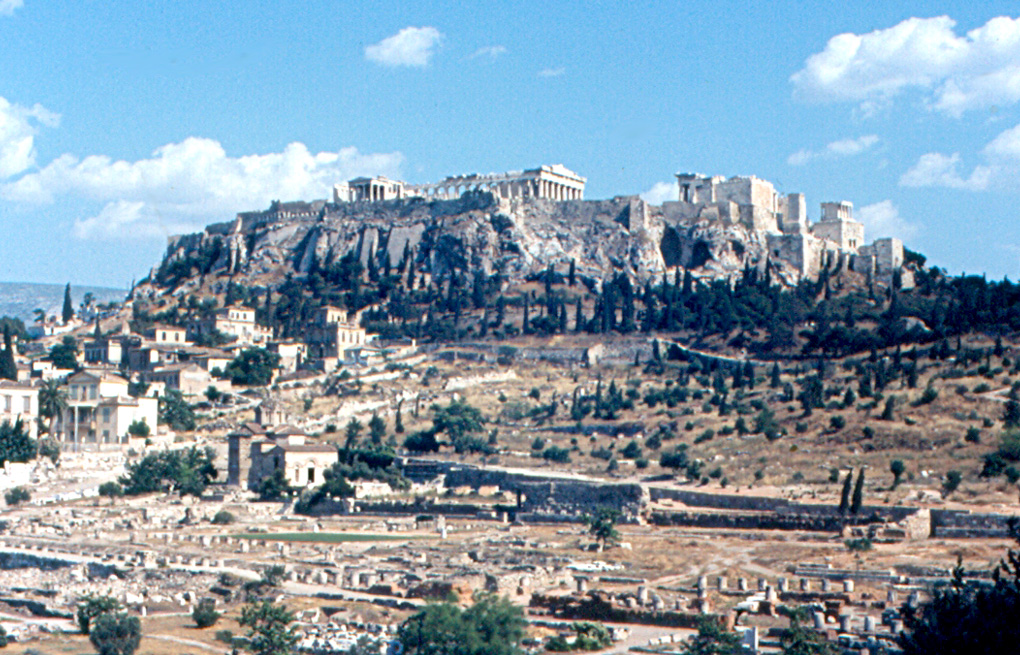
From below, the hill presents as a sheer rock mass with the temple line along its top edge; from the Theseion on the far side of the ancient Agora the Parthenon sits centrally in the view with the Propylaea — the monumental entrance — to the right, which is the classic framing of the site as a single composition rather than a collection of buildings.
The easily missed detail
Five criteria is the detail, and it changes what you look at. Because the Acropolis is listed partly under criterion (vi), for its association with ideas rather than only for its architecture, the site rewards attention to what happened on it as much as to what stands on it. The hill was a sanctuary, a treasury and a civic stage, and the inscription recognizes that layer explicitly. Visitors who arrive to photograph a building often miss that the designation covers the whole plateau and its slopes, not the Parthenon alone.
A practical rhythm
- First slot of the day — Secure it on the official portal; the summit has no shade and NOAA's June and September means sit near 82°F and 83°F.
- Mid-morning — The slopes and the surrounding archaeological zone, lower down and partly shaded.
- Afternoon — The museums below the hill, which is where the sculptural material from the inscribed site is interpreted.
What could complicate the plan
The US Department of State rates Greece Level 1, Exercise Normal Precautions, so the complications here are operational. Tickets exist only through the official portal, so a sold-out slot cannot be bought around. The site is open rock with no shelter, and summer heat affects both comfort and site operations. Archaeological conservation on the Acropolis is long-running and parts of the monuments carry scaffolding at any given time, which is a condition of the place rather than an interruption to it. March's mean maximum near 58°F means an early-spring visit is cool as well as quiet.
What to do next
The Athens when-to-visit question in this group sets out the full monthly temperature picture, and the food question covers where and when the city eats.
Sources
- UNESCO World Heritage Centre, Acropolis, Athens — inscription under criteria (i), (ii), (iii), (iv) and (vi)
- Hellenic Ministry of Culture — Acropolis tickets issued only through the official hhticket.gr portal
- NOAA National Centers for Environmental Information, Engineering Weather Data, Athens, Greece — March, June and September mean maxima from the long-term record
- US Department of State, Greece Travel Advisory — Level 1 rating