Athens / Greece Food and drink
Where should I eat in Athens, and which local food or drink is worth trying?
The short answer
Start with feta — and know what you are buying: the European Commission registered Feta as a Protected Designation of Origin by Regulation (EC) No 1829/2002 of 14 October 2002, restricting the name to cheese from mainland Greece and the department of Lesbos.
The answer, with local context
The feta registration is one of the more contested food designations in Europe, and the detail is genuinely useful at the table. The 2002 regulation entered Feta into Part A of the annex to Regulation (EC) No 1107/96 under cheeses, Greece, reinstating a name the Court of Justice had previously struck from that annex in part. In doing so the Commission concluded that Feta had not become a generic term.
The specification is tight. The designated area covers only the territory of mainland Greece plus the department of Lesbos — all other Greek islands and archipelagos are excluded. The milk must come from sheep and goats of local breeds traditionally reared in those regions, and the animals' diet must be based on the vegetation of pasture areas within the authorized regions. In Athens, the practical consequence is that the registered product on a taverna table comes from the mainland hinterland surrounding the city and from one Aegean island, not from the whole country.
The second thing that governs Athenian eating is heat. NOAA's long-term record for the city gives August a mean minimum near 73°F (23°C) and February a mean maximum near 56°F (13°C), with November near 65°F (18°C). A mean minimum of 73°F is why Athens eats late in summer: the evening is the first tolerable part of the day, and kitchens and rooftop tables run accordingly. In February the same rooftops are closed and the eating moves indoors and earlier.
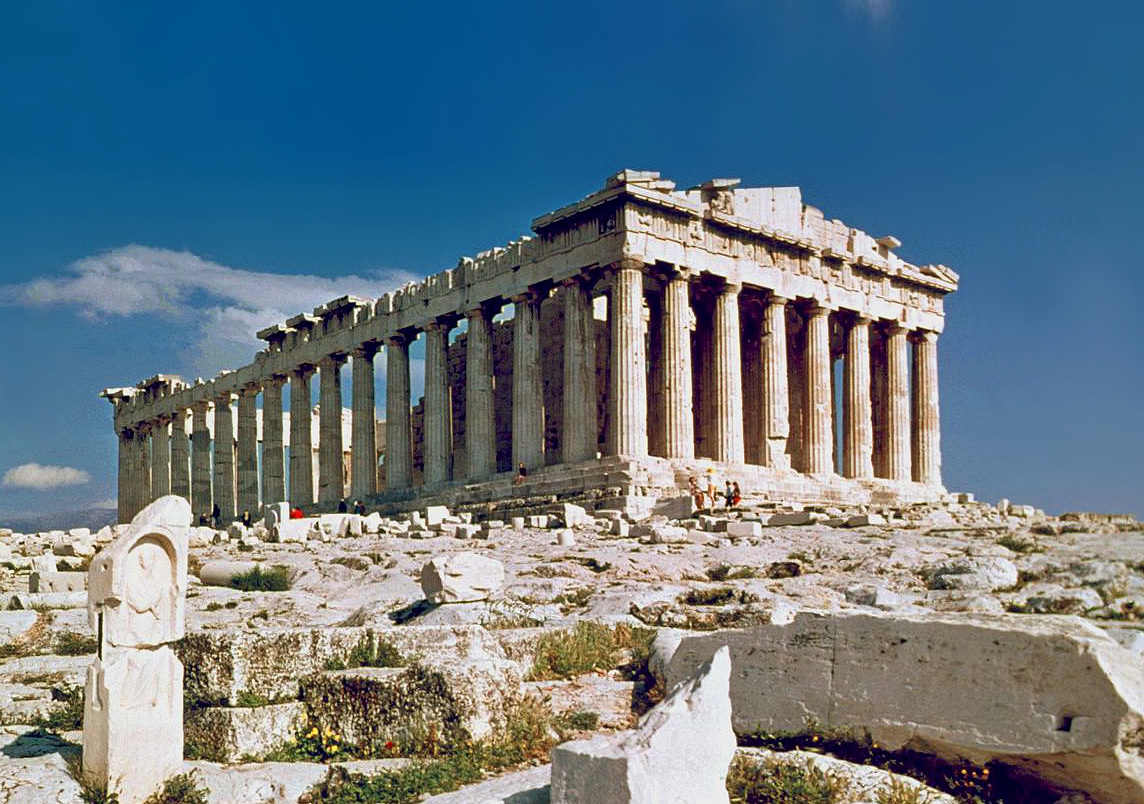
Geography does the rest. UNESCO's inscribed property in the city is listed as Acropolis, Athens, and the dense old quarters immediately below the hill are where the oldest tavernas sit — close enough to the site that an evening meal and an Acropolis view are the same decision.
Picture the place
The streets immediately under the north and east flanks of the Acropolis rock climb in short, stepped runs, and tables are set out on the steps themselves — which is why so many of them look up at the lit rock face rather than out at anything.
The easily missed detail
Lesbos is the exception that proves the rule. The feta designation covers mainland Greece and that one island department, and nothing else — so cheese made on Crete, Santorini or Rhodes, however good, cannot legally be sold as feta within the EU. It also sets the animal side of the specification: sheep and goats of local breeds, fed on pasture vegetation from the authorized regions. Asking whether the feta on the plate is the registered PDO product is a reasonable question in Athens, and the answer tells you something about the kitchen.
A practical rhythm
- Late evening in summer — With August mean minima near 73°F, the city's own dinner hour is the comfortable one.
- Midday in winter — February's mean maximum near 56°F moves the main meal indoors and earlier.
- November — Mean maxima near 65°F, the last month when outdoor tables below the Acropolis still work.
What could complicate the plan
Summer nights that do not drop below the low 70s°F make midday eating genuinely uncomfortable, and many kitchens in the old quarters work on a long afternoon break. The US Department of State rates Greece Level 1, Exercise Normal Precautions, so the constraints are practical ones: the lanes below the Acropolis are stepped and uneven, which limits step-free access to many of the oldest tavernas. And the PDO rules govern what a product may be called, not what a menu writes, so the designation is a question to ask rather than a guarantee to assume.
What to do next
The Athens when-to-visit question in this group has the monthly temperature range in full, and the things-to-do question explains how to book the Acropolis around an evening meal below it.
Sources
- Commission Regulation (EC) No 1829/2002 of 14 October 2002, Official Journal L 277, as published by the Agencia Estatal Boletín Oficial del Estado — Feta PDO registration, designated area of mainland Greece and Lesbos, breed and feed requirements, reversal of the partial annulment
- NOAA National Centers for Environmental Information, Engineering Weather Data, Athens, Greece — August mean minima, February and November mean maxima from the long-term record
- UNESCO World Heritage Centre, Acropolis, Athens — the official name of the city's inscribed property
- US Department of State, Greece Travel Advisory — Level 1 rating