Bahrain country guide When to visit
When is the best time to visit Bahrain for Bahrain Fort?
The short answer
November through March, and specifically not a Monday — the Bahrain Authority for Culture and Antiquities opens the Qal'at al-Bahrain Site Museum Tuesday to Sunday, 8am to 8pm, and closes it on Mondays, and the fort itself is an unshaded excavated mound you walk across.
The answer, with local context
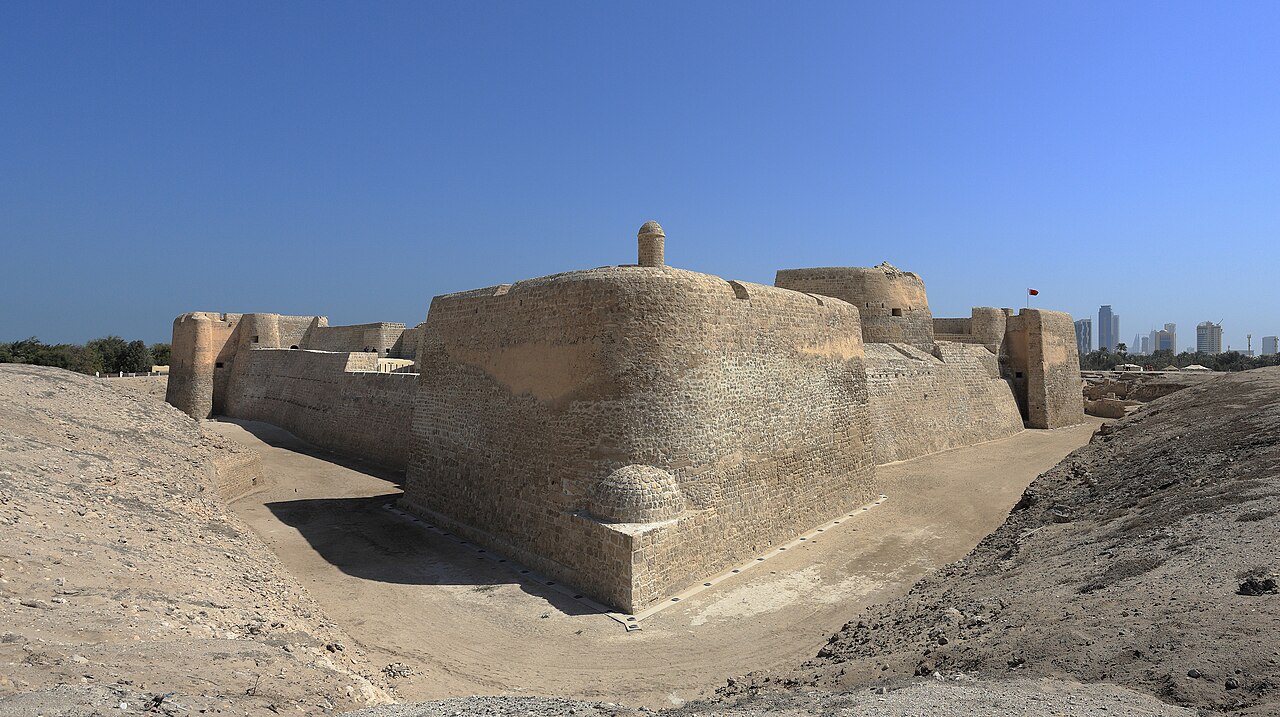
The site is physically demanding in a way its photographs do not suggest. UNESCO's description of Qal'at al-Bahrain, the Ancient Harbour and Capital of Dilmun, gives an artificial tell of about 300 by 600 m — roughly 980 by 1,970 feet — standing about 12 m, near 39 feet, above the surrounding ground. The inscribed property covers over 16 hectares of tell plus a sea channel of just under 16 hectares and a sea tower about 1,600 m, close to a mile, northwest of the mound. There is no tree cover on any of it.
That mound is the accumulated record of occupation running from about 2300 BC to the 16th century AD, with the Outstanding Universal Value statement describing almost 4,500 years of continuous use. The Portuguese fort that gives the site its popular name sits on top of all of it, which is why the modern name describes the youngest layer. UNESCO inscribed the property in 2005 through Decision 29COM 8B.26, on criteria (ii), (iii) and (iv).
Working hours in Bahrain compress the useful part of a winter day. The US International Trade Administration's Bahrain guide gives a Sunday-to-Thursday workweek, with government offices generally open 7:30 a.m. to 2 p.m. If you need any official business done around a site visit, it has to happen in the morning.
Picture the place
The tell rises straight out of flat coastal ground on Bahrain's northern shore, so the Portuguese walls on its crown are visible from a long way off across reclaimed land, and the sea channel on the far side still reads as a channel rather than as open water.
The easily missed detail
The museum and the fort are two separate experiences with two separate rhythms. The Site Museum, opened in February 2008 across from the fort, runs over two floors and arranges its collection into 5 chronologically ordered galleries, one per historical period. That means you can read the sequence indoors in cool air and then walk out onto the physical layers — but only Tuesday to Sunday, and only if you have not spent the whole of a short winter afternoon outside first.
A practical rhythm
- 8am — Be at the museum when it opens; the galleries make sense of a mound that otherwise looks like rubble.
- Mid-morning — Walk the tell while the sun is still low; 12 m of elevation with no shade is a different proposition at noon.
- Evening — The museum stays open to 8pm, far later than most Gulf heritage sites, so a second indoor pass after sunset is possible.
What could complicate the plan
Monday closure is the one that catches people, because the fort grounds and the museum are usually visited together. Beyond that, the whole experience is outdoors and exposed, so Bahrain's summer rules out the middle of the day for months at a time. And the site is an active archaeological excavation rather than a reconstructed monument, so sections are fenced and what is visible changes.
What to do next
For Bahrain's other designated sites, see the question in this guide on what a first-time traveler should see beyond the obvious highlights; for entry rules, see the Bahrain trip-planning question.
Sources
- Bahrain Authority for Culture and Antiquities — museum opening days and hours, Monday closure, February 2008 opening, two floors, five period galleries
- UNESCO World Heritage Centre, Qal'at al-Bahrain — tell dimensions and height, property and sea-channel areas, sea tower distance, occupation range, 2005 inscription, Decision 29COM 8B.26, criteria (ii), (iii) and (iv)
- US International Trade Administration, Bahrain Country Commercial Guide, business travel — workweek and government office hours