Barcelona / Spain When to visit
When should I visit Barcelona, Spain, for the best experience?
The short answer
Mid-May to late June, or the second half of September — August is Barcelona's warmest month, with a mean daily maximum of 83.3°F (28.5°C), and October is its wettest at 3.58 inches (91 mm), so the weeks on either side of those two peaks are the ones that give you long days without either extreme.
The answer, with local context
The numbers come from AEMET, Spain's national meteorological agency, which publishes normals for the Barcelona Aeropuerto station over 1981 to 2010. The shape of the year they describe is unusual for a Mediterranean city: the heat peak and the rain peak fall only two months apart, with August hottest and October wettest. That is the opposite of the dry-autumn pattern travelers often assume, and it is why late September reads so much better than mid-October on paper.
The city's headline monument reinforces the shoulder-season case from a different direction. The Basílica de la Sagrada Família opens 9 a.m. to 6 p.m. Monday to Saturday from November through February, and 10:30 a.m. to 6 p.m. on Sundays. In March and October the weekday window stretches to 9 a.m.–7 p.m. An extra hour of access at the end of the day is worth a great deal in a city where the light is good late and the interior depends on it.
Barcelona's Gaudí buildings have carried UNESCO World Heritage status since 1984, inscribed under criteria (i), (ii) and (iv) as the Works of Antoni Gaudí. Inscription has a practical consequence for dates: the properties are managed as heritage sites with controlled admission rather than as open attractions, so high season is felt as a scheduling problem rather than a crowding one.
Picture the place
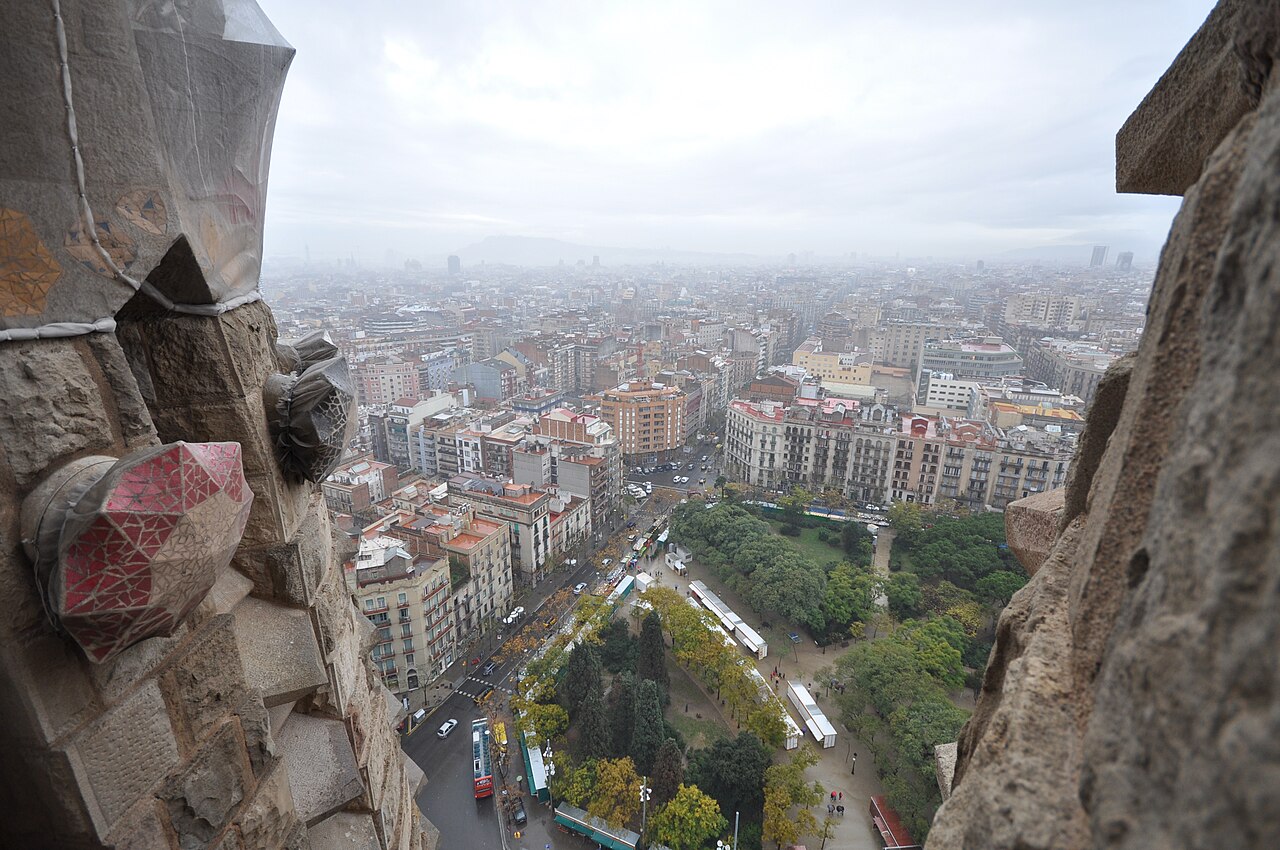
Barcelona's grid runs at an angle to the coast, so in late September the sun drops down the long diagonal avenues rather than across them, and the Eixample's chamfered corners catch light on one face and shade on the other for most of the afternoon.
The easily missed detail
October being the wettest month does not make it a wet month in the way northern Europe understands the term — 3.58 inches across a whole month is concentrated rather than constant, and it arrives in short heavy episodes. The planning consequence is not to avoid October but to avoid building a day around a single outdoor booking in it, because the pattern that produces that total produces it in a few hours rather than over thirty days.
A practical rhythm
- Mid-May to June — Long daylight, the basilica already on its longer weekday hours, and temperatures short of the August maximum.
- Second half of September — The heat has broken but the October rainfall peak has not arrived.
- November to February — The quietest window, with the trade-off written into the timetable: the basilica closes at 6 p.m. and opens late on Sundays.
What could complicate the plan
The State Department's advice for Spain is to exercise increased caution due to terrorism and civil unrest, and Barcelona is where civil unrest in Spain is most likely to affect a visitor's day through transport disruption and street closures rather than anything more direct. Timed-entry heritage admissions mean a weather change cannot simply be absorbed by shifting a visit a few hours. The basilica also runs reduced 9 a.m.–2 p.m. hours on 25 and 26 December and on 1 and 6 January, so a winter trip over the holidays loses afternoon access on four separate days.
What to do next
The things-to-do question in this chapter covers admission prices and the hourly visitor cap at Park Güell, which is the other half of the scheduling problem.
Sources
- AEMET, Agencia Estatal de Meteorología — warmest and wettest months, station and reference period
- Basílica de la Sagrada Família — seasonal opening hours and reduced holiday hours
- UNESCO World Heritage Centre, Works of Antoni Gaudí — inscription year and criteria
- U.S. Department of State, Spain travel advisory — advisory wording