Belgium country guide When to visit
When is the best time to visit Belgium for Bruges?
The short answer
May and June, or September — Belgium now averages only about 30 summer days a year, so the warm-and-dry weeks are genuinely scarce, and those months also fall outside the Belfry's two published winter short days of 9 a.m. to 4 p.m. on 24 and 31 December.
The answer, with local context
Belgium is small enough that the national climate record and the Bruges record are close relatives. The Royal Meteorological Institute's reference station at Uccle shows how the 1991–2020 normals differ from 1961–1990: the annual mean is about 2.2°F (1.2°C) warmer, spring has gained the most at 2.7°F (1.5°C) and autumn the least at 1.4°F (0.8°C), frost days are down by roughly 13 a year, and annual sunshine is up by 94 hours. Summer days have risen from about 20 a year to about 30, and days of real heat from about two to about five.
That spring figure is the one that matters for a Bruges trip. Spring has warmed more than any other season, which has pulled the usable outdoor season earlier rather than extending it later, and May now does work that used to belong to June.
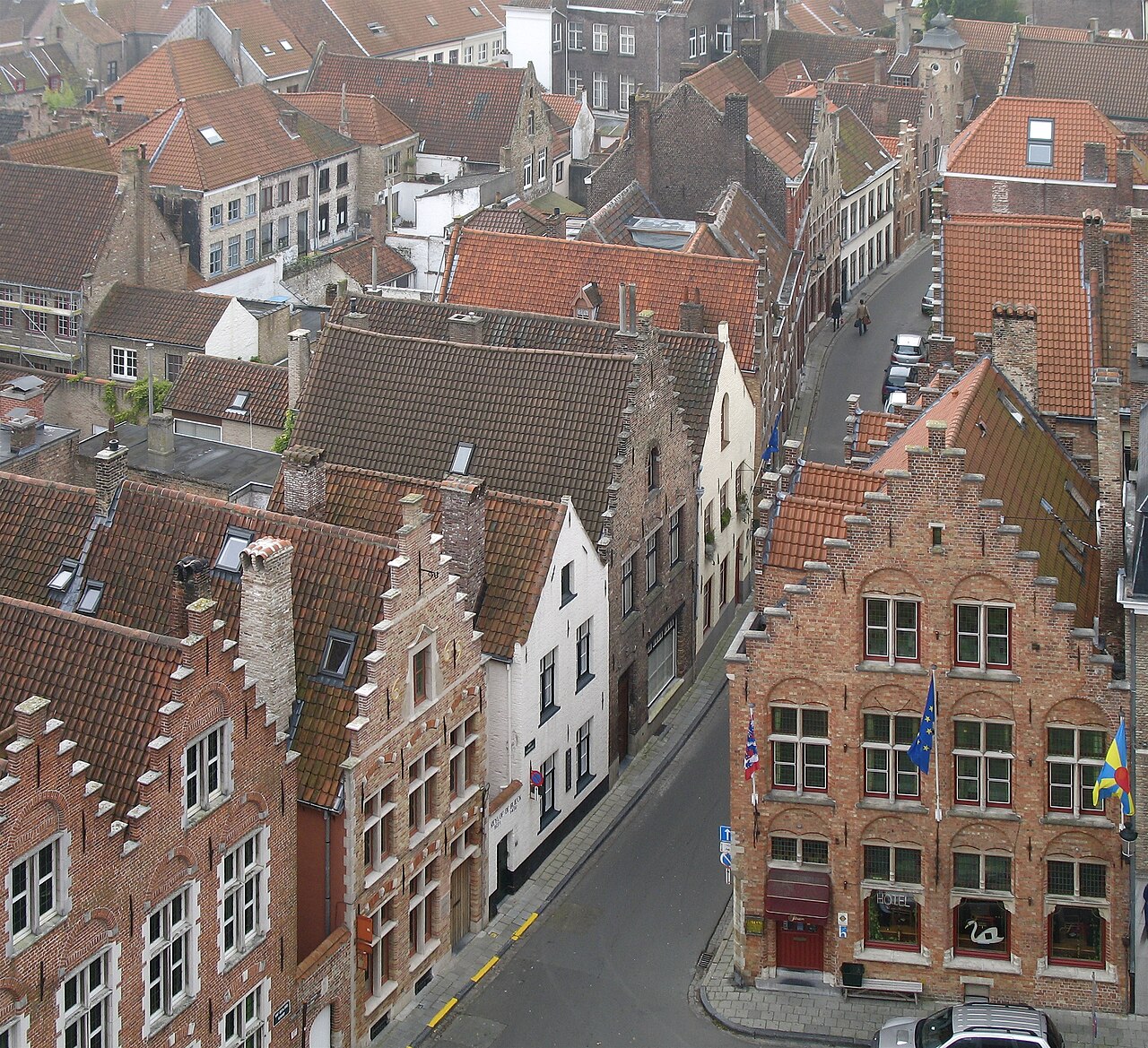
Bruges itself is a UNESCO World Heritage property — the Historic Centre of Brugge, inscribed under criteria (ii), (iv) and (vi) with a listing date of 30 November 2000. UNESCO describes it as an outstanding example of a medieval historic settlement that kept its urban fabric intact as it changed, and cites its brick Gothic architecture and its role as the birthplace of the Flemish Primitives, the school of Jan van Eyck and Hans Memling. The city is also part of the transnational Belfries of Belgium and France property, which is why its single most visited monument is a bell tower.
The easily missed detail
The Belfry is not a weather-proof visit. Musea Brugge states plainly that the tower may close during gusts or stormy weather for safety reasons, and that affected ticket holders are issued a voucher for a new ticket rather than refused outright. Entry is by booked time slot, the number of visitors admitted per hour is capped, and you are expected to arrive on time. The tower also closes for the afternoon on Ascension Day. In a country with Belgium's wind record, choosing a month with fewer storm days is choosing a month in which the tower is more likely to be open at all.
A practical rhythm
- Morning — Book the Belfry slot early in the day, when a voucher for a weather closure still leaves you time to use it.
- Midday — The medieval street fabric UNESCO inscribed is the attraction at ground level, and it needs no ticket.
- Late afternoon — The brick Gothic facades face in every direction in a city this dense, so there is always a lit side and a shaded one.
What could complicate the plan
US and other visa-exempt travelers get 90 days in any 180-day period across the Schengen Area, and days spent in other Schengen countries in the previous 180 count against the same total; overstaying can bring a ban of up to three years. The UK Foreign Office notes two rules that catch people out — the passport must have been issued less than ten years before arrival, and its expiry must fall at least three months after you leave the Schengen area. Belgium also requires you to carry your passport at all times. Under the Entry/Exit System, biometric registration is free, children aged 11 or under are photographed but not fingerprinted, and the digital record lasts three years.
What to do next
The question in this chapter on Belgium beyond the obvious highlights covers the other fifteen World Heritage properties the country holds.
Sources
- Royal Meteorological Institute of Belgium (IRM/KMI) — 1991–2020 normals against 1961–1990 at Uccle
- UNESCO World Heritage Centre, Historic Centre of Brugge — criteria, listing date, official description
- Musea Brugge, Belfort practical information — time slots, hourly limit, storm closures and vouchers, 24 and 31 December hours, Ascension Day
- UK Foreign, Commonwealth and Development Office, Belgium entry requirements — Schengen 90-in-180, passport issue and expiry rules, EES registration, carrying ID