Bhutan country guide Places and experiences
What should a first-time traveler see in Bhutan beyond the obvious highlights?
The short answer
The dzongs and the national parks that Bhutan itself has nominated — the country has 0 properties inscribed on the UNESCO World Heritage List and 8 on its Tentative List, each entered in 2012, and that list is effectively the government's own ranking of what matters.
The answer, with local context
UNESCO's Bhutan page names all 8: the Ancient Ruin of Drukgyel Dzong; "Dzongs: the center of temporal and religious authorities," a grouped nomination covering Punakha Dzong, Wangdue Phodrang Dzong, Paro Dzong, Trongsa Dzong and Dagana Dzong; Sacred Sites associated with Phajo Drugom Zhigpo and his descendants; Tamzhing Monastery; Royal Manas National Park; Jigme Dorji National Park; Bumdeling Wildlife Sanctuary; and Sakteng Wildlife Sanctuary. Four of the eight are protected natural areas, which is unusual for a Himalayan cultural destination and tells you where to spend a second week.
Jigme Dorji National Park is the largest of them. Protected Planet, the UNEP-WCMC database, gives its reported area as 4,374.06 km², about 1,689 square miles, in a country where the whole protected network amounts to 23 protected areas plus 11 other effective area-based conservation measures. Of those 23, 10 carry a management effectiveness evaluation — a figure worth knowing because it distinguishes the parks with documented management from those that are lines on a map.
Living culture is the other reason to go east. UNESCO's description of the Drametse mask dance records that the dance has been performed at the same monastery for centuries, that it is believed to have originated with celestial heroes and heroines, and that versions spread to other parts of Bhutan in the 19th century. The dance alternates a calm, contemplative section representing peaceful deities with a fast, athletic section portraying wrathful ones. Drametse is in eastern Bhutan, which almost no first trip reaches.
Picture the place
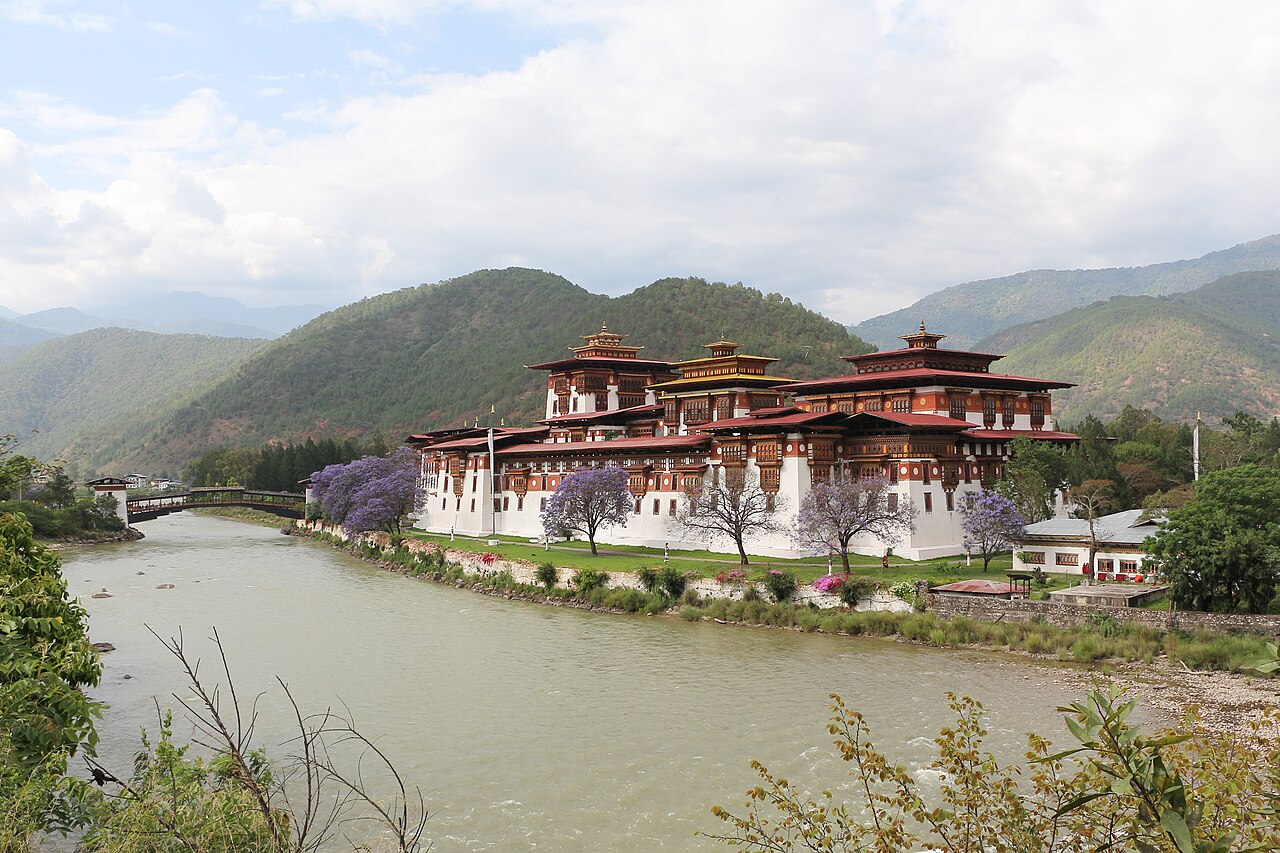
A Bhutanese dzong is fortress and monastery and district office at once, built as a whitewashed mass above a river confluence with timber galleries under a wide overhanging roof — which is why the grouped nomination describes them as centres of temporal and religious authority rather than as castles or as temples.
The easily missed detail
The grouped dzong nomination names 5 specific dzongs — Punakha, Wangdue Phodrang, Paro, Trongsa and Dagana — and Trongsa and Dagana sit well beyond the standard Paro-Thimphu-Punakha loop. Building an itinerary around the nominated 5 rather than the convenient 3 is the single clearest way to get past the version of Bhutan that everyone sees, and it uses Bhutan's own stated priorities to do it.
A practical rhythm
- West — Paro and Punakha dzongs, plus the Ancient Ruin of Drukgyel Dzong, which the Tentative List treats as a site in its own right.
- Centre — Trongsa Dzong and Tamzhing Monastery, a long drive that most itineraries cut.
- Wild country — Jigme Dorji National Park's 4,374.06 km², or Royal Manas in the south, both nominated in 2012 and both needing days rather than hours.
What could complicate the plan
Distance and rules. Bhutan's road network is slow and the FCDO notes that mountaineering is banned while trekking is available across the country at a wide range of altitudes, with advice to be taken from your tour guide — so high-country plans have a hard ceiling. The same guidance requires guides at places of interest. And because none of these 8 sites is inscribed, none has a World Heritage management plan setting out visitor access; what you can see is decided locally.
What to do next
Read the Bhutan food and drink question in this guide for what you will be eating on these long drives, and the when-to-visit question for the seasons that keep the roads open.
Sources
- UNESCO World Heritage Centre, Bhutan — 0 inscribed properties, 8 Tentative List sites all entered in 2012, and their full names including the 5 dzongs in the grouped nomination
- Protected Planet, UNEP-WCMC — 23 protected areas, 11 OECMs, 10 management effectiveness evaluations, Jigme Dorji National Park reported area of 4,374.06 km²
- UNESCO Intangible Cultural Heritage, Mask dance of the drums from Drametse — centuries of performance at one monastery, 19th-century spread, the two contrasting sections of the dance
- UK Foreign, Commonwealth and Development Office, Bhutan travel advice — mountaineering ban, trekking availability, guide requirement