Bhutan country guide When to visit
When is the best time to visit Bhutan for Paro Taktsang?
The short answer
March to May or late September to November — Bhutan charges adults a Sustainable Development Fee of US$100 per day, so every day lost to monsoon cloud or a landslide-closed road has a published price attached to it.
The answer, with local context
Bhutan's Department of Tourism sets the SDF at US$100 per day per adult, with concessionary rates for children, on top of a one-off, non-refundable visa application fee of US$40. That daily charge is what makes Bhutan's seasons matter more than in most countries: a clouded-out week is not just a disappointment, it is a bill.
The monsoon is the thing to avoid, and the UK Foreign, Commonwealth and Development Office states the consequence plainly in its Bhutan travel advice, updated on 10 December 2025: monsoon rains can cause landslides that cut off some roads for days. The same page notes there are no traffic lights anywhere in Bhutan and that road conditions can be dangerous, especially during the monsoon, with car and motorbike accidents among the biggest causes of injury and death. A summer trip risks losing the drive between Paro and Thimphu, which is the spine of almost every itinerary.
The autumn and spring windows also line up with Bhutan's festival calendar. UNESCO inscribed the Mask dance of the drums from Drametse on the Representative List in 2008, at the Committee's 3rd session, and its description records that the Drametse festival is held twice a year, organized by Ogyen Tegchok Namdroel Choeling Monastery and honouring the Buddhist guru Padmasambhava. The performance brings 16 masked male dancers together with 10 musicians playing cymbals, trumpets and drums.
Picture the place
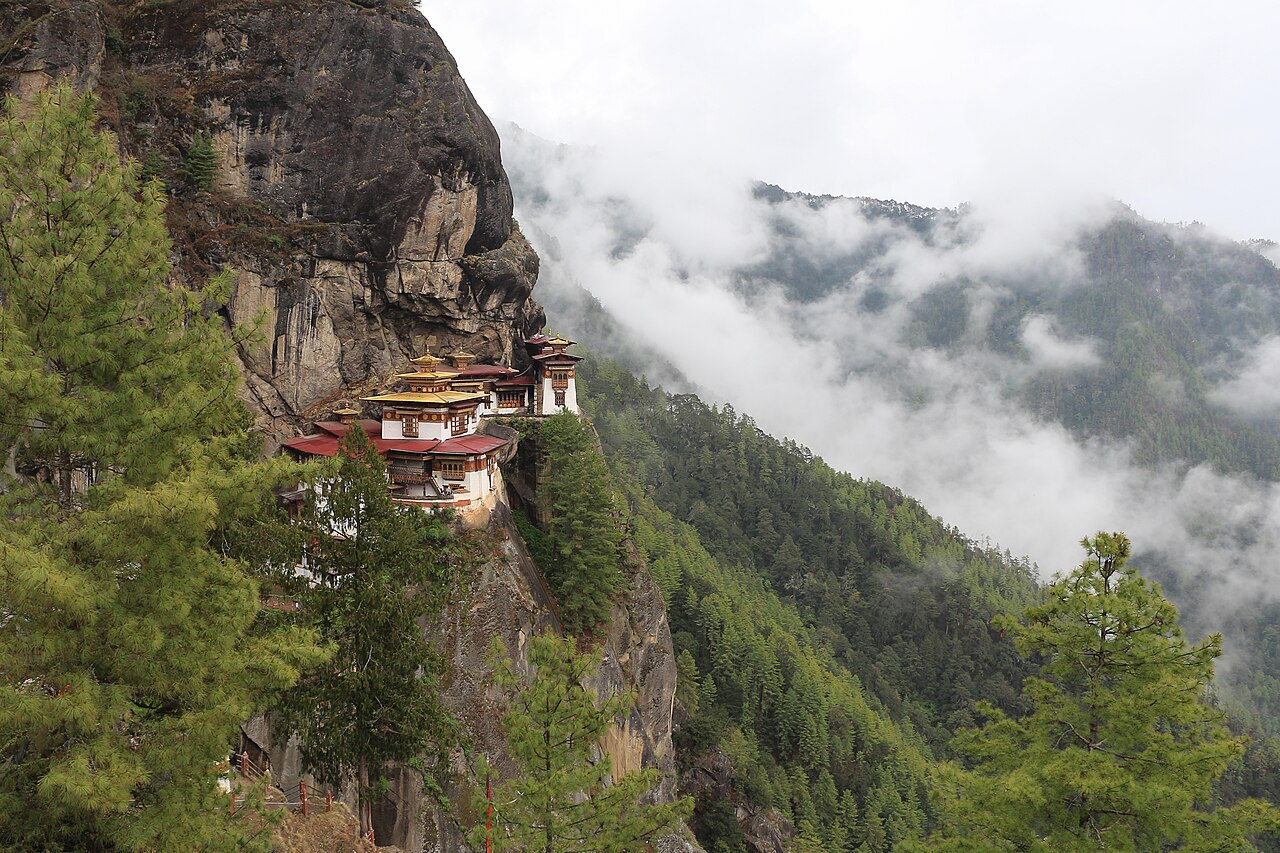
Taktsang is approached on foot up a forested slope, and the FCDO's warning about monsoon-season surfaces applies to the trail as much as the road — wet pine needles on a steep gradient are the practical difference between the spring and summer versions of the same walk.
The easily missed detail
Taktsang is not a World Heritage site, and it is not even on Bhutan's waiting list. UNESCO's Bhutan page shows 8 sites on the country's Tentative List, and the Paro entry among them is Paro Dzong, as part of a grouped nomination of the country's dzongs — not the cliff monastery above the valley. Nothing about that diminishes Taktsang, but it does mean there is no inscription document setting out its hours, access or protection; the rules you encounter are monastic and operational, relayed through the guide you are required to travel with.
A practical rhythm
- Early start — Walk up before the day's cloud builds; Bhutan's road and trail conditions are at their best in the first hours.
- Midday — The monastery buildings themselves, where photography and dress rules are set locally and the guide is the authority.
- Descent and drive — Be off the road before dark; the FCDO advises avoiding night travel where possible, and there are no traffic lights to help.
What could complicate the plan
Three things, all of them documented. The SDF of US$100 per adult per day runs for every night of the trip, so weather delays cost money. Monsoon landslides can close roads for days at a stretch. And the FCDO states that you must use tour guides at places of interest or you may be refused entry — so independent timing at Taktsang is not an option.
What to do next
For the rest of the country, see the question in this guide on what a first-time traveler should see in Bhutan beyond the obvious highlights; for visas, permits and health rules, see the Bhutan trip-planning question.
Sources
- Department of Tourism, Royal Government of Bhutan — Sustainable Development Fee of US$100 per day per adult, children's concessionary rates, US$40 non-refundable visa application fee
- UK Foreign, Commonwealth and Development Office, Bhutan travel advice — page update date, monsoon landslides closing roads, absence of traffic lights, road accident risk, night travel advice, mandatory guides at places of interest
- UNESCO Intangible Cultural Heritage, Mask dance of the drums from Drametse — 2008 inscription at the 3rd session, twice-yearly festival, organizing monastery, 16 dancers and 10 musicians
- UNESCO World Heritage Centre, Bhutan — the 8 Tentative List sites, including Paro Dzong within the grouped dzong nomination