Bolivia country guide Places and experiences
What should a first-time traveler see in Bolivia beyond the obvious highlights?
The short answer
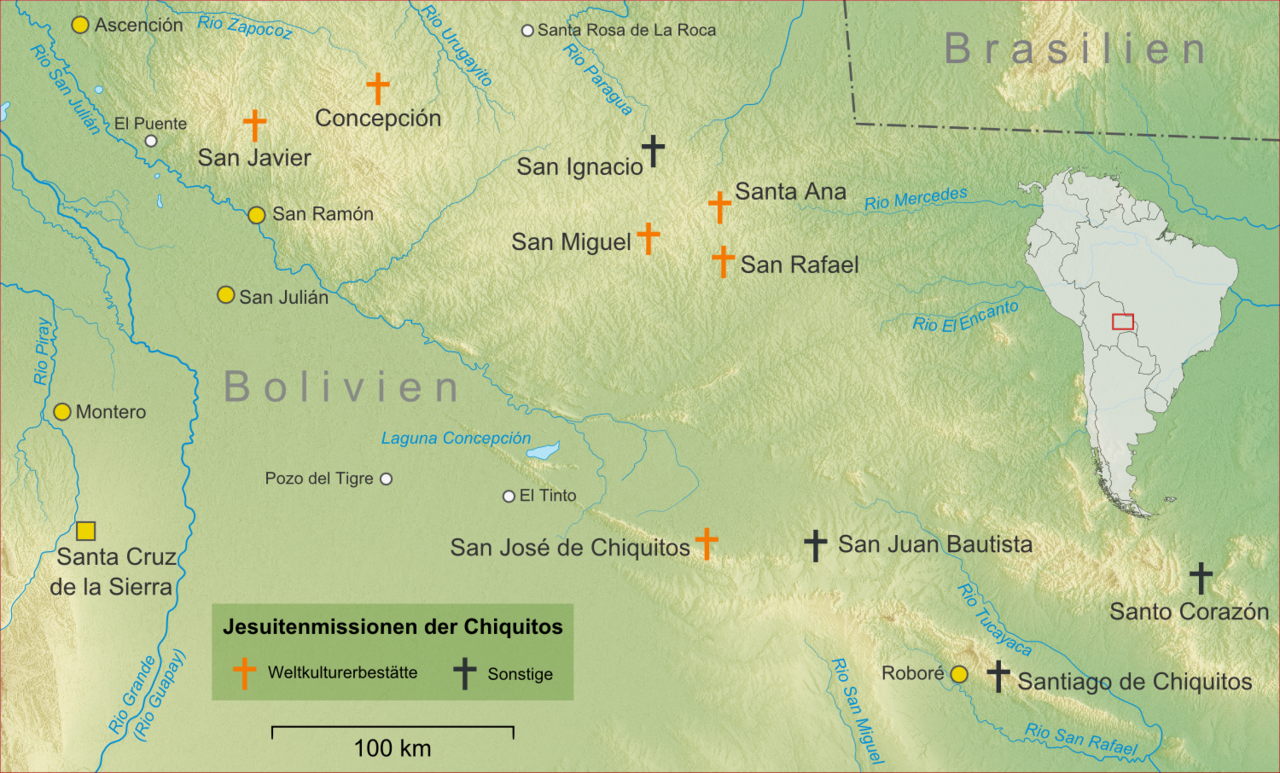
Bolivia carries 7 inscribed World Heritage properties and 5 Tentative List sites, and the least-visited of the seven — the Jesuit Missions of the Chiquitos and Noel Kempff Mercado National Park — sit in the eastern lowlands rather than on the Altiplano.
The answer, with local context
The seven span almost the whole country and almost every category of thing worth traveling for. UNESCO's record for Bolivia names the City of Potosí, the Historic City of Sucre, the Jesuit Missions of the Chiquitos, Noel Kempff Mercado National Park, Tiwanaku as the spiritual and political center of the Tiwanaku culture, and the Qhapaq Ñan Andean road system. Two of them — the Chiquitos missions and Noel Kempff Mercado — lie east of the Andes, which is where almost no short Bolivia itinerary goes.
That east-west split is the real structure of a Bolivian trip. The Altiplano holds the salt flat, La Paz and Tiwanaku; the lowlands hold the mission circuit, the Amazon headwaters and Santa Cruz, which FAO identifies as the department where most of Bolivia's sorghum is grown. Moving between them is a descent of thousands of feet and a change of climate zone, not a regional hop.
The far southwest is the third Bolivia, and it is a wetland on paper. The Ramsar site at Los Lípez protects a complex of high-Andean endorheic saline, hypersaline and brackish lakes, along with bofedales and geothermal wetlands; Laguna Colorada was the original name of the site and remains its best-known water body. Bolivia accepted the World Heritage Convention on 4 October 1976, so the designation framework behind all of this has been in place for half a century.
Picture the place
Los Lípez is wetland in a form most visitors have no template for: shallow salt and soda lakes sitting at 4,200 m and above, fed by springs and geothermal seeps rather than rivers, in a landscape with no outlet to the sea.
The easily missed detail
The Tentative List is where Bolivia's next designations are queued, and 5 sites sit on it. The list is the closest thing to a public statement of what a country considers its own undervalued heritage, which makes it a better guide to the unobvious than any ranking — and a reason to read UNESCO's Bolivia page before fixing a route.
A practical rhythm
- Altiplano leg — Potosí, Sucre and Tiwanaku are all inscribed properties and all reachable on the high plateau.
- Lowland leg — The Chiquitos mission circuit and Noel Kempff Mercado, both east of the Andes and both requiring their own travel days.
- Southwest leg — The Los Lípez lagoons, continuing south from Uyuni rather than returning the way you came.
What could complicate the plan
The State Department's Bolivia information flags the Yungas region around Coroico and Caranavi for carjackings and robberies by organized criminal groups, and advises contacting the US Embassy before traveling there — relevant because the Yungas road is the standard route from La Paz down toward the lowlands. The Chapare region is marked "Do Not Travel" for high violent crime. Demonstrations, strikes and roadblocks can occur at any time and can turn violent, which in a country this large and this mountainous can strand an itinerary rather than merely delay it. Neither lowland World Heritage property is a day trip from anywhere a visitor is likely to be staying.
What to do next
The seasonal question in this chapter covers the acclimatization timeline for the Altiplano, and the food question covers what the different regions actually grow.
Sources
- UNESCO World Heritage Centre, Bolivia (Plurinational State of) — 7 inscribed properties, 5 Tentative List sites, named properties, Convention acceptance on 4 October 1976
- Ramsar Sites Information Service, Los Lípez — wetland types, Laguna Colorada, high-Andean saline lake complex
- US Department of State, Bolivia country information — Yungas and Chapare warnings, unrest and roadblocks
- FAO GIEWS, Bolivia country brief — Santa Cruz as the main sorghum department