Bologna / Italy Things to do
What are the most worthwhile things to do in Bologna on a first visit?
The short answer
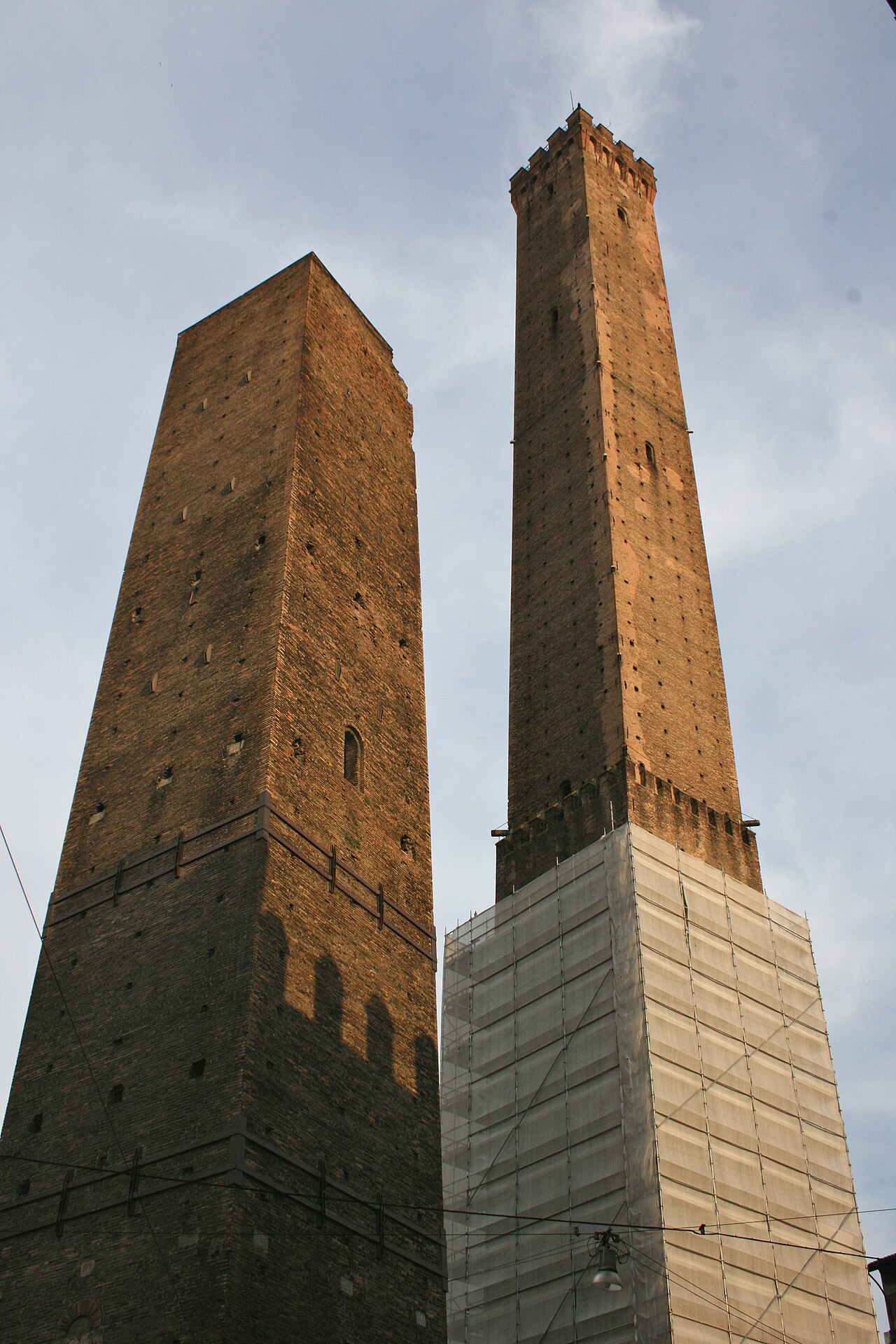
Walk Piazza Maggiore into San Petronio, read the city from the Quadrilatero's food lanes, climb the portico to San Luca — and see the Two Towers from the street, because both are closed while the leaning Garisenda is rescued.
The answer, with local context
Start where the city starts: Piazza Maggiore. The Basilica di San Petronio, begun in 1390 and never finished — its facade still half marble, half brick — is one of the largest churches in the world built in brick, and inside runs the longest indoor meridian line in existence: 219 feet (66.8 m) of brass set into the floor by the astronomer Giovanni Domenico Cassini in 1655, turning the basilica into a solar observatory. The piazza's other furniture is the city's biography in one square: Giambologna's Neptune Fountain (1566), the Palazzo d'Accursio town hall, and the Palazzo del Podestà. When the towers are closed (see below), Bologna Welcome's recommended panorama is here: the Torre dell'Orologio clock tower inside Palazzo d'Accursio, whose terrace reads the whole red-tiled city. Around the corner, the Archiginnasio (1563), the university's historic seat, hides the Anatomical Theatre of 1637, a cedar-and-spruce dissection hall rebuilt after wartime bombing.
The Two Towers demand honesty in 2026. The Asinelli — 319 feet (97.2 m), built 1109–1119, 498 steps, Bologna's emblem — has been closed to climbers since October 23, 2023, and the piazza at their base is fenced: sensors had detected dangerous movement in its neighbor, the shorter Garisenda, which leans some 4 degrees (Dante used it as a simile in the Inferno) and is now the object of a multi-year stabilization using the pylon-and-cable technique that saved Pisa's tower, run with the engineers who salvaged the Costa Concordia. There is no confirmed reopening date; estimates run toward 2028. Viewed from Via Rizzoli, the pair still stops traffic — Bologna once bristled with perhaps 100 such family towers, and these are the survivors. Plan the panorama from the Clock Tower and San Luca instead.
The rest of the first visit is a weave of the city's other selves. The Complesso di Santo Stefano — the "Seven Churches," a labyrinth of Romanesque chapels, cloisters and a replica Holy Sepulchre accumulated over a thousand years — is the centro's most atmospheric hour. The university quarter along Via Zamboni adds the Pinacoteca Nazionale (Raphael, Guido Reni, the Carracci — the family that founded a painting academy here in 1582) and the Jewish ghetto's lanes. And the walk that binds it together: from Porta Saragozza, take the Portico di San Luca — 666 arches over 2.4 miles (3.8 km), the world's longest portico, built 1674–1793 to shelter the Madonna's procession — up to the sanctuary above the city, under an arcade that a 1288 city statute's logic made possible: Bologna required porticoes tall enough for a man on horseback to pass without doffing his hat.
Picture the place
Inside San Petronio at noon on a clear day, a coin of sunlight travels down from the gnomon hole high in the vault and crosses Cassini's brass meridian on the floor — the church as an instrument, still keeping solar time after 370 years.
The easily missed detail
Bologna is a canal city in disguise. Medieval Bologna ran on water — silk mills, locks, a port — and fragments survive under the centro: the little window on Via Piella (the "finestrella") opens onto the Canale delle Moline, a sudden Venetian glimpse between the houses, and the Reno canal still runs beneath the streets you are walking. Most first-timers never learn the red city has water in its veins.
A practical rhythm
- Piazza Maggiore first — San Petronio at opening, the meridian near noon, and the Clock Tower terrace for the panorama the Asinelli cannot currently give
- San Luca as the day's spine — Climb the portico in the morning cool and descend for lunch in the Quadrilatero
- Santo Stefano at dusk — The Seven Churches complex is at its quietest and strangest in the last hour of light
What could complicate the plan
Tower status is the moving part: the Garisenda works may last to 2028, the Asinelli's reopening is unconfirmed, and any guide printed before late 2023 that sells you the climb is out of date — check Bologna Welcome before the trip. San Petronio's panoramic terrace is permanently closed as well. The Archiginnasio and Pinacoteca keep museum hours with Monday closures, and the Quadrilatero's famous food shops largely close on Sundays.
What to do next
Do the piazza and Clock Tower on day one, the San Luca portico on day two, and let Santo Stefano and the university quarter fill the hours between meals.
Sources
- Comune di Bologna / Bologna Welcome — the Two Towers: Asinelli closed since October 23, 2023 during the Garisenda stabilization; the area fenced; the Torre dell'Orologio as the recommended panorama
- UNESCO World Heritage Centre — The Porticoes of Bologna (2021), including the Portico di San Luca: 3,796 m and 666 arches, built 1674–1793
- Basilica di San Petronio — begun 1390; Cassini's 1655 meridian line, at 66.8 m the longest in the world
- Archiginnasio di Bologna — the 1563 university palace and its 1637 Anatomical Theatre