Bruges / Belgium Things to do
What are the most worthwhile things to do in Bruges on a first visit?
The short answer
Climb the Belfry's 366 steps, take the 30-minute canal boat from Rozenhoedkaai, stand before Michelangelo's Madonna in the Church of Our Lady, and end inside the Beguinage at dusk — the essential Bruges is compact enough for one long, well-ordered day.
The answer, with local context
The Belfry is the city's thesis statement: 272 feet (83 m) of 13th-century civic pride over the Markt, climbed in 366 narrowing steps past the treasury where the city's charters and seals slept behind iron doors, and past the carillon drum to the 47 bells themselves. From the top, Bruges's whole story flattens into a map: the canals that made it rich, the rampart ring that replaced its walls, the polders running flat to the sea that silted up and ended the golden age. Go at opening — the stair admits a limited number at a time and the queue is the city's most predictable one. Afterwards, cross the square to the Burg, the older power center: the Gothic town hall (1376 onward) and the Basilica of the Holy Blood, where the relic is presented for veneration on Friday mornings and the lower chapel is a pure, dark Romanesque survival from the 12th century.
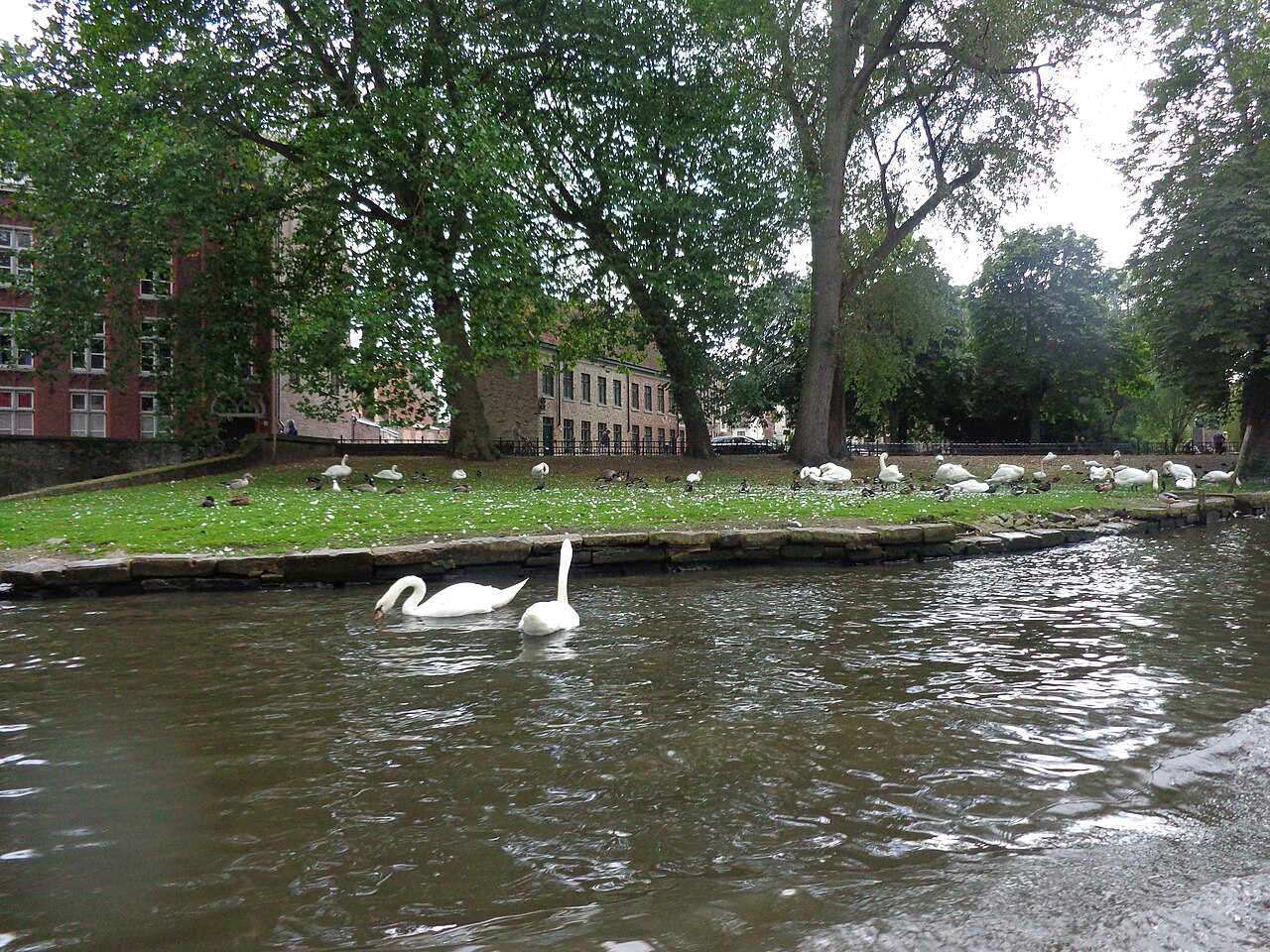
Water is the second element. The canal boat tours — half an hour, leaving from several jetties, the classic from the Rozenhoedkaai — pass under brick bridges too low for standing, along the Groenerei (the locals' vote for the prettiest canal), past the swan colonies of the Dijver and into corners no street reaches. Then walk those same canals at ground level: south from the center along the Dijver to the Church of Our Lady, whose brick spire (379 feet / 115.6 m, among the tallest brick towers anywhere) guards the city's supreme treasure, Michelangelo's Madonna and Child of 1504 — carved in Carrara, bought by Bruges merchants, and the only one of his sculptures to leave Italy during his lifetime. The art continues in the Groeningemuseum — Jan van Eyck's Madonna with Canon van der Paele (1436) and the Flemish Primitives — and in the Sint-Janshospitaal, a working hospital from the 12th century to 1978 that now holds Hans Memling's jewel-box panels.
Finish in the city's quiet south. The Begijnhof Ten Wijngaerde, founded in 1245 by Margaret of Constantinople, is a whitewashed village around a poplar-and-daffodil green behind a single gate: once home to beguines, the lay religious women of Flanders (their béguinages are UNESCO-listed), now kept by Benedictine sisters and silence — visitors are asked to keep it. The adjacent Minnewater, the "Lake of Love," was the old port basin; the rampart walk beyond carries four windmills, of which the Sint-Janshuismolen (1770) still grinds grain and opens to visitors in season.
Picture the place
From the Rozenhoedkaai the whole of Bruges arranges itself for one photograph: step-gabled houses in ochre and brick, a boat sliding under the bridge, swans inspecting the reflection, and the Belfry standing over all of it like an exclamation point.
The easily missed detail
The swans are a punishment. By the city's own legend, Bruges executed Pieter Lanchals — a councilor of the unpopular Maximilian of Austria — in 1488, and because Lanchals means "long neck," the city was condemned to keep swans ("long necks") on its canals forever at its own expense. Whether or not the emperor issued the decree, the city has maintained the birds ever since: the swans you photograph are municipal employees of five centuries' standing.
A practical rhythm
- Belfry at 9:30 — Be at the door for the first entries; do the Markt and Burg before the squares fill at midday
- Boat before lunch — The late-morning sailing beats the afternoon queues, and the Groenerei is at its greenest before noon
- Beguinage at closing light — Walk south in the late afternoon, when the day crowds have thinned and the courtyard turns to birdsong
What could complicate the plan
The Belfry stair is genuinely tight — one-way medieval stone, no lift, and numbers capped — so claustrophobic or mobility-limited visitors should take the courtyard carillon concerts instead. Canal boats do not run in winter (roughly mid-November to March) and suspend in storm weather. The Church of Our Lady's museum section closes for services, and the Madonna sits behind timed entry on busy days; the Beguinage gate closes in the evening and silence is enforced.
What to do next
Buy Belfry tickets for the first slot of day one, walk the Burg churches before 11, and save the Beguinage for the end of the day — leave chocolate and beer for the evening's second act.
Sources
- Visit Bruges — the Belfry (83 m, 366 steps, 47 bells), the Church of Our Lady's brick spire (115.6 m), and the canal boat tours
- UNESCO World Heritage Centre — the Historic Centre of Bruges (2000) and the Flemish Béguinages (1998), including Ten Wijngaerde, founded 1245
- Musea Brugge — the Groeningemuseum's Flemish Primitives (van Eyck's Canon van der Paele Madonna, 1436) and Memling's works in the Sint-Janshospitaal; Michelangelo's Madonna and Child (1504)
- City of Bruges — the Sint-Janshuismolen windmill (1770) on the eastern ramparts, still grinding