Colonia del Sacramento / Uruguay Things to do
What are the most worthwhile things to do in Colonia del Sacramento on a first visit?
The short answer
Walk the walled quarter itself, slowly and without a route — the inscribed area has no single monument and no main entrance, because UNESCO listed the whole 17th-to-19th-century walled town as one property under criterion (iv).
The answer, with local context
Most World Heritage towns reward a checklist. Colonia resists one, and understanding why changes the visit. The street plan was laid out by the Portuguese after they founded the settlement in 1680, and it deliberately departs from the grid that Spain required under the Laws of the Indies. UNESCO describes it as free-form, shaped by the terrain and by the town's role as a fortified position, mixing wide avenues and squares with narrow cobbled streets and more private, enclosed spaces. The practical consequence is that turning a corner changes the scale of everything around you within a few steps.
The building stock is the second half of the point. The quarter is composed overwhelmingly of modest single-storey houses, with 2 floors a rarity, built with long stone walls, wooden trellises and tiled roofs. UNESCO's assessment is that these blend Portuguese and Spanish construction methods — the town changed hands repeatedly, and the fabric records it rather than illustrating one tradition. That is what criterion (iv) recognizes: the quarter as remarkable testimony to the nature and objectives of late-17th-century European colonial settlement.
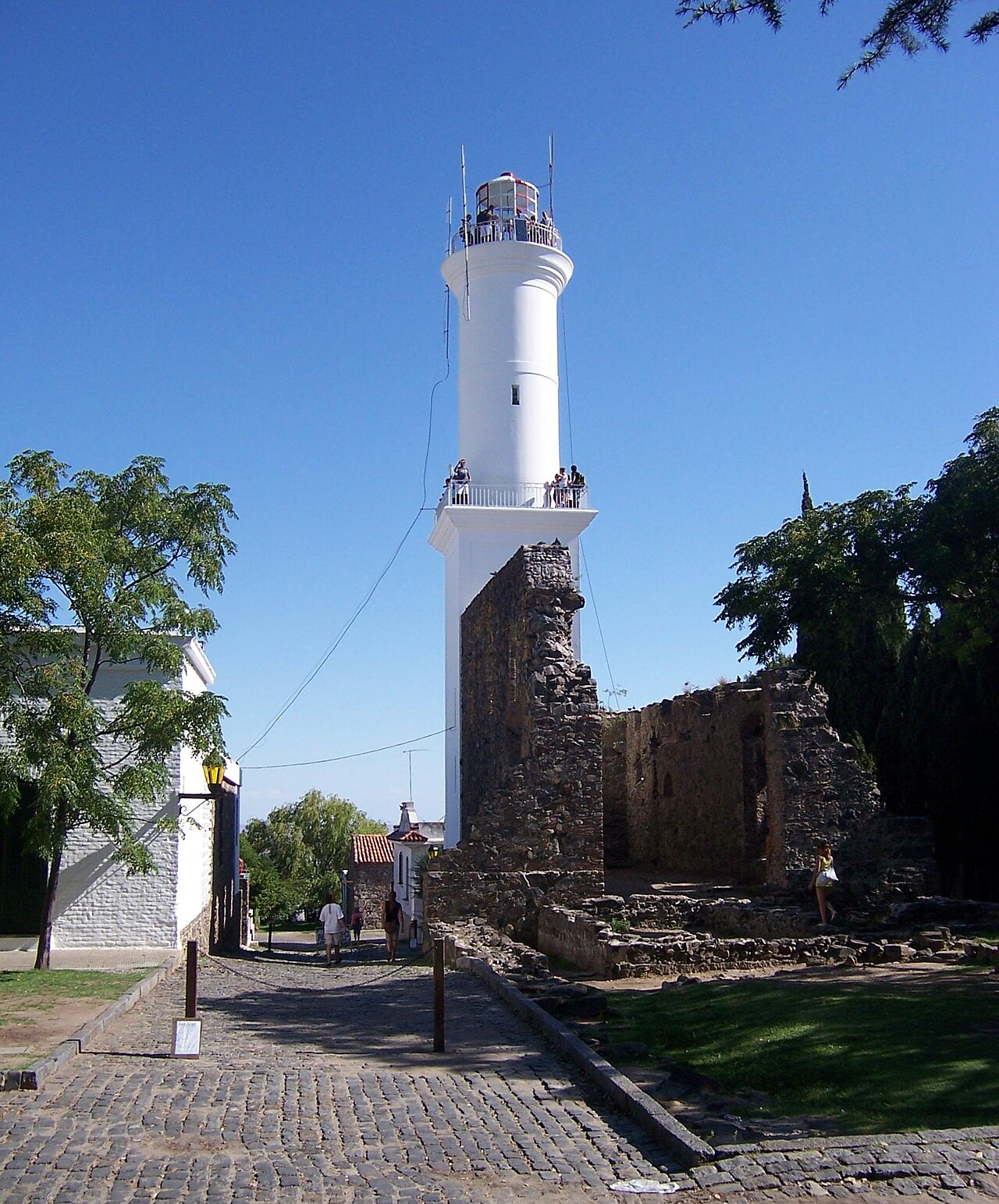
The bay is the third element, and the one visitors most often treat as scenery rather than substance. Seen from the water, the historic quarter reads as an almost unbroken low horizontal, interrupted only by the lighthouse and the church towers. A property boundary that follows the old walls, with a buffer zone covering the modern city center, means the contrast between the two is sharp and legible on foot.
Picture the place
The quarter occupies a low peninsula pushing into the Río de la Plata, facing Buenos Aires across the estuary. The cobbles are uneven, the lanes are short, and because so little is more than one storey high the river light reaches almost everywhere in it — which is also why the lighthouse dominates every view from the bay side.
The easily missed detail
UNESCO has recommended considering a future extension of the property to take in the Bay and Islands of Colonia del Sacramento — meaning the water in front of the town is understood as part of the heritage, not a backdrop to it. The same reporting records that an inventory of the quarter was begun in 2005 and expected to conclude in 2014, and that the property boundaries were clarified for presentation to the World Heritage Committee at its 38th session. It also notes that a proposed marina and hotel-casino in a block at the old harbor was judged inappropriate in architectural and urban design terms. The old harbor is therefore worth seeing precisely as a contested edge rather than a finished attraction.
A practical rhythm
- Inside the walls — Give the lanes more time than their length suggests; the free-form plan means distance is a poor guide to how much there is to see.
- The old harbor — Look at the waterfront block where the marina and hotel-casino scheme was proposed, and at how abruptly the inscribed area ends.
- The buffer zone — Walk out into the modern center; the boundary between a 17th-century military plan and a 20th-century town is one of the clearest in the region.
What could complicate the plan
There is no central ticket and no coordinating visitor authority, because the property still lacks a comprehensive participatory management plan — UNESCO's reporting notes the State Party established a Technical Office and an Honorary Council to support implementation instead. Individual museums and monuments therefore keep their own hours, which can and do change without notice. The cobbles are genuinely rough and the lanes narrow, so wheeled luggage and limited mobility are both real constraints. Weather is the other limiter: the Colonia station logged 119 days with precipitation in 2024, and a town whose principal attraction is walking it offers little shelter.
What to do next
For timing, the Colonia when-to-visit question in this group gives the station's monthly figures; for eating and drinking, the Colonia food question covers Uruguay's wine sector and the harvest months.
Sources
- UNESCO World Heritage Centre, Historic Quarter of the City of Colonia del Sacramento — criterion (iv), 1680 founding, free-form plan, building typology, skyline and boundary description
- UNESCO World Heritage Centre, state of conservation report, Colonia del Sacramento — management-plan status, Technical Office and Honorary Council, 2005 inventory, marina and hotel-casino concern, proposed Bay and Islands extension
- Instituto Nacional de Estadística, Uruguay, Anuario Estadístico Nacional 2025, table 1.2.4 (data from INUMET) — Colonia station rain-day count for 2024
- UK Foreign, Commonwealth and Development Office, Uruguay travel advice — entry conditions for the visit as a whole