Colonia del Sacramento / Uruguay When to visit
When should I visit Colonia del Sacramento, Uruguay, for the best experience?
The short answer
Mid-October through December, or March into April — the Colonia weather station logged monthly means of 16.4 °C (61.5°F) in October 2023 and 19.6 °C (67.3°F) that November, warm enough for long walks over cobbles without the full heat of a Río de la Plata summer.
The answer, with local context
Uruguay's national statistics office publishes the Colonia station's observed monthly means, supplied by the state meteorological institute. The two most recent years on file show how mild the shoulder seasons are and how sharp the winter dip is. January 2023 averaged 25.0 °C (77.0°F) and March that year 25.6 °C (78.1°F); July 2024 averaged just 9.5 °C (49.1°F), against 12.2 °C (54.0°F) in July 2023. Annual means came in at 18.2 °C (64.8°F) for 2023 and 17.7 °C (63.9°F) for 2024.
Rain is the variable that catches people out, because it is not seasonal here in any dependable way. The station recorded 109 days with precipitation in 2023 and 119 in 2024 — roughly 1 day in 3, spread across every month of both years. Totals diverged wildly: 809.3 mm (31.9 inches) in 2023 against 1,113.2 mm (43.8 inches) in 2024, with March 2024 alone delivering 402.3 mm (15.8 inches). February was the driest month in both years, with 5 rain days each time.
What that means in practice is that Colonia has no reliably dry month to aim for, so the deciding factor becomes temperature and daylight rather than rainfall. The late-spring and early-autumn windows give you warm afternoons, cool evenings and the long light that the low peninsula is built for.
Picture the place
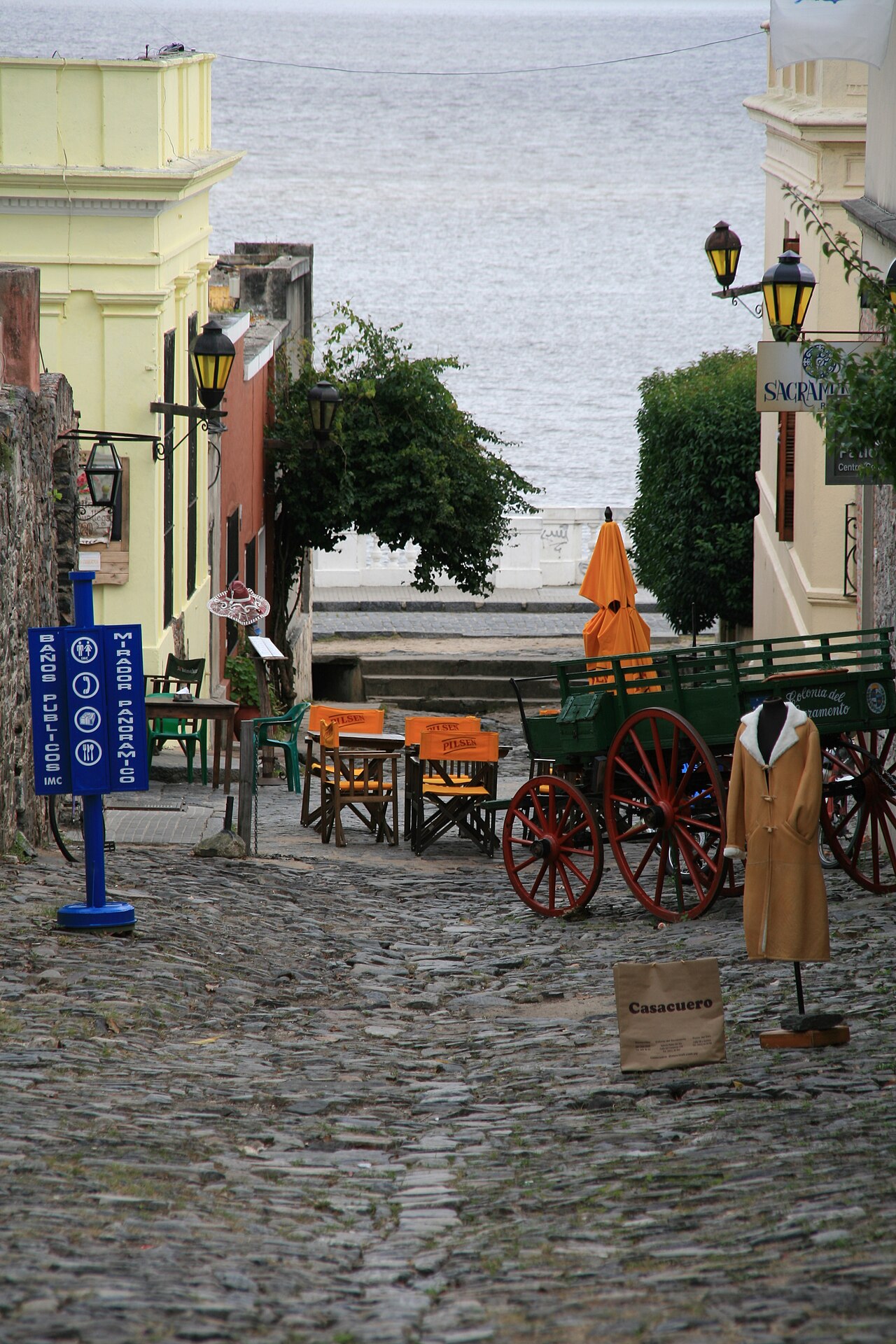
The old town sits on a short peninsula on the north shore of the Río de la Plata, directly across the water from Buenos Aires, and almost nothing in it rises: UNESCO notes that only the lighthouse and the church towers break the skyline when the quarter is seen from the bay. In April the river wind comes in across a town of single-storey houses and tiled roofs with nothing to stop it.
The easily missed detail
The quarter was inscribed on the World Heritage List in 1995 under criterion (iv), by Committee decision 19COM VIIIC.1. The reason matters for how you walk it. The Portuguese founded the town in 1680, and because it was Portuguese rather than Spanish it never received the grid that the Laws of the Indies imposed elsewhere in the region. The plan is free-form, bent to the terrain and to the town's military role, which is why it mixes broad avenues and open squares with narrow cobbled lanes in a few hundred meters. The inscribed area follows the walled city as it stood from the 17th to the 19th centuries.
A practical rhythm
- Morning — Start inside the walled area while the lanes are still shaded; the buildings are mostly single-storey, with two-storey houses rare, so shade is short-lived once the sun climbs.
- Afternoon — Move inland into the buffer zone, which takes in the modern city center, when the old quarter is at its warmest.
- Evening — Return to the bay side. The waterfront is the one place in Colonia where the whole low profile of the historic quarter reads at once.
What could complicate the plan
Entry rules are straightforward but not nothing: the UK Foreign, Commonwealth and Development Office advice, publicly updated on 10 December 2025, states that a passport must be valid for the duration of the stay and carry at least 1 blank page for an entry stamp, with visa-free visits of up to 90 days for British citizens and longer stays handled by Uruguay's Dirección Nacional de Migración. The bigger planning risk is rain, given 109 to 119 wet days a year at this station, and the fact that the quarter is walked rather than toured means a wet day genuinely costs you the site. Colonia also carries no comprehensive participatory management plan — UNESCO's state-of-conservation reporting records a management-plan project approved under USD 30,000 of international assistance in 2009 and a World Heritage Centre mission in November 2011 — so individual buildings open and close without a central schedule.
What to do next
The Colonia things-to-do question in this group covers what the free-form street plan actually puts in front of you, and the Colonia food question deals with Tannat and the February-to-March grape harvest.
Sources
- UNESCO World Heritage Centre, Historic Quarter of the City of Colonia del Sacramento — inscription year, criterion, decision code, 1680 founding, street plan and skyline description
- Instituto Nacional de Estadística, Uruguay, Anuario Estadístico Nacional 2025, tables 1.2.2, 1.2.3 and 1.2.4 (data from INUMET) — Colonia station monthly means, precipitation totals and rain-day counts for 2023 and 2024
- UK Foreign, Commonwealth and Development Office, Uruguay travel advice — passport validity, blank page, 90-day visa-free stay