Dubrovnik / Croatia Things to do
What are the most worthwhile things to do in Dubrovnik on a first visit?
The short answer
Walk the full wall circuit, then go up and go offshore — the Old City of Dubrovnik was inscribed by UNESCO in 1979 under criteria (i), (iii) and (iv), and the walls are the only vantage point from which that inscription makes sense.
The answer, with local context
The 1979 inscription cites criterion (i) for artistic achievement, (iii) as testimony to a cultural tradition and (iv) as an outstanding example of a building type and urban plan. What that means on the ground is that the monument is the whole town — the street grid, the forts, the public buildings and the walls as one object — rather than any single structure. Walking the circuit is therefore not a viewpoint exercise; it is the only way to read the plan.
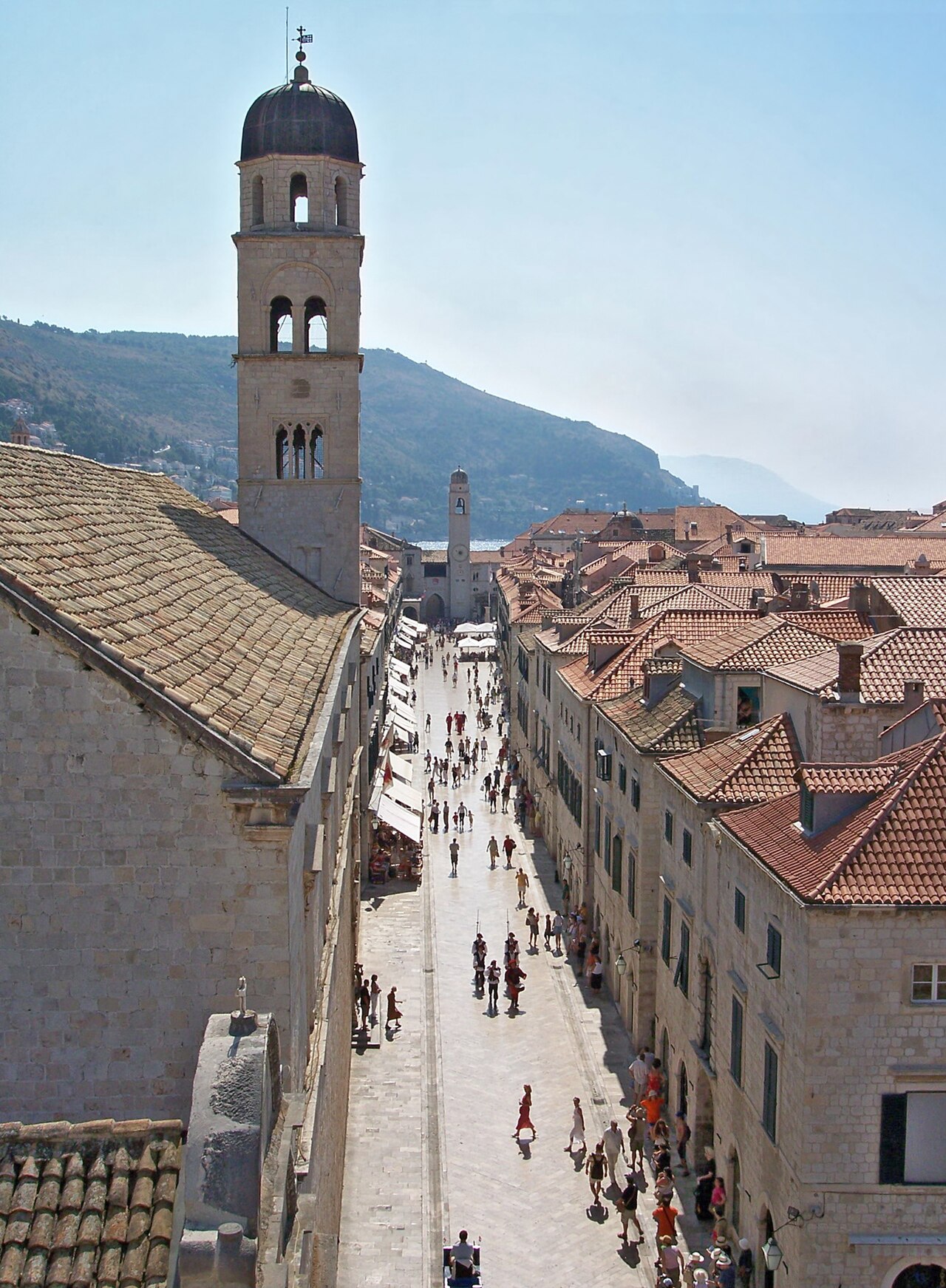
Inside, the Stradun runs the length of the old town as a single broad limestone street, repaved in the fifteenth century after fire and earthquake, with the two gates — Pile at the west end and Ploče at the east — closing it at either end. The Rector's Palace, seat of the Republic of Ragusa's elected head of state, now houses the city's cultural history collection. The Franciscan friars' pharmacy, founded in 1317, is among the oldest continuously operating pharmacies in Europe and still dispenses from the same premises.
Outside the walls, Fort Lovrijenac stands on its own rock west of the city, separated from the walls by a short stretch of sea, which is why the Republic kept it under a separate garrison. Lokrum, the wooded island a short boat ride offshore, is a protected nature reserve managed as such rather than developed, with a Benedictine monastery complex at its center. Mount Srđ behind the town is reached by cable car and gives the plan of the old city from above.
Picture the place
The Stradun's limestone has been walked smooth enough to reflect, so on a bright day the street throws light up into the shaded arcades on either side, and the whole length of it reads as a single polished surface rather than paving stones.
The easily missed detail
The wall circuit is one-way and does not allow re-entry, so you cannot step off for a coffee and resume. That changes how you plan the rest of the day entirely: the circuit has to be treated as a single continuous commitment, taken at whatever hour you can manage it in one go, rather than as something to dip into between other sights. Fort Lovrijenac, being physically separate from the walls, is a separate approach on foot.
A practical rhythm
- The circuit — The full wall walk in one unbroken go, since the route is one-way and re-entry is not permitted.
- Inside the gates — The Stradun between Pile and Ploče, the Rector's Palace collection, and the 1317 Franciscan pharmacy.
- Beyond the walls — Fort Lovrijenac on its rock, the Lokrum reserve by boat, and Srđ by cable car for the overhead view.
What could complicate the plan
The walls are a stepped, uneven and largely unshaded structure, and there is no lift or alternative route — mobility limitations rule out the circuit rather than merely slowing it. The one-way, no-re-entry rule means a badly timed start cannot be fixed partway round. Lokrum depends on boat services that do not run year-round, and the Srđ cable car is a mechanical installation subject to wind and maintenance stoppages, so neither should be the only plan for a given day. The entry side is the least of it: no visa is needed for a tourist stay under 90 days in any 180-day window, the passport has to stay valid 3 months beyond the planned date of departure, and 1 page must be free for the entry stamp.
What to do next
Read the Dubrovnik when-to-visit answer in this group for the seasonal and festival timings that shape all of this, and the Dubrovnik food question for where to eat between the walls and the harbor.
Sources
- UNESCO World Heritage Centre — inscription of the Old City of Dubrovnik in 1979 under criteria (i), (iii) and (iv)
- Public Institution Reserve Lokrum — Lokrum's status as a protected nature reserve and its Benedictine monastery complex
- Dubrovnik Museums, Rector's Palace — the palace as seat of the Republic of Ragusa's rector and its present cultural history collection
- US Department of State, Croatia country information — no visa for tourism or business stays under 90 days in any 180-day period, passport validity of three months after the planned date of departure, one page required for an entry stamp (retrieved 5 November 2026)