Finland country guide Places and experiences
What should a first-time traveler see in Finland beyond the obvious highlights?
The short answer
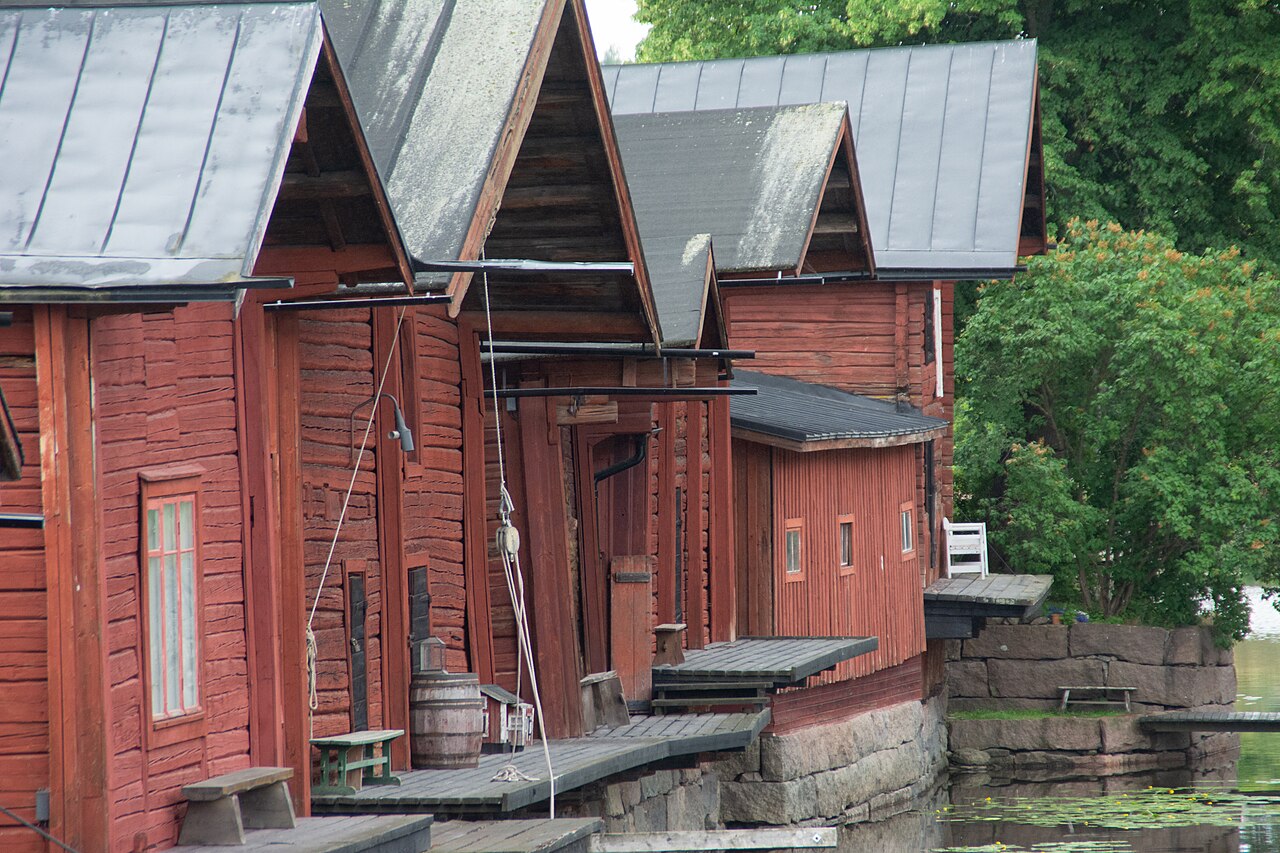
The wooden towns of Rauma and Porvoo, the land-rising Kvarken archipelago, a Bronze Age burial coast, the lake-and-seal country of Saimaa, and Oulu in its Capital of Culture year — Finland's second layer is wooden, watery and quietly strange.
The answer, with local context
Go west first. Old Rauma, UNESCO-listed since 1991, is the largest unified wooden town in the Nordic countries — some 600 wooden buildings and 800 residents inside the grid, still a working town rather than a museum, famous for bobbin lace (its Lace Week runs each July). Up the same coast, the Kvarken Archipelago (UNESCO, 2006, with Sweden's High Coast) shows geology in motion: the land here is still rebounding from the Ice Age at roughly a third of an inch (8–9 mm) a year, the fastest uplift on earth, so new islands surface within living memory and the flattest sea in Finland keeps rearranging itself — cross it on the Svedjehamn trails and the Björkö–Panike hiking route. Inland, the Bronze Age speaks at Sammallahdenmäki (UNESCO, 1999), 36 burial cairns scattered through pine forest near Rauma, and at Petäjävesi Old Church (UNESCO, 1994), a log church of 1763–1765 built by peasant carpenters with a shingled roof and a carved pulpit, standing by its lake in central Finland.
The east is water organized into labyrinths. Lake Saimaa — Finland's largest lake system, its main basin alone 537 square miles (1,393 km²) — holds two national parks (Linnansaari and Kolovesi) built for paddling, and the Saimaa ringed seal, a freshwater subspecies found nowhere else, recovered from near-extinction to roughly 480 animals under Metsähallitus protection; summer boat trips from Rantasalmi and Savonlinna look for them hauled out on the rocks. Savonlinna itself is anchored by Olavinlinna (1475), the world's northernmost medieval stone castle still standing, moated on its own island. North of the lakes, Koli National Park's Ukko-Koli summit (1,138 feet, 347 m) looks over Lake Pielinen in the view that composed Finnish national identity — Sibelius and the painter Pekka Halonen both worked from these fells.
Then take the country's edges. The Åland Islands — autonomous, demilitarised, Swedish-speaking, some 6,700 islands and skerries between Finland and Sweden — run on ferries, apple orchards and maritime museums (the four-masted barque Pommern at Mariehamn). Tampere, the industrial second city, declares itself the sauna capital of the world and backs it with a working textile-mill skyline, the world's only Moomin Museum, and Rajaportti, Finland's oldest public sauna still running (1906). And for 2026 there is a dateline reason to go north before the fells: Oulu, the Gulf of Bothnia technology city, holds the European Capital of Culture title through the year — the once-in-a-generation excuse to ride the train to the top of the bay.
Picture the place
Morning in Old Rauma: a lace-maker's window open to the lane, geraniums on the sill, a cat on a painted gate — six hundred wooden houses and not one of them pretending to be anything but a home.
The easily missed detail
Finland's strangest heritage site is a factory: the Verla groundwood and board mill (UNESCO, 1996), a complete 19th-century mill village in the Kymi valley where the machines, workers' houses and even the mill owner's rock carvings of animals survive intact in the forest. Pair it with the nearby Repovesi National Park — suspension bridge, kettle lakes, and the water-taxi routes of a park rebuilt from military training ground to people's park — and the southeast's industrial-forest story completes the lake story.
A practical rhythm
- West coast arc — Rauma, Sammallahdenmäki and Kvarken over three days, sleeping in wooden-town guesthouses
- Saimaa by paddle — A day canoeing Linnansaari from a Rantasalmi base beats any drive-around for seal country
- One dateline — Oulu's Capital of Culture programme makes 2026 the year the north comes first, not last
What could complicate the plan
The west coast and archipelagos are summer systems: ferries thin out, mill and church sites shorten hours, and Åland's services contract sharply outside June–August. Saimaa's seals are protected — approach distances are enforced and sightings are never guaranteed; the honest frame is a lake day with a chance, not a safari. Oulu's culture-year weekends book the city's hotels solid around headline events.
What to do next
Draw the second-layer map: Porvoo → Verla/Repovesi → Saimaa → Koli → west to Petäjävesi → Rauma and Kvarken → Åland by ferry, and let Oulu cap it in 2026.
Sources
- UNESCO World Heritage Centre — Old Rauma (1991), the Fortress of Suomenlinna (1991), Petäjävesi Old Church (1994), the Verla mill (1996), Sammallahdenmäki (1999), the High Coast/Kvarken Archipelago (2006)
- Metsähallitus (Parks & Wildlife Finland) — the 41 national parks, Linnansaari and Kolovesi, and the Saimaa ringed seal (roughly 480 individuals)
- Natural Resources Institute Finland (Luke) / Ministry of Agriculture and Forestry — forest covering about 75% of the land; the Kvarken uplift of about 8–9 mm a year
- Oulu2026 Foundation — Oulu as European Capital of Culture for 2026