Golden Circle / Iceland Things to do
What are the most worthwhile things to do in Golden Circle on a first visit?
The short answer
Three essentials — walk the rift at Þingvellir, watch Strokkur erupt at Geysir, stand over Gullfoss — done properly with Silfra's fissure, Kerið crater and a geothermal lagoon as the loop's rewarding extras.
The answer, with local context
Þingvellir is the one to give time. This is where the North American and Eurasian plates drift apart — by up to about three-quarters of an inch (2 cm) a year — across a rift valley UNESCO inscribed in 2004, and where Iceland's parliament, the Althing, was founded in 930 AD and met outdoors for nearly nine centuries. Walk the Almannagjá gorge from the Hakið visitor center (at car park P1, the one the day's 1,000 ISK parking fee covers all day), pass the Law Rock where the lawspeaker recited the law, drop to Öxarárfoss, the waterfall diverted into the assembly plain centuries ago, and look across Þingvallavatn — at 32 square miles (84 km²) Iceland's largest natural lake. The superlative experience needs booking: Silfra, the spring-filled fissure between the plates, holds water filtered through lava for decades at 35–39°F (2–4°C) with visibility beyond 300 feet (100 m); snorkeling and diving there run year-round, only with licensed operators who supply the dry suits and the park's permits. Allow two hours on foot; three with Silfra booked before or after.
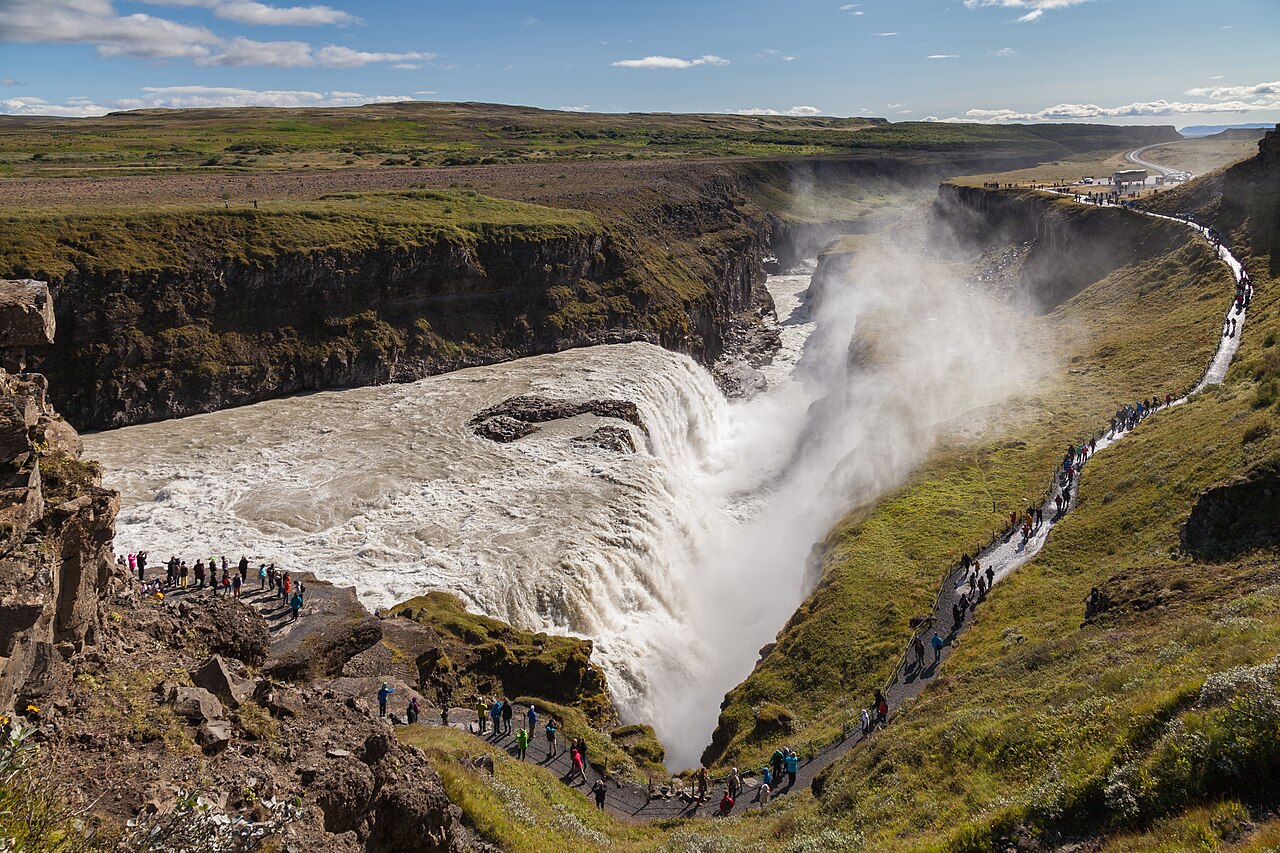
Geysir is geology performing on schedule. The Great Geysir — the original that named every geyser on earth, active since the 14th-century earthquakes and now mostly dormant — rests in its steaming basin, but Strokkur, a hundred paces away, erupts every 5–10 minutes, throwing its column 50–65 feet (15–20 m) and occasionally twice that; the etiquette is to stand upwind, wait through a false dome or two, and give it twenty minutes rather than five. The field around it (the Haukadalur valley) boils at 176–212°F (80–100°C) in its pools — stay on the marked paths; the crust is thinner than it looks. Then Gullfoss, 10 minutes on: the Hvítá river pours about 5,000 cubic feet per second (140 m³/s) of glacial water over two tiers totaling 105 feet (32 m) into a crevice canyon, saved from a hydroelectric scheme by the farmer's daughter Sigríður Tómasdóttir, whose campaign led the state to buy and protect the falls in 1975. Walk both the upper rim and the lower path into the spray (waterproofs, grippy shoes), and read her statue at the top car park.
The extras rank: Kerið, the 3,000-year-old explosion crater with its rust-red slopes and aquamarine lake, charges about 700 ISK per person at the gate and takes 30 minutes; Laugarvatn Fontana, on the lake between Þingvellir and Geysir, bakes rye bread in the hot sand and runs geothermal baths for the loop's mid-point soak; and the Friðheimar greenhouse (booked ahead, under Food) turns tomatoes into lunch inside the loop. A first visit with the big three done slowly, Silfra or Fontana added, and Kerið at golden hour is complete.
Picture the place
At Silfra's exit platform the snorkelers come up blue-lipped and laughing, having just swum between two continents in water older than their grandparents — the guide hauls them out by the wrists like seals.
The easily missed detail
Þingvellir's quiet masterpiece is its church and farm: the small Þingvallakirkja (the present church dates to 1859, on the site of one of Iceland's first, c. 1015) and the park warden's farm stand below the rift where almost nobody walks, beside the drowning pool and the old assembly booths' grassed foundations. Ten minutes beyond the Law Rock crowds, the valley's acoustics return — wind, ravens, and the river that was moved to serve a parliament.
A practical rhythm
- Two hours minimum at Þingvellir — Hakið viewpoint, Almannagjá, the Law Rock, Öxarárfoss, the church: the loop's deepest stop is also its first for most
- Twenty patient minutes at Strokkur — Eruptions bunch and pause; upwind side, camera ready before the dome swells
- Waterproofs at Gullfoss — The lower path is a shower in any wind; the rainbow and the scale live down there
What could complicate the plan
Silfra sells out days ahead in season and has hard rules — age and swimming ability requirements, and strict no-touch discipline in the fissure (the ecosystem and the visibility both depend on it). Winter ice makes Gullfoss's lower path and Þingvellir's gorge genuinely treacherous without the crampons rental fleets push and conditions sometimes close paths outright. Parking everywhere is now plate-camera enforced: an unpaid Parka session follows the rental car home with surcharges, so settle each lot before driving on.
What to do next
Book Silfra the week you book the car, fix the counter-clockwise order, and give Þingvellir the afternoon light.
Sources
- UNESCO World Heritage Centre — Þingvellir National Park, inscribed 2004: the Althing assembly site (founded 930) in the plate-boundary rift
- Þingvellir National Park (thingvellir.is) — the P1–P5 car parks, the daily 1,000 ISK parking fee, the Hakið visitor centre and Silfra's operator-permit system
- Environment Agency of Iceland — the Silfra fissure's water (2–4°C), its visibility and its licensed-operator rules
- Icelandic Institute of Natural History / Landsvirkjun — Gullfoss's two tiers (32 m) and the Hvítá's average flow; Sigríður Tómasdóttir and the 1975 protection