Granada / Spain Things to do
What are the most worthwhile things to do in Granada on a first visit?
The short answer
One monument done properly (the Alhambra, half a day minimum), one quarter walked slowly (the Albaicín to the San Nicolás lookout), the Catholic Monarchs' tomb, and flamenco in a Sacromonte cave — Granada's four essentials span two civilizations.
The answer, with local context
The Alhambra is not a sight but a city: a fortified palatine complex above the Darro river whose parts run on different keys. The General ticket (see When to visit for the €22.27 and the booking discipline) covers the Alcazaba — the 9th–13th-century fortress whose Torre de la Vela looks over the whole vega — the Palace of Charles V (begun 1527, its circular courtyard the Spanish Renaissance's most perfect geometry), the Partal gardens, the Generalife summer palace with its water-stair, and above all the Nasrid Palaces, entered at your printed half-hour: the Mexuar, the Comares Palace with its vast reflecting pool and the Hall of the Ambassadors under a carved cedar dome of more than 8,000 pieces, and the Court of the Lions, whose fountain's twelve lions carry the most famous courtyard in Islamic architecture. Give the complex four hours; the mistake is two. The Patronato caps the monument at roughly 6,600 visitors a day, and even so the palaces reward the day's edge hours.
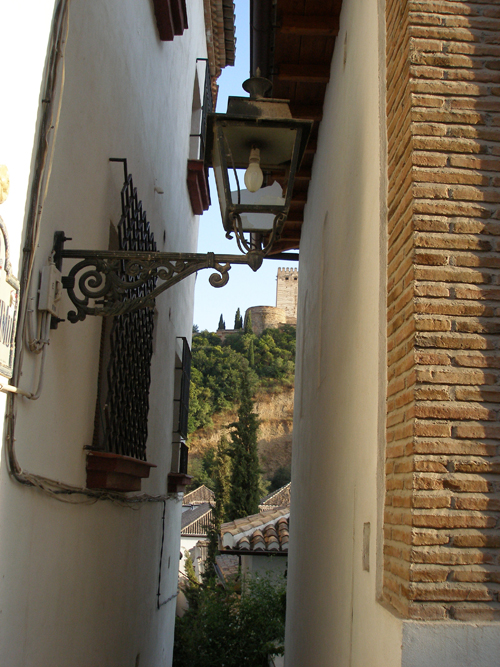
Across the ravine, the Albaicín — the old Moorish quarter, UNESCO-listed with the Alhambra — is the second essential: a hillside of white lanes, cármenes (walled garden houses) and small plazas climbing to the Mirador de San Nicolás, where the Alhambra fills the view against the Sierra Nevada and the sunset crowd gathers nightly. Walk up through the Calderería's tea houses (the teterías of the old Alcaicería silk market's lanes), pause at the Bañuelo (the 11th-century Arab baths, among Spain's oldest), and come down past the Darro's bridges on the Carrera del Darro, one of Europe's prettiest streets. Below, the Royal Chapel (Capilla Real, 1505–1517) holds the tombs of Ferdinand and Isabella — the monarchs who took Granada in 1492 and are buried in the city they conquered, in a chapel plainer and more moving than the immense Cathedral next door (begun 1523, Spain's first Renaissance cathedral, still holding the great chancel Siloé designed).
The fourth essential sounds after dark. In Sacromonte, the gypsy quarter of cave houses across from the Alhambra's Generalife side, the zambra — the flamenco form born in these caves for Roma weddings — is still danced nightly in cave venues like Venta El Gallo and the Cuevas Los Tarantos, and the Museo Cuevas del Sacromonte (10 cave dwellings preserved at the Barranco de los Negros) explains the world before the show. Add, if the days allow, the Cartuja monastery (La Cartuja, 1516 onward) whose sacristy is Spanish Baroque at its most delirious, and the Alhambra's own museum and the Federico García Lorca sites — the poet's summer house in the Huerta de San Vicente — for the city's modern soul.
Picture the place
The Court of the Lions at the slot's opening minute: water ticking from the fountain, swallows stitching the sky rectangle above, and the marble still cool from the night.
The easily missed detail
The Alhambra's most revealing room is its smallest museum piece: in the Palace of Charles V, the Museo de la Alhambra keeps the original Nasrid treasures the palaces themselves can no longer hold — the great Alhambra Vase (the 14th-century Jarra de las Gacelas), carved doors, and the lions' siblings in tile. It is free with the monument ticket, almost empty while the palaces queue, and it explains everything you are about to see. Visit it before your Nasrid slot, not after.
A practical rhythm
- Alhambra by halves — Gardens and Alcazaba in the morning cool; the Nasrid slot late-morning; the museum in the wait between
- Albaicín at the golden hour — Up through the tea houses at 6 p.m., San Nicolás for sunset, down the Carrera del Darro by lamplight
- Caves after dinner — Zambra shows run late (10 p.m. onward); book the Sacromonte museum for the afternoon of the same day
What could complicate the plan
The Nasrid slot governs the whole visit: arrive at the palaces' own checkpoint (a ten-minute walk inside the complex from the main gate) inside your half-hour or lose the palaces entirely, with no refund or exchange — tickets are named and ID-checked. Summer heat makes the unshaded Alcazaba and Generalife climbs punishing by noon, and San Nicolás at sunset is a crowd scene with pickpockets documented around the miradores — keep the bag in front. Cave venues vary in quality: choose the established Sacromonte houses over touts' offers at Plaza Nueva. Granada also sits inside the Schengen Area — 25 member states of the European Union plus 4 countries outside it — so a US passport holder needs no visa, but the visit counts against a ceiling of 90 days within any 180 days shared across the entire zone.
What to do next
Buy the General ticket first, build the day around the slot, and let the Albaicín sunset and a Sacromonte night complete the triangle.
Sources
- Patronato de la Alhambra y Generalife — the monument's sections (Alcazaba, Nasrid Palaces, Generalife, Partal, Palace of Charles V), the daily visitor cap of about 6,600 and the timed Nasrid entry
- UNESCO World Heritage Centre — the Alhambra, Generalife and Albaicín (1984/1994): the Nasrid palatine city and the Moorish quarter
- Capilla Real de Granada / Archdiocese of Granada — the Royal Chapel (1505–1517) and the tombs of the Catholic Monarchs
- Museo Cuevas del Sacromonte — the cave-dwelling museum and the zambra tradition of the Sacromonte quarter
- European Commission, Migration and Home Affairs — the Schengen area as 25 EU member states and 4 non-EU countries, and the maximum of 90 days within any 180-day period (retrieved 5 November 2026)