Granada / Spain Food and drink
Where should I eat in Granada, and which local food or drink is worth trying?
The short answer
Tapeo first — Granada's free tapa with every drink — then the city's own plates: habas con jamón, remojón, Trevélez ham and a pionono for dessert, eaten between the Calle Navas bars and the Albaicín tea houses.
The answer, with local context
Granada's food system is its famous custom: order a drink in a traditional bar and a tapa arrives free — not a token olive but a small plate that grows more generous as your round count rises. The city is one of the last in Spain (with León and parts of Jaén and Almería) to keep the custom at full strength, and it structures the evening: tapeo between 8 and 11 p.m., moving bar to bar. The classic grounds are Calle Navas and the streets around Plaza Nueva and the Town Hall; the names locals defend are Bodegas Castañeda (a 1917 bodega pouring vermouth and wines from the barrel, famous for the house "calicasas" mixed wine), Los Diamantes (fried fish — boquerones, shrimp, squid — crisped to order since 1939, two locations), Bar Poë (a tiny bar where you choose your tapa from a written list, a rarity), and the traditional counters of Calle Elvira. Where choice is offered, spend it on the city: habas con jamón — broad beans fried with cured ham, Granada's defining tapa — and remojón granadino, the Moorish-descended salad of orange, salt cod, olives and egg that tastes like the vega itself.
Sit-down Granada cooks mountain and orchard. The ham is Jamón de Trevélez, cured in the Sierra Nevada's highest village (Trevélez, at some 4,800 feet/1,476 m one of Spain's highest settlements) and protected by its own PDO — naturally cured without nitrates, sweet and pale. Winter brings the olla de San Antón, the post-Christmas bean-and-pork stew eaten around the January saint's day, and year-round the tortilla del Sacromonte — the cave quarter's omelette of brains and testicles, a badge dish for the brave — plus migas (fried breadcrumbs) on rainy days in the Alpujarras-facing taverns. The city's top tables include Chikito (in Plaza del Campillo, a literary haunt since the Alameda café days, cooking Granada's produce in modern Andalusian form). For the Moorish register, the teterías of Calle Calderería Nueva serve mint tea, baklava and Arabic sweets in lantern-lit rooms — Granada's second dessert course.
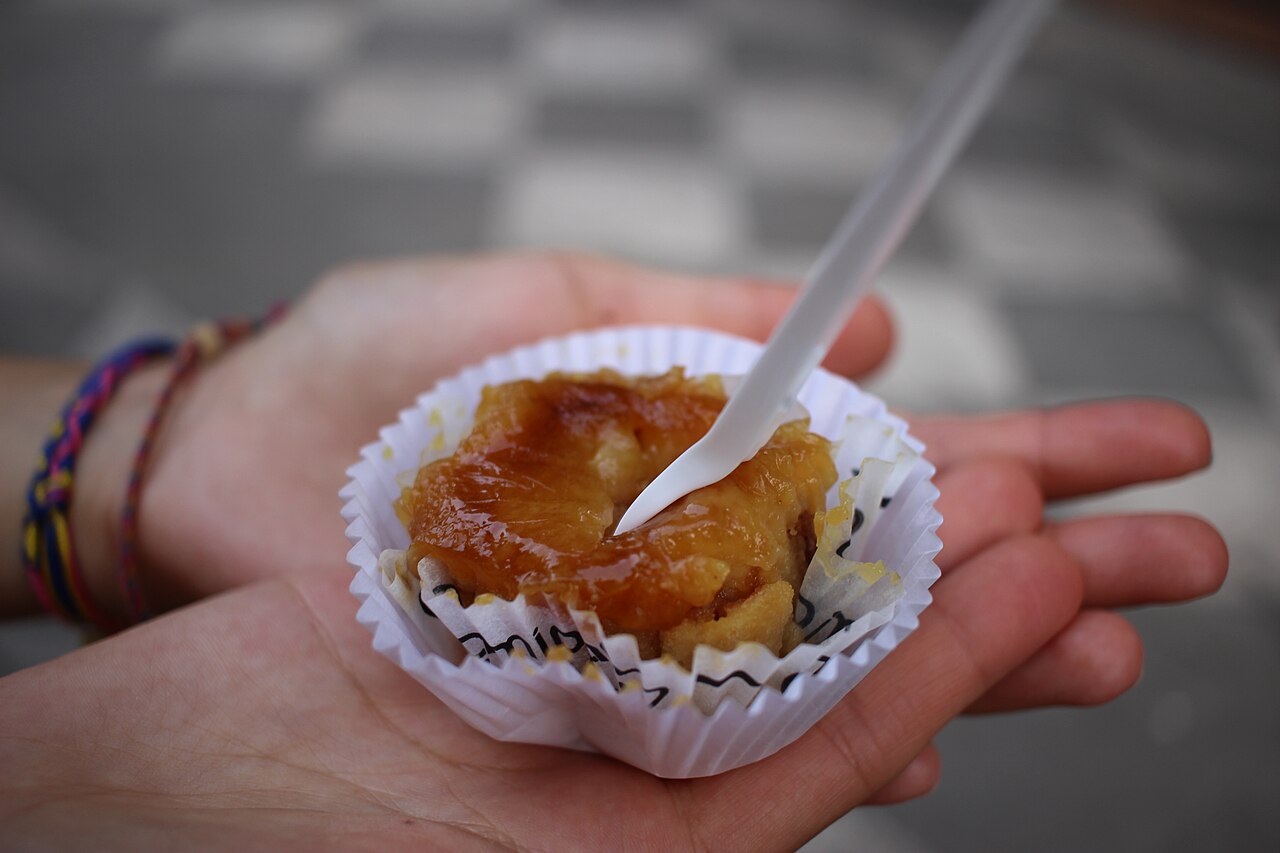
Dessert proper is the pionono: a bite-size cylinder of sponge soaked in syrup, crowned with toasted cream, invented in Santa Fe (the town 10 miles west where the Catholic Monarchs signed the Capitulations) in the 19th century and named for Pope Pius IX — Pío Nono. Buy them at the pastelerías of Santa Fe (Casa Ysla claims the original recipe) or in the city center, and take a box home the day you leave. Drink, beyond the tapas wine (the province's high-altitude vineyards pour under the Granada designation, and Alhambra Reserva 1925 is the city's own lager, brewed by Cervezas Alhambra since 1925): in summer, a tinto de verano like everywhere in Andalusia, and in the morning, coffee at the Alameda in Plaza del Campillo where the tertulia tradition lingers.
Picture the place
Calle Navas at 9:30 p.m.: every bar's counter three deep, a caña arriving with a sizzling dish of broad beans and ham you did not order and will not be charged for, the bill for the evening so far under ten euros.
The easily missed detail
The tapa economy has a grammar: the first drink earns the house's standard tapa; the generous plates come with the second and third rounds in the same bar, and bars that let you choose (Poë, La Riviera) are the exception. Tourists who bar-hop one drink at a time eat the smallest tapas in the city. Settle into two bars for the night, and Granada feeds you dinner for the price of three wines.
A practical rhythm
- Tapeo as dinner — Two rounds in two classic bars on Calle Navas eats a full supper; book a sit-down for the second night
- Choose the local plates — Habas con jamón, remojón, Trevélez ham: the tapa list is a map of the province
- Piononos on departure day — They travel a day, not a week; Santa Fe's originals if the road passes, Casa Ysla in town if not
What could complicate the plan
The monument, not the bar, fixes your meal times. The Alhambra's daytime visit runs 08:30 to 20:00 from 1 April to 14 October and 08:30 to 18:00 from 15 October to 31 March, tickets must be collected at least an hour before the access time printed on them, and the complex closes only on 25 December and 1 January — so a morning ticket leaves the whole tapeo intact, while the summer night visit to the Nasrid Palaces, 22:00 to 23:30 from Tuesday to Saturday, turns dinner into a 9 p.m. sprint or a midnight sandwich. Heat edits the rest: AEMET's normals for the Granada Aeropuerto station over 1981–2010 put the mean daily maximum at 34.8°C (94.6°F) in July and 34.2°C (93.6°F) in August, which is why July tables fill after dark and why a box of piononos bought at noon should not spend the afternoon in a parked car. One more expectation to adjust: the free tapa is a custom of the traditional counters, not a civic right — the modern and fine-dining rooms around the center charge for everything they bring.
What to do next
Start at Bodegas Castañeda for vermouth, walk to Los Diamantes for the fry, and save one Albaicín evening for tea and baklava above the Darro.
Sources
- Ayuntamiento de Granada / Granada Turismo — the free-tapa custom and the city's tapas districts (Calle Navas, Plaza Nueva, Calle Elvira)
- Consejo Regulador DOP Jamón de Trevélez — the Sierra Nevada ham's protected designation and natural curing
- Casa Ysla / Santa Fe — the pionono's 19th-century invention for Pius IX and its Santa Fe origin
- Junta de Andalucía (Turismo Andaluz) — the teterías of the Albaicín and the Alcaicería quarter
- Patronato de la Alhambra y Generalife — seasonal daytime hours, the Nasrid Palaces night-visit hours, the one-hour ticket-collection rule and the 25 December and 1 January closures
- AEMET (Spanish State Meteorological Agency), standard climate values for Granada Aeropuerto — mean daily maximum temperatures for July and August, 1981–2010 normals