Hong Kong / China When to visit
When should I visit Hong Kong, China, for the best experience?
The short answer
Late October through early December — the Hong Kong Observatory's 1991–2020 normals put November at a mean daily high of 76°F (24.5°C) with just 1.5 inches of rain and 5.7 rain days, and the typhoon record shows no November days at all at Tropical Cyclone Warning Signal No. 8 or above.
The answer, with local context
Hong Kong's year splits cleanly into a wet half and a dry half, and the gap is enormous. June alone averages 19.4 inches of rain across 19.3 rain days; December averages 1.1 inches across 5.3. The annual total is 95.7 inches, and nearly 80 percent of it arrives between May and September. Humidity follows the same curve — 83 percent in April and May, down to 70 percent in December.
Temperature is the easier half of the decision. Mean daily highs sit at 89°F (31.6°C) in July and 88°F (31.3°C) in August, with mean temperatures of 84°F (28.9°C) and 84°F (28.7°C) respectively. October comes in at 83°F (28.1°C) high and 73 percent humidity, November at 76°F, December at 69°F (20.4°C). January, the coolest month, averages a high of 66°F (18.7°C) and a mean of 62°F (16.5°C) — cool enough for a jacket on the Peak after dark, never cold enough to close anything.
The decisive factor is not rain but tropical cyclones. Between 1991 and 2020, Hong Kong averaged 15.87 days a year under Tropical Cyclone Warning Signal No. 1 or higher, 7.43 days under Signal No. 3 or higher, and 2.43 days under Signal No. 8 or higher — the level at which schools shut, offices empty, ferries stop and the city effectively pauses. August is the worst month on that measure, averaging 4.17 signal days and 0.80 days at Signal No. 8 or above. September is barely better at 3.83 and 0.67. From December through March the record shows no signal days at all.
Picture the place
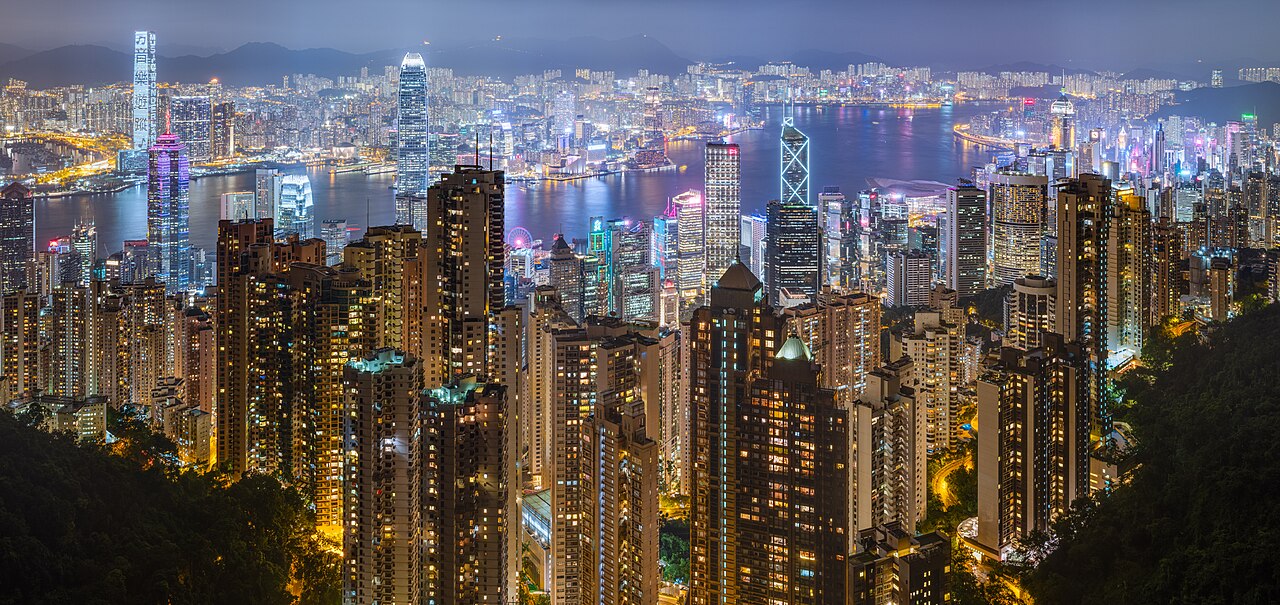
In late November the haze that sits over the harbor in summer has usually thinned, and the ridge behind Central holds its edge against the sky instead of dissolving into it. Rainfall has dropped to a fifteenth of the June figure, so the granite steps on the hillside trails above Tai Hang are dry rather than slick, and the view from the Peak on a clear evening runs the full length of Kowloon.
The easily missed detail
Hong Kong contains no UNESCO World Heritage property — a point worth knowing before you plan around one. What it does have is the Hong Kong UNESCO Global Geopark, accepted into the Global Geoparks Network on 17 September 2011 at the 10th European Geoparks Conference in Langesund, Norway. Its centerpiece, the High Island Formation, was added to the geopark in 2009: rhyolite columns averaging about 1.2 meters across, some reaching 3 meters, standing up to 100 meters high and spread over roughly 100 square kilometers of land and seabed, the remains of a caldera some 20 kilometers wide formed by volcanism about 140 million years ago. Reaching them involves boats and exposed coastline, which is exactly why the dry, signal-free months matter.
A practical rhythm
- November to early December — Lowest rainfall outside midwinter, no recorded days at Signal No. 8 or above, humidity at 72 percent. The best window for the Sai Kung coastline and the geopark boat trips.
- February to April — Mean highs climb from 67°F to 78°F (19.4°C to 25.6°C), but humidity reaches 83 percent and sea fog is common; harbor views are the first thing to go.
- June to September — Peak heat, peak rain and the whole of the typhoon season. August averages nearly one full day of Signal No. 8 or higher, which can erase a day of your itinerary at a few hours' notice.
What could complicate the plan
A Signal No. 8 closes the Star Ferry, suspends outlying island services and grounds much of the airport's schedule, and it can be hoisted with only a few hours' notice between June and October. The US Centers for Disease Control and Prevention lists Hong Kong among the destinations named in its Global Measles travel health notice, issued at Level 1 — Practice Usual Precautions and dated May 28, 2025, so measles vaccination status is worth confirming before departure. The geopark's sea arches and column stacks are reached by boat from Sai Kung or Ma Liu Shui, and operators cancel in rough water regardless of season.
What to do next
Read the Hong Kong things-to-do question in this group for how the geopark, the Peak and Lantau fit into a first visit, then the food question for what to eat between them.
Sources
- Hong Kong Observatory, Monthly Meteorological Normals for Hong Kong (1991–2020) — monthly mean maximum temperature, mean temperature, relative humidity, rainfall and rain days
- Hong Kong Observatory, Number of Days with Signals in Hong Kong between 1991–2020 — mean monthly and annual tropical cyclone warning signal days
- Government of Hong Kong SAR press release, 18 September 2011 — Global Geoparks Network acceptance date and location
- Government of Hong Kong SAR press release on the High Island Formation — column dimensions, caldera size, area and date added to the geopark
- US Centers for Disease Control and Prevention, Travel Health Notices — Global Measles notice level and date, Hong Kong listed