Iguazu Falls / Argentina Things to do
What are the most worthwhile things to do in Iguazu Falls on a first visit?
The short answer
Spend at least as long in the forest as at the water — the park's World Heritage listing rests on criteria (vii) and (x), and criterion (x) is about biodiversity: over 2,000 vascular plant species, around 400 bird species and possibly as many as 80 mammal species.
The answer, with local context
The waterfall is the reason the park exists on paper under criterion (vii), and it is worth being precise about its scale: a main semicircular front about 2,700 m (8,860 ft) wide with a drop of roughly 80 m (262 ft), set within a river approximately 1,500 m wide above the lip. Argentina's national parks service counts more than 450 bird species in the park, and names the sooty swift — vencejo de cascada — as its emblem, a bird that nests and roosts behind the curtain of falling water. UNESCO's own description adds some 80 tree species among the 2,000-plus vascular plants, in the Paranaense subtropical rainforest subtype of the Interior Atlantic Forest.
The large mammals are the part most visitors do not expect to be documented. IUCN's assessment records that jaguar numbers in the park rose from 7 in 2006 to 13 in 2014, and that roughly 230 to 300 jaguars survive across the Atlantic Forest region, about a third of them in and around the Iguazú and Iguaçu parks on the two sides of the border. UNESCO's description also names the broad-snouted caiman, giant anteater, harpy eagle and ocelot. IUCN rates biodiversity and charismatic species as Low Concern with a stable trend, against High Concern for the waterfall itself — the forest is in better shape than the river.
Scale is the third thing to plan around. The Argentine property covers 67,698 hectares, and together with Brazil's Iguaçu National Park the transboundary complex runs to about 240,000 hectares. That is not a half-day site. IUCN notes that most days see under 5,500 visitors against an established capacity of 6,902 per day, but that peak periods exceed infrastructure capacity, producing delays and crowding — so the forest trails are where you escape the pinch points.
Picture the place
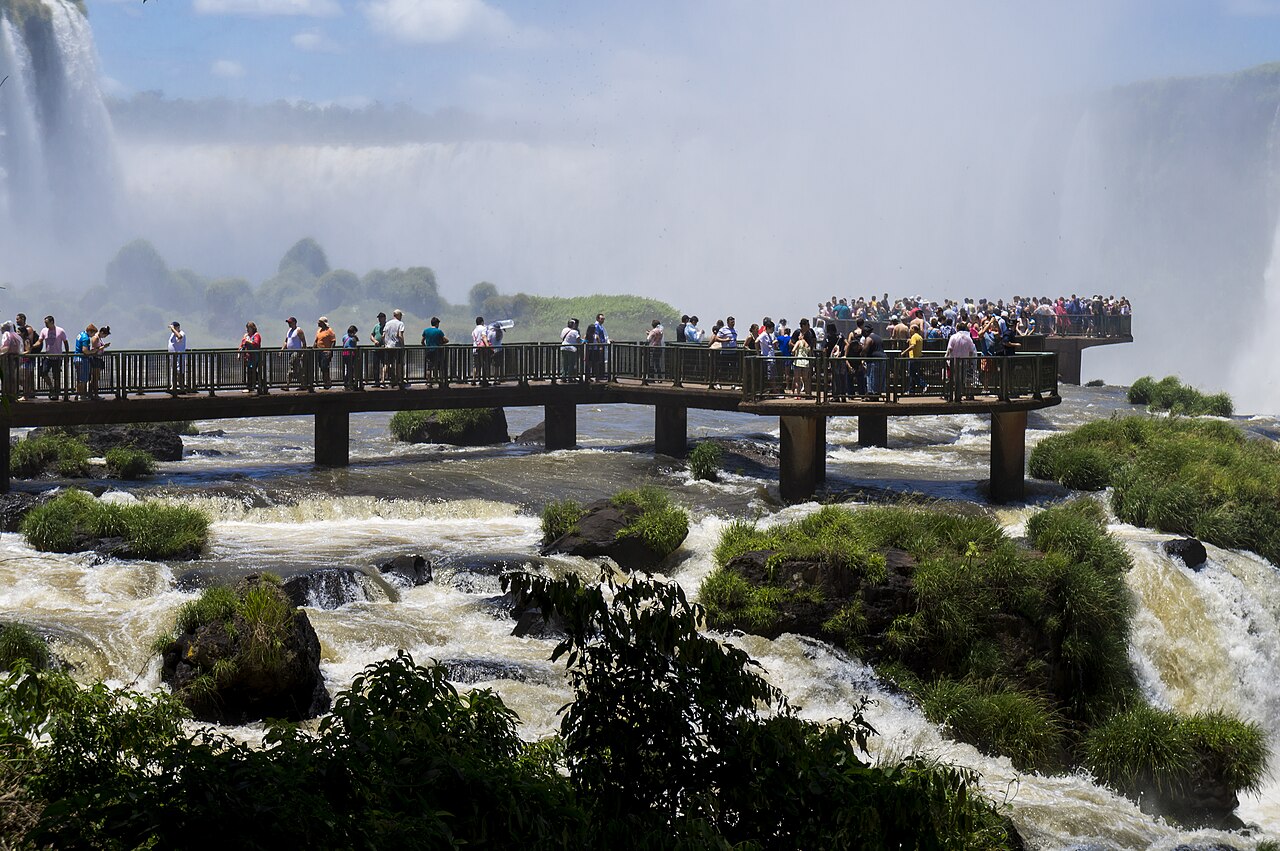
Closed subtropical canopy runs right up to the water, which is why the falls arrive suddenly rather than gradually. Above the main front the river spreads to about 1,500 m before it breaks, so the sound reaches you well before the view does.
The easily missed detail
The greatest threat to what you have come to see is upstream and legal. IUCN rates dams and water management on the upper Iguazú River as a Very High threat, widespread across 15 to 50 percent of the property, and states that their combined impact is the park's greatest threat and lies outside its management control. Flow regulation changes the falls themselves. The same assessment also flags unfinished business on the boundary — the buffer zone, including a new provincial reserve, remains to be finalised — and rates wildlife-vehicle collisions on access routes as a High threat, widespread across 15 to 50 percent of the site, which is the clearest argument there is for driving slowly on the approach roads.
A practical rhythm
- Water first, early — The main front is 2,700 m (8,860 ft) wide, and it absorbs crowds least well; go before the day's 5,500-odd visitors arrive.
- Then the forest trails — 2,000-plus vascular plant species and more than 450 bird species are the other half of the inscription, and the trails are where the pressure drops.
- Late afternoon on the approach road — Drive it slowly; wildlife-vehicle collisions are rated a High threat across much of the property.
What could complicate the plan
Trail access is the fragile part. Floods in September 2023 destroyed trail catwalks and access was not restored until May 2024, and IUCN names both extraordinary floods and droughts among current pressures, with climate change rated High across 15 to 50 percent of the site. Invasive non-native species rate High across 5 to 15 percent of the property inside the boundary, and hunting, fishing and trapping also rate High and widespread — so sightings of the larger mammals are not something to plan a day around, even with 13 jaguars recorded in 2014. Visitation itself is rated a High threat, localised to under 5 percent of the site, which is precisely the trail corridor you will be walking. Water pollution is rated High with extent not known.
What to do next
The Iguazú when-to-visit question in this group covers daily visitor capacity and the flood closures in detail; the Iguazú food question covers yerba mate, the crop that dominates the surrounding province.
Sources
- UNESCO World Heritage Centre, Iguazu National Park — criteria (vii) and (x), vascular plant, tree, bird and mammal species counts, named species, falls dimensions, Interior Atlantic Forest, 67,000 and 240,000 hectare figures
- IUCN World Heritage Outlook, Iguazú National Park — jaguar counts and regional population, value ratings, dam threat, buffer zone status, threat table, visitor numbers and capacity, 2023 flood and 2024 reopening
- Administración de Parques Nacionales, Argentina, Parque Nacional Iguazú factsheet — 67,698 hectares, more than 450 bird species, river width above the falls, sooty swift as emblem species