Iguazu Falls / Argentina When to visit
When should I visit Iguazu Falls, Argentina, for the best experience?
The short answer
The falls run year-round, so choose your date for space rather than for water — Iguazú National Park has an established carrying capacity of 6,902 visitors per day, and the number of days exceeding 8,000 visitors rose from 2 in 2014 to 14 in 2018.
The answer, with local context
Crowding, not weather, is the variable you can actually control here. IUCN's conservation outlook assessment, finalised on 11 October 2025, records 1.5 million visitors in 2019, 1.5 million again in 2023 and 1.3 million in 2024. Most days stay under 5,500 visitors, comfortably below the 6,902 daily capacity — but the peaks exceed what the trail and transport infrastructure can absorb, producing delays and congestion. The practical reading is that the average day is fine and the peak day is not, so your date choice is a choice about peaks.
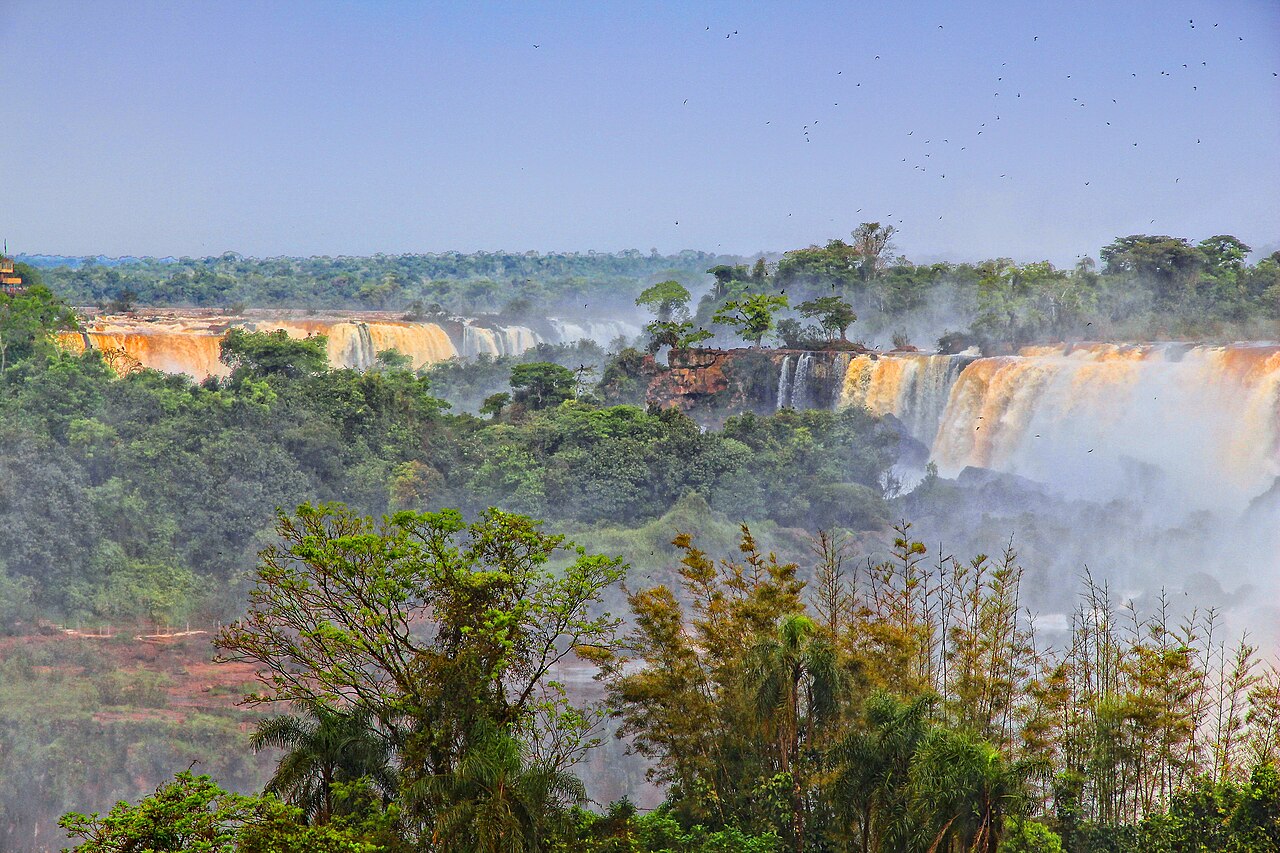
Water level is the second variable, and it cuts both ways. The falls drop about 80 m (262 ft) across a main semicircular front roughly 2,700 m (8,860 ft) wide, fed by a river that Argentina's national parks service describes as about 1,500 m wide immediately above them. High water makes the spectacle; it also closes trails. IUCN records that floods in September 2023 destroyed trail catwalks and that access was restored in May 2024 — an 8-month interruption — and that Argentina's national meteorological service attributed the September-to-November 2023 floods to El Niño, with climate change intensifying the impacts. Extraordinary floods and droughts are both named in the assessment, alongside increased rainfall and temperatures especially in spring and winter.
The third factor is upstream and invisible from the viewing platforms. IUCN rates dams and water management on the upper Iguazú River as a Very High threat, widespread across 15 to 50 percent of the property, and identifies their combined effect on flow as the single greatest threat to the site — one that lies outside the park's own management control. The waterfall as a heritage value is rated High Concern with a stable trend for exactly that reason.
Picture the place
The park protects 67,698 hectares of Selva Paranense — Interior Atlantic Forest — and the falls sit inside it rather than beside it, so the approach is through closed subtropical canopy rather than across open ground. The sooty swift, the park's emblem species, roosts behind the falling water itself.
The easily missed detail
The park is older than the designation most visitors associate with it. It was created in 1934 under National Law No. 12.103/34, and only in 1984 was it inscribed on the World Heritage List, under criteria (vii) and (x). IUCN has assessed the site 4 times — in 2014, 2017, 2020 and 2025 — and returned "Significant concern" every time, while rating protection and management as Mostly Effective and citing a 2017–2023 management plan and a 2021 public use plan. That combination is the honest picture: a well-run park facing threats generated beyond its boundary.
A practical rhythm
- Weekdays — The 6,902-per-day capacity is a ceiling, not a target; most days fall under 5,500, and those are the days to be there.
- After heavy rain — Expect closures as well as volume; the September 2023 floods took out catwalks until May 2024.
- Allow a second day — Peak-period congestion is an infrastructure limit the assessment names explicitly, and a second entry removes the pressure to see everything in one pass.
What could complicate the plan
Flooding is the main cause of partial closure, and it is not confined to one season: the assessment names both extraordinary floods and droughts as current pressures, with climate change rated a High threat across 15 to 50 percent of the property. Wildlife-vehicle collisions on the access routes are also rated High and widespread, which bears on how and when you drive in. Invasive non-native species are rated High and scattered across 5 to 15 percent of the site, and hunting, fishing and trapping likewise rate High. Nothing here closes the park — but a trip built around one specific walkway on one specific day is fragile, and the Garganta del Diablo trail is the one most exposed to high water.
What to do next
The Iguazú things-to-do question in this group covers the forest and its wildlife, including the jaguar population figures; the Iguazú food question deals with yerba mate and Misiones.
Sources
- IUCN World Heritage Outlook, Iguazú National Park — conservation outlook rating and assessment dates, visitor totals, 6,902 daily carrying capacity, days above 8,000, September 2023 flood and May 2024 reopening, threat table and ratings, management plan dates
- UNESCO World Heritage Centre, Iguazu National Park — inscription year, criteria, height and width of the main falls, 1934 national park declaration
- Administración de Parques Nacionales, Argentina, Parque Nacional Iguazú factsheet — creation year and law, 67,698 hectares, Selva Paranense ecoregion, river width above the falls, emblem species