Iraq country guide Food and drink
What local dishes should I try in Iraq, and where should I look for them?
The short answer
Dates in Iraq carry an international designation — UNESCO inscribed "Date palm, knowledge, skills, traditions and practices" on the Representative List in 2022 under decision 17.COM 7.b.33, nominated by 15 States Parties with Iraq among them.
The answer, with local context
The inscription is deliberately broad. UNESCO describes the date palm as an evergreen of deserts and dry temperate climates whose roots reach deep for moisture, growing in oases where irrigation water is available, and it records the associated practices as caring for and cultivating the tree and using its leaves, fronds and fibres for traditional crafts and social rituals. The palm appears in poetry and songs, and the element treats it as a key source of nutrition alongside the crafts and professions built around it. The United Arab Emirates acted as coordinating State for the nomination.
What that designation does not capture is how much of Iraq's food comes out of water rather than sand. The IUCN's assessment of the Ahwar of Southern Iraq rates fishing, harvesting and control of aquatic species as a High threat to the property, and water-borne and other effluent pollution as High as well. Those two ratings describe a working fishery and a polluted one in the same breath — the marshes feed the south, and the body assessing them says both the harvesting and the water quality are problems.
Invasive non-native species are itemized at High alongside them, which in a wetland food system means changes to what is actually being caught.
Picture the place
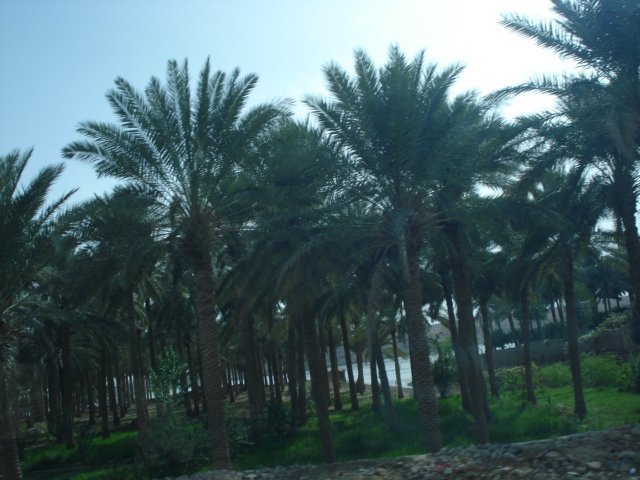
An oasis date grove is irrigated ground under a canopy, the palms spaced for access and the crop harvested by climbing. Fronds and fibres come off the same tree as the fruit, which is why the UNESCO element covers crafts and food together rather than separately.
The easily missed detail
15 States Parties nominated the date palm element jointly, which puts it among the most broadly shared entries on the Representative List. The practical consequence for a traveler is that Iraqi date culture is not a local curiosity but one node in a recognized regional tradition running from Mauritania to Oman — and the varieties, the harvest handling and the craft uses differ meaningfully between them.
A practical rhythm
- The groves — Date cultivation sits where irrigation water reaches, which in Iraq means the river systems rather than the open desert.
- The marshes — The southern wetlands are the other food landscape, and the one under formal conservation assessment.
- The crafts — Leaves, fronds and fibres are part of the same designated tradition as the fruit.
What could complicate the plan
Access, not appetite, is the limit. The US State Department records that US government personnel in Baghdad are barred from using Baghdad International Airport because of security concerns — a restriction that applies to the staff best placed to assess the risk. In the south, the IUCN's threat list for the Ahwar includes uncontrolled recreational tourism at High, so even informal visits to the marsh communities carry a documented footprint.
What to do next
The Iraq places-and-experiences question in this group sets out the inscribed sites in the marshes and the north, including the archaeological cities inside the Ahwar property.
Sources
- UNESCO Intangible Cultural Heritage, Date palm, knowledge, skills, traditions and practices — inscription year, decision code, States Parties count, coordinating State, description, nutrition and craft uses
- IUCN World Heritage Outlook, The Ahwar of Southern Iraq — fishing and harvesting threat rating, effluent pollution rating, invasive species rating, tourism rating
- US Department of State, Iraq Travel Advisory — Baghdad International Airport restriction on government personnel