Jaipur / India Things to do
What are the most worthwhile things to do in Jaipur on a first visit?
The short answer
See the walled city, Hawa Mahal, Jantar Mantar, City Palace and Amber Fort to understand Jaipur’s architecture, astronomy and urban planning instead of treating each pink building as the same attraction.
The answer, with local context
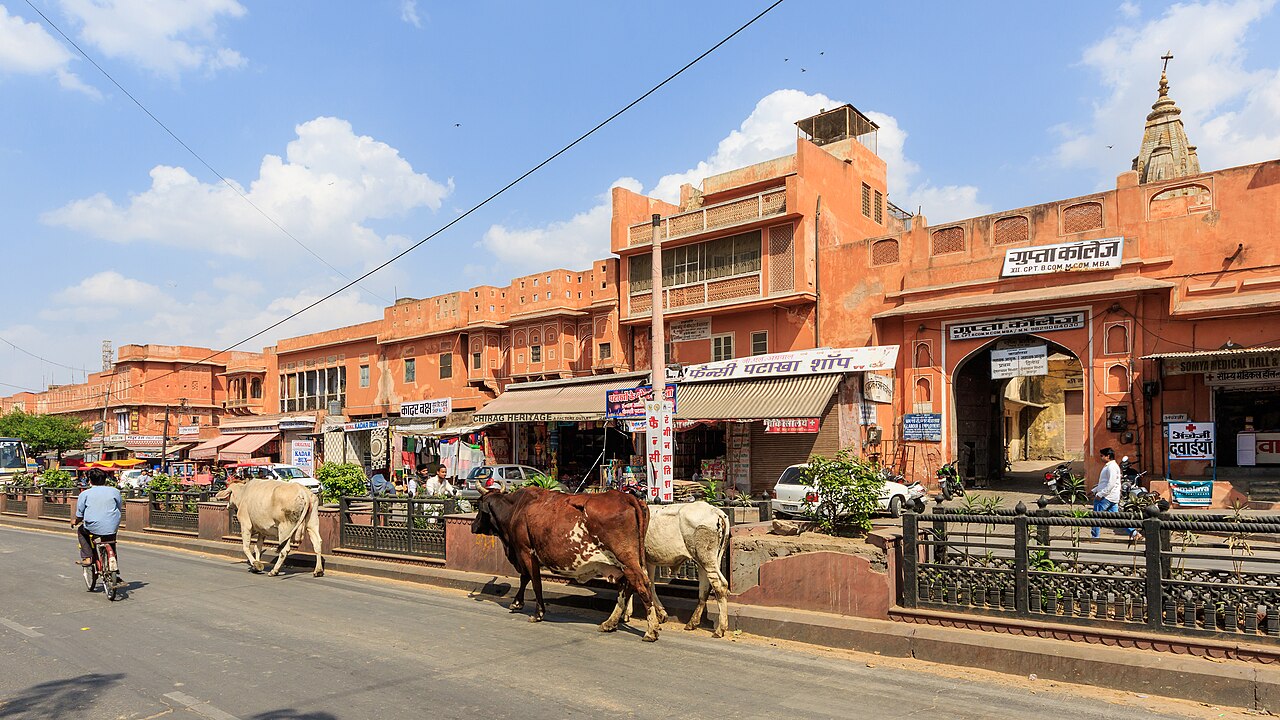
Jaipur’s old city was founded in 1727 under Sawai Jai Singh II and laid out on an unusual planned grid. UNESCO inscribed Jaipur City in 2019, recognizing its urban structure and architectural tradition. A walk through the markets and avenues shows this organization more clearly than moving only from landmark to landmark by car. Hawa Mahal, built in 1799, is especially recognizable for its many small windows across the distinctive facade.
Jantar Mantar is a separate world-heritage property inscribed in 2010 for its collection of large astronomical instruments. UNESCO lists it under criteria (iii) and (iv) for some twenty main fixed instruments, built in the early 18th century, several of which are the largest ever constructed in their category — the point is not that the instruments are old but that they are enormous, because accuracy in masonry astronomy came from size. It belongs in a different category from City Palace, whose buildings connect Jaipur with its royal history. Amber Fort, some distance outside the walled center, introduces the hilltop defenses and palace architecture of the older regional capital. Do not describe Amber as lying within the UNESCO-listed street grid of central Jaipur.
For a secondary stop, Rajasthan Tourism identifies Albert Hall Museum as an additional cultural institution. The wider visitor experience includes craft and market districts, but purchasing jewelry or textiles is not required to appreciate the traditional commercial streets. Try to balance two major monuments with one slower neighborhood walk rather than visiting five sites in one exhausting afternoon.
Picture the place
Hawa Mahal’s layered pink facade fills a narrow street view, while Amber sits above the city in a much more expansive hill-and-fort setting.
The easily missed detail
The UNESCO designation for Jaipur City and the separate astronomical designation for Jantar Mantar reflect two related but distinct reasons the destination matters: urban design and scientific instruments.
A practical rhythm
- First morning — Explore Amber Fort before returning toward the walled center.
- Afternoon — Visit Jantar Mantar and City Palace, checking their separately managed access.
- Evening walk — See the Hawa Mahal frontage and browse an old-city market without turning the outing solely into shopping.
What could complicate the plan
Some palaces and museum rooms have individual fees, and old-city traffic can make short-looking transfers slow. Large stone sites are physically demanding in hot months; the monsoon brings concentrated rain, particularly in July and August.
What to do next
explains the most comfortable months for the outdoor circuit, and suggests appropriate Rajasthani meals between stops.
Sources
- UNESCO World Heritage Centre — Jaipur City 2019 inscription
- UNESCO World Heritage Centre, The Jantar Mantar, Jaipur — inscription criteria (iii) and (iv), the some twenty main fixed instruments, the early-18th-century construction and the largest-in-category instruments
- India Meteorological Department, Jaipur — June-September rainfall and monsoon distribution
- Rajasthan Tourism, cuisine — ghevar, ker sangri and regional foods
- Rajasthan Tourism — monuments and city tourism
- U.S. State Department — entry considerations