Jamaica country guide When to visit
When is the best time to visit Jamaica for Blue Mountains?
The short answer
Late January through mid-April — Jamaica's driest national stretch, and the window when the Blue Mountain ridge is least often buried in cloud, with the park charging US$10 per non-resident adult for a single-entry pass and US$20 for the hiking trail.
The answer, with local context
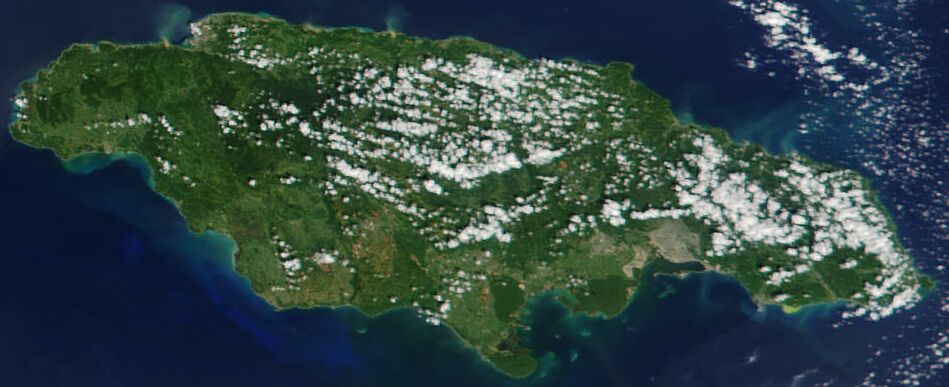
Jamaica is 146 miles long and 51 miles across at its widest, and the mountains down its spine split the island into two different climates. Kingston, in the rain shadow on the southern side, averages roughly 32 inches of rain a year. Port Antonio on the windward northeast coast takes several times that. So "the best time to visit Jamaica" is really two questions, and the Blue Mountains sit on the dividing line between them.
Nationally the rain arrives in two peaks, in May and again in October, with the October peak the heavier of the two. February and March are the driest months almost everywhere, often under an inch in Kingston. That is the pattern you want for the mountains, because the ridge generates its own cloud: the wetter the island, the more hours of the day the summit spends inside it.
Altitude does the rest. Blue Mountain Peak reaches 7,402 feet (2,256 m), the highest point in Jamaica, and night temperatures near the top can fall into the 40s°F (single digits Celsius) while Kingston, barely twenty miles away in a straight line, sits at 72°F (22°C). Walkers who start before dawn for sunrise from the summit are dressing for two climates in one morning.
The published fees are set by regulation, not by an operator. Under the Natural Resources Conservation (Blue and John Crow Mountains National Park) (User Fees) (Amendment) Regulations, 2019, a non-resident adult pays US$10 for a single-entry park pass, US$5 for a child aged 6 to 12, and nothing below age 6. The hiking trail carries its own charge of US$20 for non-residents over 12. An annual pass is US$30, and camping in a designated campground is US$10 per night for a non-resident adult.
Picture the place
The forest changes character with height: broadleaf woodland on the lower slopes gives way near the ridge to stunted, moss-draped elfin woodland, where the trees are shorter than the people walking past them because the wind and cloud never let up. Dawn on the ridge is frequently above a solid cloud layer sitting over the coastal plain.
The easily missed detail
The Blue and John Crow Mountains became Jamaica's first World Heritage property in 2015, inscribed by decision 39 COM 8B.7 at the Committee's 39th session in Bonn, under criteria (iii), (vi) and (x). Criteria (iii) and (vi) are cultural: the inscription recognizes the range as the refuge of the Windward Maroons, who used its terrain to resist capture. That is why the park's cultural trails matter as much as its summit trail, and why a mountain visit here is not only a hike.
A practical rhythm
- February and March — Driest nationally and clearest on the ridge; the months to book if the summit is the reason for the trip.
- June 1 to November 30 — The Atlantic hurricane season as defined by the National Hurricane Center; trails and access roads can be closed by rain damage well after a storm has passed.
- December and January — Dry enough and the coolest nights of the year on the mountain, which suits walking but means real cold at altitude before sunrise.
What could complicate the plan
US citizens need a valid passport and proof of planned departure, and do not need a visa for tourist travel of up to 90 days; yellow fever vaccination is required only for arrivals from a country with yellow fever risk. The State Department's country information page carries the headline "Reconsider travel to Jamaica due to crime." The UK Foreign, Commonwealth and Development Office reports that healthcare access remains limited in the areas worst affected by Hurricane Melissa, with some areas still operating field hospitals — a real consideration for a trip built around remote high ground.
What to do next
Pair this with the Jamaica trip-planning question in this group for internal distances and entry detail, and with the places-and-experiences question for what else sits within reach of the mountain road.
Sources
- NEPA Jamaica, Natural Resources Conservation (Blue and John Crow Mountains National Park) (User Fees) (Amendment) Regulations, 2019 — park entry, hiking trail, annual pass and camping fees
- UNESCO World Heritage Centre, decision 39 COM 8B.7 — inscription year 2015, criteria (iii)(vi)(x), session and property name
- NOAA National Hurricane Center — Atlantic hurricane season dates
- US Department of State, Jamaica International Travel Information — passport, 90-day visa-free tourist entry, yellow fever condition, advisory headline
- UK Foreign, Commonwealth and Development Office, Jamaica travel advice: Health — limited healthcare access in areas worst affected by Hurricane Melissa
- Meteorological Service of Jamaica — island rainfall distribution and monthly normals