Kathmandu / Nepal Things to do
What are the most worthwhile things to do in Kathmandu on a first visit?
The short answer
Explore Kathmandu Durbar Square, Swayambhu, Boudhanath, Pashupatinath and the old Asan market streets, then use additional days for neighboring Patan and Bhaktapur.
The answer, with local context
The city lies within the UNESCO-listed Kathmandu Valley, inscribed in 1979. UNESCO describes seven monument zones, and four major ones are closely associated with Kathmandu city: Hanuman Dhoka/Kathmandu Durbar Square, the Buddhist Swayambhu hilltop complex, the vast Boudhanath stupa and the Hindu Pashupatinath sacred precinct. Each has a different religious or civic role; the UNESCO listing is not one museum requiring a single all-access ticket.
At Kathmandu Durbar Square, former royal courtyards, temples and the Kumari Ghar convey aspects of the city’s political and religious history. The Asan district offers a dense traditional market setting, while Thamel is a convenient commercial quarter with lodgings and visitor services. Swayambhu is elevated above the city and requires a different approach from the level streets around the old palace complex.
For more than a short stay, Patan Durbar Square and Bhaktapur Durbar Square have their own historic civic centers, and Changu Narayan completes the seven-zone UNESCO serial property. These sites should not be misidentified as neighborhoods of central Kathmandu. Following the 2015 earthquake, reconstruction and conservation have been important parts of the visitor landscape; access to particular structures can vary. The valley's conservation record is itself visible on the ground: UNESCO placed the Kathmandu Valley on the List of World Heritage in Danger in 2003 and removed it in 2007, and a 2006 Committee decision dealt with minor modifications to the boundaries of the seven monument zones. Signage, permitted building lines and restoration scaffolding around the squares are the practical residue of that history.
Picture the place
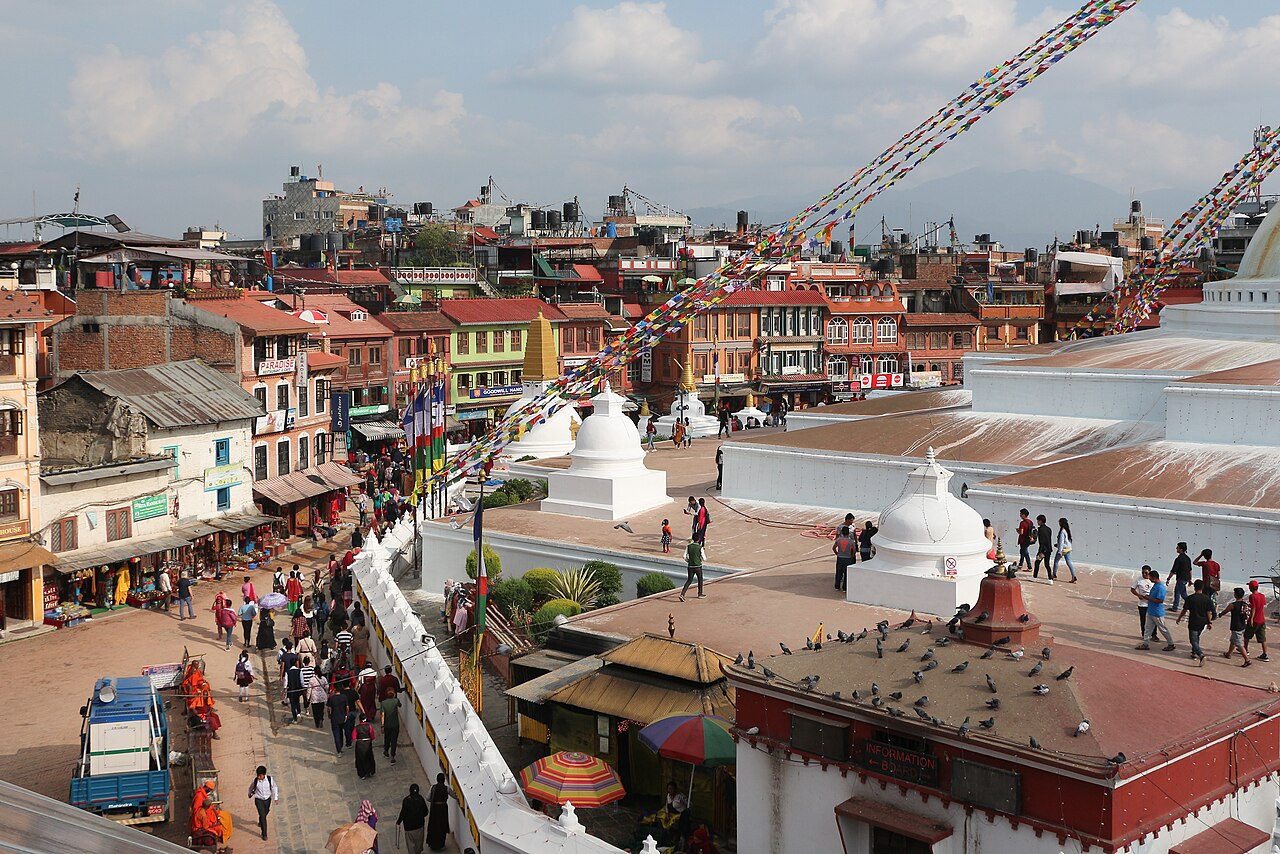
Pigeons and stepped temple plinths animate the royal-square setting, while Boudhanath’s immense round stupa creates a slower circuit for people walking clockwise around it.
The easily missed detail
Pashupatinath is a living Hindu sacred complex, not an unrestricted archaeological display. Access to the principal temple sanctuary is limited to Hindus, making observation and respectful conduct essential.
A practical rhythm
- Old-city walk — Begin with Hanuman Dhoka/Durbar Square and the Asan market lanes.
- Shrine visit — Choose Boudhanath or Swayambhu and allow time for the religious and neighborhood setting.
- Valley day — Visit Patan or Bhaktapur rather than forcing every UNESCO zone into the same afternoon.
What could complicate the plan
Crowded roads, stone steps and religious-site rules complicate access. Earthquake restoration may keep some structures closed, and photography rules can vary across living religious spaces.
What to do next
helps select the walking season; gives the Newar and broader Nepali foods worth trying during these neighborhood visits.
Sources
- UNESCO World Heritage Centre — Kathmandu Valley 1979, seven zones
- UNESCO World Heritage Centre, Kathmandu Valley Committee decisions — the 2003 inscription on the List of World Heritage in Danger, the 2007 removal and the 2006 minor boundary modification across the seven monument zones
- Nepal Tourism Board, Kathmandu — specific Kathmandu monuments and neighborhoods
- Nepal Tourism Board, culture — dal bhat, momo, Newar cuisine
- Nepal Department of Hydrology and Meteorology — national official climate normals program
- U.S. State Department — entry and travel conditions