Komodo National Park / Indonesia Food and drink
Where should I eat in Komodo National Park, and which local food or drink is worth trying?
The short answer
Plan restaurant meals in Labuan Bajo on Flores before and after the park excursion, choosing grilled local fish, vegetable dishes and Indonesian rice preparations; do not expect a town-style dining district inside Komodo National Park.
The answer, with local context
Komodo National Park is a regulated conservation landscape encompassing the main islands of Komodo, Rinca and Padar and protected waters. UNESCO inscribed it in 1991; its World Heritage property covers about 219,322 hectares. Visitor activities focus on managed wildlife, island and marine experiences, not independent restaurant-hopping. Most multi-stop boat outings provide packed or onboard meals, depending on the specific operator and fare.
Labuan Bajo, at the western end of Flores, is the principal accommodation and food-service gateway for many park trips. The town is an appropriate place to look for grilled fish, rice dishes such as nasi goreng, vegetable sides and locally prepared seafood. Menus mix broader Indonesian dishes with food associated with the fishing economy of Flores and the surrounding sea. It would be misleading to claim every Labuan Bajo kitchen serves the same traditional regional specialty or that fish bought in town must have been caught in the national park.
Make the food plan compatible with the excursion. Park visits require controlled admission and, in dragon habitat, ranger-led conduct; departure times and boat routes are governed by marine conditions. The national park authority publishes official carrying-capacity and activity arrangements, and Indonesia’s forestry ministry announced SiOra electronic reservations in 2025. Ask the operator whether drinking water, lunch, snacks and return-to-town transport are included. A morning departure is no time to discover that your package is transport-only.
Picture the place
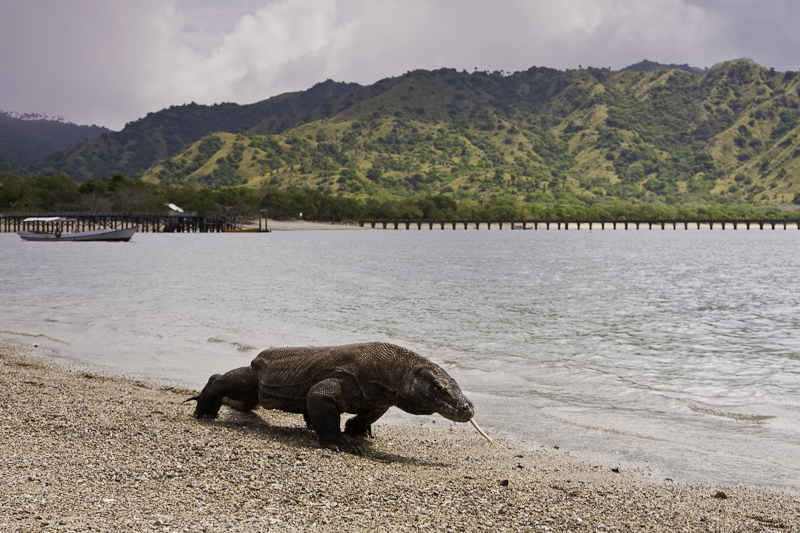
Labuan Bajo’s waterfront and working boats create a different setting from the dry hills and coral-fringed bays of the protected islands.
The easily missed detail
The presence of fish restaurants in the gateway town should not be represented as proof of dining facilities inside the conservation area. A park excursion is typically a planned boat-and-guide operation with food brought along.
A practical rhythm
- Night before — Eat in Labuan Bajo and purchase any permitted personal snacks or water required for the next day.
- Boat day — Use the meal arrangement specified by the licensed operator without feeding wildlife or leaving waste ashore.
- On return — Choose a grilled-fish or Indonesian rice dinner in town after the vessel has returned safely.
What could complicate the plan
Food storage aboard boats, allergies, potable water and weather-related delays are important. The park restricts visitor behavior and wildlife interactions; do not leave food in habitat or expect an isolated landing beach to have a public restaurant.
What to do next
helps choose the actual wildlife and marine activities, and discusses the seasonal and regulatory choices that govern departures.
Sources
- Komodo National Park Authority — guided-travel rule and visitor centre
- Komodo National Park Authority, official entry information — fees/carrying capacity and time windows by activity
- UNESCO World Heritage Centre — 1991 inscription, three main islands, marine area
- Indonesian Ministry of Forestry — SiOra electronic reservation platform announced 2025
- U.S. State Department — entry and national safety information