Kyrgyzstan country guide When to visit
When is the best time to visit Kyrgyzstan for Issyk-Kul?
The short answer
Issyk-Kul is a winter site as much as a summer one — its Ramsar listing records up to 70,000 migratory waterbirds annually, and names the lake as of primary importance as a wintering ground, which is the opposite of how the resort season treats it.
The answer, with local context
The Issyk-kul State Nature Reserve with Issyk-kul Lake was designated a Wetland of International Importance on 12 November 2002 and covers 626,439 hectares, wrapped around a lake that does not freeze. That non-freezing is the whole reason for the wintering designation: open water at altitude in a region that otherwise locks up.
Altitude is the other variable, and it is substantial across the country rather than just at the lake. UNESCO's record for the Western Tien-Shan property, which Kyrgyzstan shares with Kazakhstan and Uzbekistan, states that the western Tien Shan ranges in altitude from 700 to 4,503 m. A single World Heritage property running from 700 m to 4,503 m does not have one season; it has several stacked on top of each other, and the usable window narrows sharply as you climb.
The State Department's guidance on mountain travel is the practical translation. It notes that many Kyrgyz cities sit at high altitude and advises learning the symptoms of altitude sickness, that hikers should expect unexpected weather including rockslides, mudslides, avalanches and heavy rain or snow often with little warning, and that mountain roads are narrow, frequently lack guardrails and may close without notice because of snow, ice or rockslides. It also records that livestock frequently roams the roads, especially at night.
One small logistical point favours the lake. The International Trade Administration reports that debit and credit cards are common in Bishkek, Osh and the Issyk-Kul resort areas, while ATMs are less common in rural districts — so the lakeshore is one of the few places outside the two main cities where cards work reliably.
Picture the place
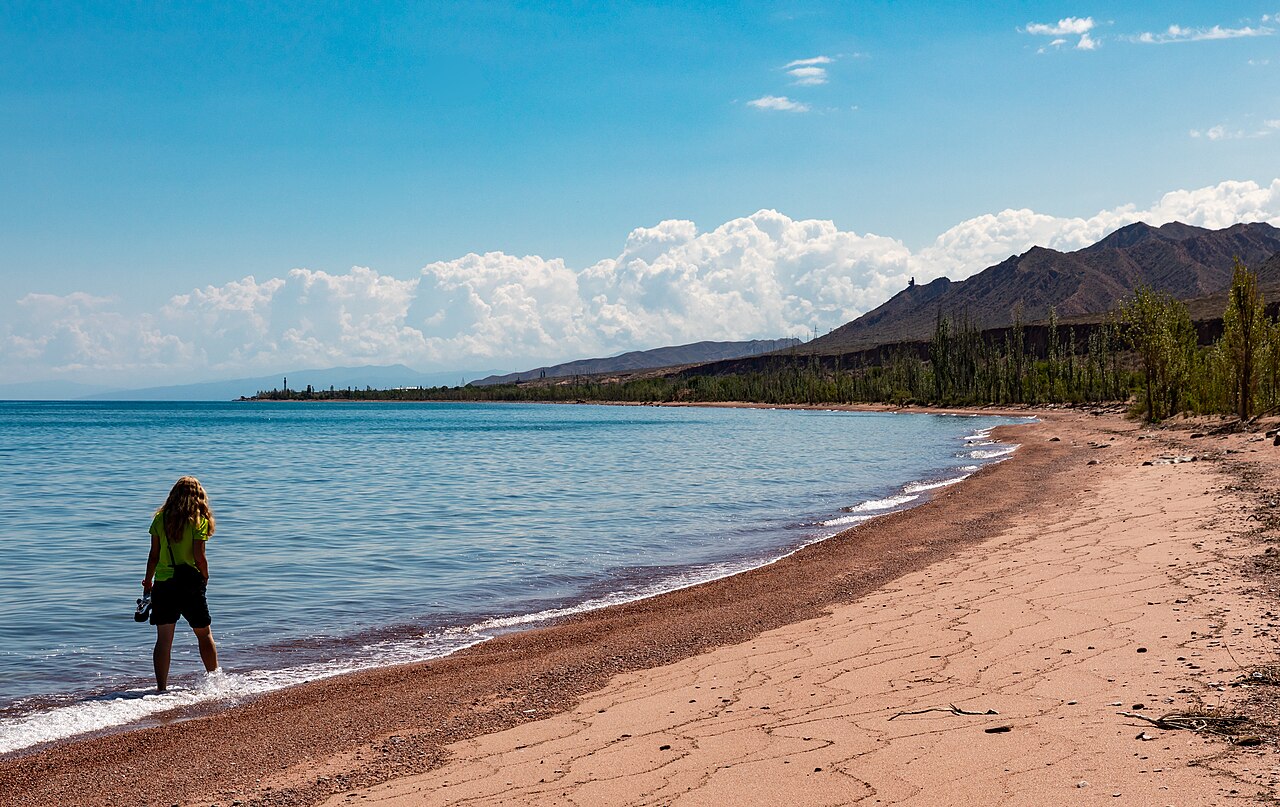
The reserve's 626,439 hectares enclose open water at altitude that stays liquid through winter while the passes around it close. Birds arrive because of that single physical fact, and the resort infrastructure empties out in exactly the months the wildlife turns up.
The easily missed detail
The wintering designation inverts the conventional advice. A visitor choosing July gets the beaches and the warm-weather road access; a visitor choosing the cold months gets the reason the lake carries an international designation at all. Those are two different trips to the same shoreline, and only one of them is what Ramsar listed.
A practical rhythm
- Cold months — The wintering waterbird concentration is the lake's internationally recognized asset.
- Warm months — Mountain roads above the lake are open; the 700 to 4,503 m range means conditions change fast with height.
- Any time — The lakeshore resort areas are among the few places outside Bishkek and Osh where cards are reliably accepted.
What could complicate the plan
Mountain roads closing without notice is the constraint that breaks itineraries here, and the State Department is explicit that the closures come with little warning. Livestock on unlit roads makes night driving a poor idea in any season. Altitude affects even city stays. And because the reserve is a protected area rather than a park with a visitor center, birdwatching access is not a ticketed arrangement you can book in advance.
What to do next
The Kyrgyzstan places-and-experiences question in this group covers the lake's conservation significance and the country's inscribed cultural sites, including the sacred mountain at Osh.
Sources
- Ramsar Sites Information Service, Issyk-kul State Nature Reserve with Issyk-kul Lake — designation date, area, wintering importance, annual waterbird figure
- UNESCO World Heritage Centre, Western Tien-Shan (property 1490) — altitude range, States Parties
- US Department of State, Kyrgyzstan country information — altitude sickness, mountain weather hazards, road closures, livestock on roads
- US International Trade Administration, Kyrgyz Republic Country Commercial Guide — card acceptance in Issyk-Kul resort areas, rural ATM availability