Lisbon / Portugal When to visit
When should I visit Lisbon, Portugal, for the best experience?
The short answer
May, or the second half of September — IPMA's 1991–2020 normals for Lisbon give May a mean high of 73°F (22.8°C) with 2.0 inches of rain across 5.7 wet days, which is warm enough for the hills and dry enough to walk them without the July heat.
The answer, with local context
Lisbon's year is sharply divided, and the station figures show it cleanly. At Lisboa/Gago Coutinho the 1991–2020 normals put July at a mean high of 83°F (28.3°C) with a mean low of 64°F (18.0°C) and just 0.11 inches of rain — 2.9 millimeters — spread over 0.4 days with a millimeter or more. August is marginally hotter at 84°F (29.0°C) and almost as dry at 0.2 inches. That is close to a rainless two months.
The wet half is equally decisive. November is the wettest month in the normals at 4.5 inches (114.6 millimeters) over 9.3 wet days, with October at 4.05 inches and December at 3.9 inches. January gives a mean high of 58°F (14.4°C) and a mean low of 46°F (7.8°C), with 3.8 inches of rain over 9.9 wet days — the highest wet-day count of the year.
Across the whole year the station records a mean high of 71°F (21.4°C), a mean low of 56°F (13.1°C), 28.4 inches of rain (722.5 millimeters) and 72.8 days with a millimeter or more. So the annual rainfall is modest by northern European standards, but almost all of it lands between October and March.
Shoulder months are where the arithmetic works. June has a mean high of 79°F (26.1°C) with only 0.53 inches over 2.0 wet days; September sits at 80°F (26.8°C) with 1.4 inches over 3.7 days. Either is drier than May and cooler than August.
Picture the place
Lisbon is built on slopes above the Tagus estuary, and the climate figures matter more here than in a flat city because the walking is vertical. A 73°F May afternoon on a cobbled incline is pleasant; an 84°F August one is work, and the rain that arrives in October makes the same stones slick.
The easily missed detail
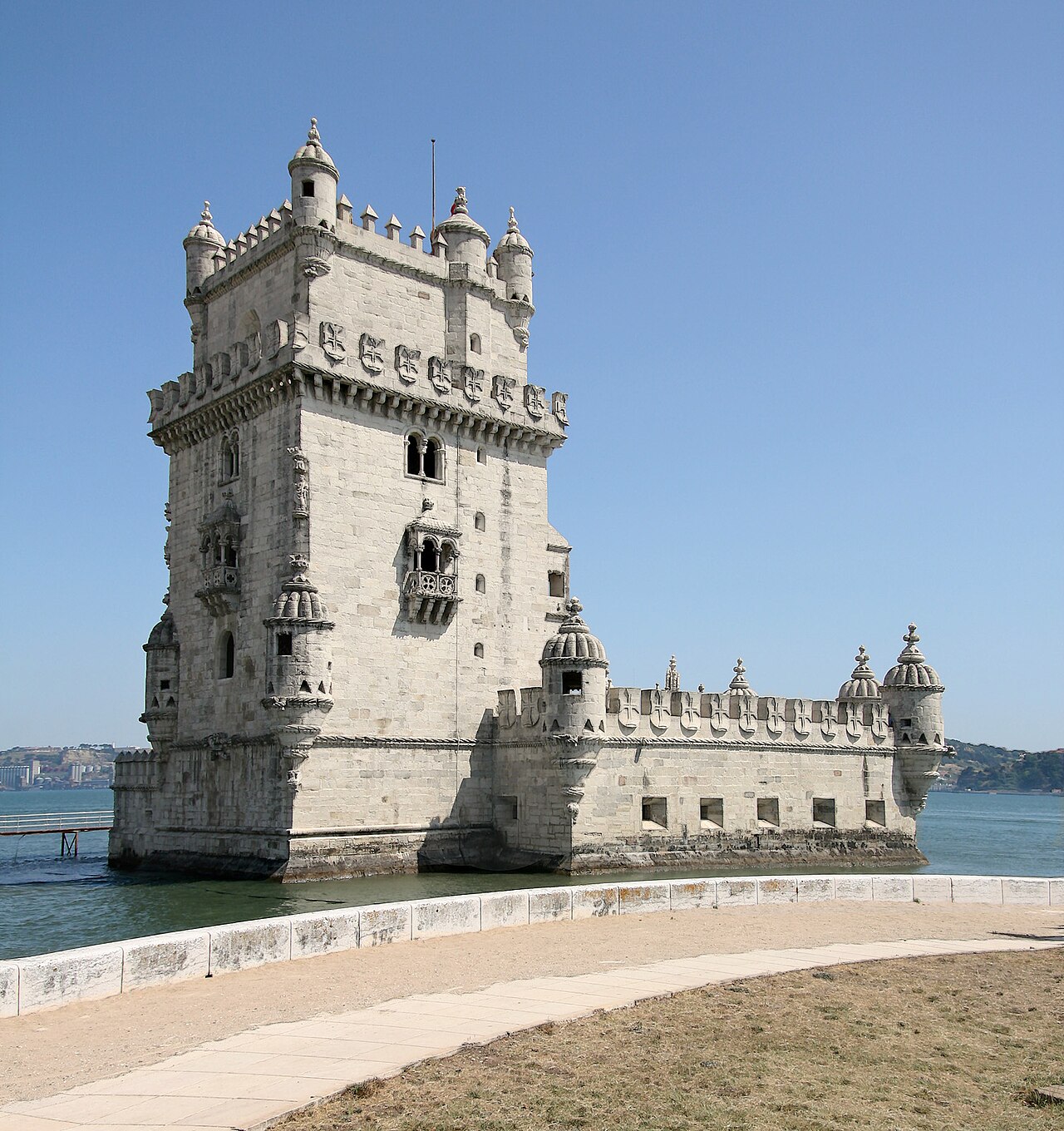
The city's UNESCO property is the Monastery of the Hieronymites and Tower of Belém in Lisbon, inscribed in 1983 under cultural criteria (iii) and (vi). That is one listing covering two separate monuments in the riverside Belém district, which sits well west of the center. Belém is exposed to the estuary, so it is the part of the city where a windy, bright winter day is most noticeable and where the summer heat is most tempered.
A practical rhythm
- May — 73°F highs and 5.7 wet days; the best balance of warmth and dryness.
- July and August — Highs of 83°F and 84°F with under a quarter-inch of rain between them.
- November — The wettest month in the normals at 4.5 inches over 9.3 days.
What could complicate the plan
The US Department of State's Portugal country information page advises travelers to exercise normal precautions, though that page is marked as last updated 16 June 2023, so it is not a recently refreshed assessment. Portugal is a Schengen state, so a US visitor's stay counts against the Schengen maximum of 90 days within any 180-day period, pooled across all Schengen countries. The EU's Entry/Exit System has been fully operational across all Schengen countries since 10 April 2026, which adds biometric registration at first entry.
What to do next
For what to do with those dry summer mornings and wet winter afternoons, read the Lisbon things-to-do answer in this group.
Sources
- IPMA (Instituto Português do Mar e da Atmosfera) — 1991–2020 monthly and annual normals for mean maximum, mean minimum, precipitation and wet days
- UNESCO World Heritage Centre — official property name and cultural criteria
- UNESCO World Heritage Centre — 1983 inscription year
- US Department of State — Portugal country information advice and page date
- European Commission, Migration and Home Affairs — EES operational status