Lithuania country guide When to visit
When is the best time to visit Lithuania for Vilnius?
The short answer
Late May through early September — under the Lithuanian Hydrometeorological Service's 1991–2020 standard climate normal, July is the warmest month at a mean 18.3°C (64.9°F), and May and July each deliver 283 hours of sunshine, the two brightest months of the Lithuanian year.
The answer, with local context
Those normals are national averages rather than a single Vilnius station reading, and they describe mean air temperature, not a daytime maximum, so treat them as the shape of the year rather than a forecast for a given afternoon. The shape is unambiguous. The annual mean sits at 7.4°C (45.3°F), up 0.5°C on the 1981–2010 normal. January bottoms out at a mean of -2.9°C (26.8°F) and December supplies just 29 hours of sunshine for the whole month. September still holds a mean of 12.8°C (55.0°F) and 179 hours of sun, which is why the first half of the month remains comfortable for long days on foot.
Rain is spread thinly and never concentrates into a true wet season. Lithuania averages 695 mm (27.4 inches) a year. July is the wettest month at 84 mm (3.3 inches) and April the driest at 37 mm (1.5 inches), so the summer you choose for warmth is also the summer that carries the heaviest showers. Mean wind drops to 2.4 to 2.5 m/s in July and August and climbs back above 3.5 m/s from November to February, which matters a great deal if your trip includes the Baltic coast.
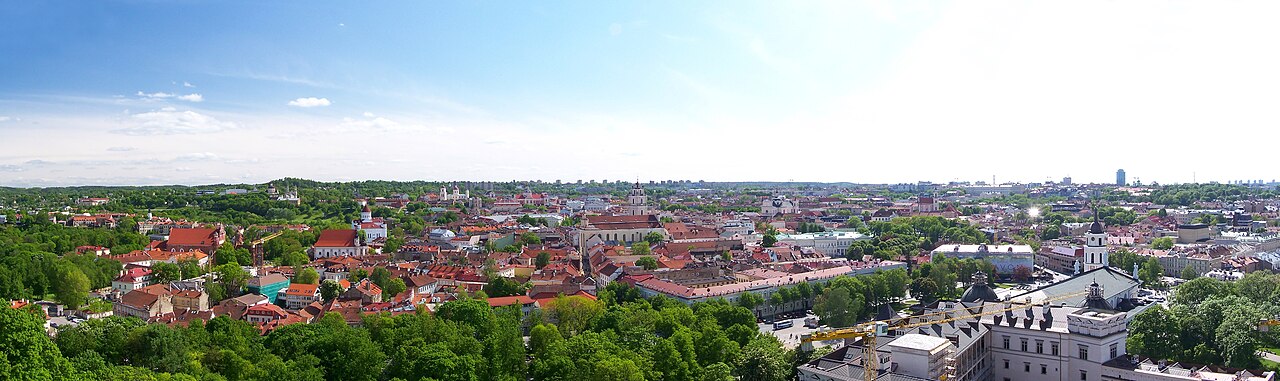
Vilnius anchors all of this. The Historic Centre was inscribed on the UNESCO World Heritage List in 1994, one of 5 Lithuanian properties on the list according to UNESCO's own States Parties record, and Lithuania accepted the World Heritage Convention on 31 March 1992. The other 4 — the Curonian Spit in 2000, the Kernavė Archaeological Site in 2004, the Struve Geodetic Arc in 2005 and Modernist Kaunas in 2023 — are all reachable from the capital on a day or overnight trip, and that spread is the real argument for coming in the long-daylight half of the year.
Picture the place
In early September the low sun rakes across Vilnius at an angle that catches the baroque facades and leaves the narrow courtyards in shade, and with 179 hours of sunshine spread across the month there are enough clear mornings to see it happen more than once. By December the city gets through the entire month on 29 hours of sun, so lamplight does most of the work.
The easily missed detail
Lithuania's World Heritage holdings are unusually transnational for a country this size, and that changes how you plan. The Curonian Spit is a shared inscription with the Russian Federation, and the Struve Geodetic Arc is a chain of survey stations running through 10 countries. The practical consequence is that the Lithuanian portions are what you can visit, and the Curonian Spit National Park Directorate manages the World Heritage property inside its own territory under the Ministry of Environment. That Directorate also records 12 World Heritage Committee decisions on the spit since 2000, ICOMOS reactive missions in 2001 and 2015, and 14 state-of-conservation analyses — a site under active scrutiny, not a static monument.
A practical rhythm
- May and June — Pick these for light rather than heat. May carries 283 hours of sunshine against a mean of 12.5°C (54.5°F), so days are long and cool enough for walking the Old Town for hours.
- July and August — The warmest and calmest stretch, with August at a mean 17.6°C (63.7°F) and the lowest mean wind speeds of the year. Best window for the coast and the spit.
- Late September onward — Sunshine falls to 106 hours in October and 39 hours in November. Shift indoors: museums, concerts and the Modernist Kaunas inscription.
What could complicate the plan
US travelers do not need a tourist visa, but the State Department's Lithuania country information page requires a passport valid for 6 months and at least 1 page per stamp, and caps currency at 10,000 euros in either direction. Lithuania is in the Schengen area, so the European Commission's short-stay rule applies: a maximum of 90 days in any 180-day period, counted by looking back 180 days from each day of your stay. The US International Trade Administration notes that American drivers must carry an International Driving Permit alongside their home license, that rail service is thinner and less frequent than the bus network, and that the tick-borne encephalitis vaccine can be warranted if you will spend time in forested areas — which covers much of the Curonian Spit and the Kernavė valley.
What to do next
Read the Lithuania trip-planning answer in this chapter for the internal distances between Vilnius, Kaunas and the coast, and the food answer for where the summer festival calendar overlaps with the warm months named here.
Sources
- Lithuanian Hydrometeorological Service — 1991–2020 monthly and annual means for temperature, precipitation, wind and sunshine
- UNESCO World Heritage Centre — inscribed property count, Tentative List count, Convention acceptance date
- National Commission for Cultural Heritage of the Republic of Lithuania — inscription years for all five Lithuanian properties
- Curonian Spit National Park Directorate — management authority, Committee decision and mission counts
- US Department of State, Lithuania country information — passport validity, visa, currency limits
- European Commission, Schengen short-stay calculator — the 90-in-180 rule and count-back method
- US International Trade Administration, Lithuania business travel — driving permit, rail coverage, tick-borne encephalitis note