Lyon / France Things to do
What are the most worthwhile things to do in Lyon on a first visit?
The short answer
The Fourvière hill (basilica and Roman theatres), the traboules of Vieux Lyon and Croix-Rousse, the Presqu'île squares, and the Confluence where the rivers meet — Lyon reads as four quarters stacked on two rivers.
The answer, with local context
Start where the city started. Lyon began as Lugdunum in 43 BC, Rome's capital of the Gauls, and its Fourvière hill still holds the evidence: the ancient theater (built around 15 BC, the oldest Roman theater in France, seating some 10,000) and the smaller Odeon beside it, with the Lugdunum museum sunk into the hillside behind them. The summer Nuits de Fourvière festival (since 1946) still stages concerts in the theater. Above them looms the Basilique Notre-Dame de Fourvière (1872–1884), the votive basilica Lyonnais call "the upside-down elephant" for its towered silhouette — its mosaicked interior is France's 19th century at full gilt, and its esplanade gives the defining view: the Saône below, the Presqu'île between the rivers, and on clear days the Alps on the horizon. Ride the funicular — Lyon's "ficelles" — down to Vieux Lyon.
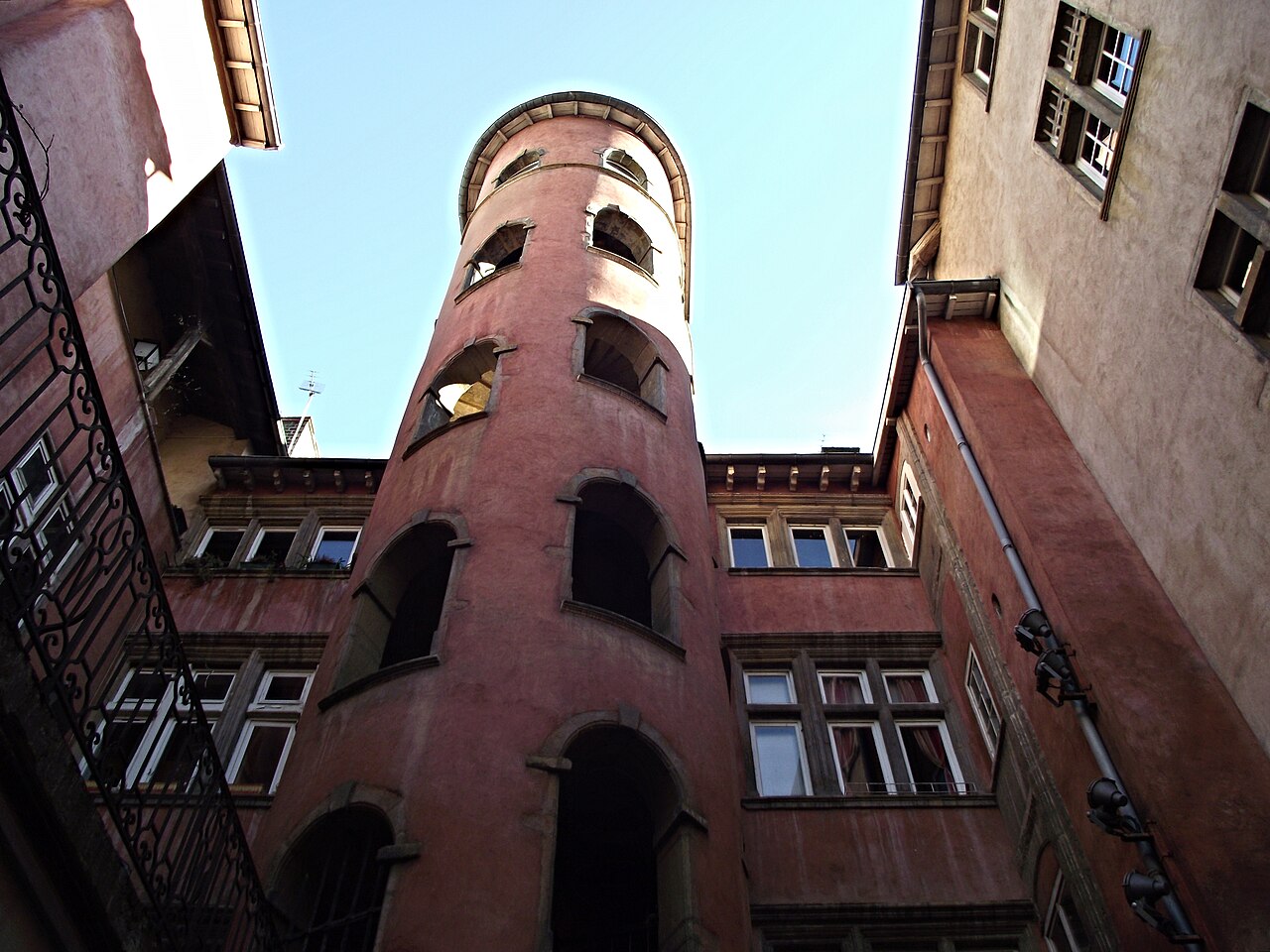
Vieux Lyon is the second act: one of Europe's largest Renaissance quarters, the merchants' streets (Rue Saint-Jean, Rue du Bœuf) lined with courtyard houses built when Lyon's fairs made it a banking capital. Its secret system is the traboules — covered passageways cutting through blocks from street to street, built for moving silk dry and feet fast; the city counts roughly 400 in total across Vieux Lyon and Croix-Rousse, a signposted handful open to the public by day (the Tour Rose courtyard on Rue du Bœuf is the showpiece). The cathedral of Saint-Jean closes the quarter: a Gothic shell holding a 14th-century astronomical clock that still performs. Across the Saône, Croix-Rousse — the silk workers' hill, "the hill that works" to Fourvière's "hill that prays" — keeps the other traboules and the Maison des Canuts, where Jacquard looms (the 1804 invention that punched-card-programmed weaving, and computing's ancestor) still clatter in demonstration.
The Presqu'île between the rivers is the city's drawing room: Place des Terreaux with Bartholdi's fountain and the Musée des Beaux-Arts, then south down the shopping spine (Rue de la République) to Place Bellecour — among Europe's largest pedestrian squares, Louis XIV on horseback at its center — and onward to the Confluence, where the Saône meets the Rhône and the Musée des Confluences (opened 2014) sits in a deconstructivist crystal at the waters' meeting. Fill the gaps with the city's living arts: the Institut Lumière in Monplaisir, where the Lumière brothers shot the first films in 1895 (their villa and the Hangar du Premier-Film survive), the Parc de la Tête d'Or (1857, 260 acres/105 hectares, free zoo and botanical garden) for the green afternoon, and the murals — the Mur des Canuts in Croix-Rousse, Europe's largest trompe-l'œil, repainting the silk workers' story across a whole building.
Picture the place
Inside a traboule at 9 a.m.: a vaulted corridor of worn stone, a spiral stair in a pink tower at the courtyard's end, and a cat watching you from a silk merchant's gallery four floors up.
The easily missed detail
Lyon gave the world two inventions it rarely gets thanked for in person: cinema (the Cinématographe, 1895 — the first film, workers leaving the Lumière factory, was shot on the street outside the institute in Monplaisir, and you can stand on the spot) and Guignol, the hand-puppet created in 1808 by the silk worker Laurent Mourguet, whose shows still play in the city's puppet theatres with the canut's dialect jokes intact. A Guignol matinée in Vieux Lyon is not children's programming by accident — it is the silk city's folk literature, performed continuously for two centuries.
A practical rhythm
- Hill first — Fourvière by funicular at opening: museum and theatres before tour groups, basilica view before the haze
- Traboule etiquette — The open passages are signposted and daytime-only; they pass through people's homes, so quiet voices and no courtyard loitering
- River logic — Walk the quarters in water order: Saône side (Vieux Lyon), Presqu'île, then Confluence by tram or the Vaporetto river shuttle
What could complicate the plan
The quarters keep different clocks: the Lugdunum museum and Maison des Canuts close Mondays or Tuesdays by season, the traboules' open courtyards are a courtesy that can be withdrawn (a closed gate is an answer, not an invitation), and summer heat turns Fourvière's climb punishing by noon — the funicular exists for a reason. Festival weeks (the Biennale, the Fête des Lumières) reprice the whole city. The astronomical clock's show times change; check at the cathedral door rather than trusting a guidebook's hours.
What to do next
Give Fourvière a morning, Vieux Lyon and the traboules an afternoon, and keep the Confluence and the Lumière Institute for the second day.
Sources
- UNESCO World Heritage Centre — the Historic Site of Lyon (1998): Fourvière, Vieux Lyon, the Presqu'île and the Croix-Rousse slopes
- Lugdunum — the ancient theatre (c. 15 BC) and odeon; the Nuits de Fourvière in the Roman theatres (since 1946)
- Maison des Canuts / City of Lyon — the traboule network (some 400 passages) and the silk-working heritage of Croix-Rousse
- Institut Lumière — the Cinématographe of 1895 and the first film, shot in Monplaisir