Malawi country guide When to visit
When is the best time to visit Malawi for Lake Malawi?
The short answer
May to October, the dry months — Malawi's meteorological service defines the start of the rains as a day, or three consecutive days, delivering at least 1 inch (25 mm) of rain not followed by nine consecutive dry days in the next 21, and until that threshold is met the lakeshore stays settled.
The answer, with local context
Malawi's Department of Climate Change and Meteorological Services publishes that onset definition as an operational rule, which makes it a better guide to the country's year than a calendar month. In its bulletin of 10 November 2025 the service recorded that the onset of the season had not yet been observed anywhere in Malawi, and forecast national totals for that November of roughly 2.0 to 3.9 inches (50 to 100 mm), with normal to below-normal rainfall expected. The rains, in other words, do not arrive on a date; they arrive when a threshold is crossed, and that can be weeks apart from one year to the next.
Temperature varies by altitude more than by season. In the first ten days of November 2025 the service recorded average maximum temperatures ranging from 80.4°F (26.9°C) at Dedza and Bvumbwe on the high ground to 97.5°F (36.4°C) at Ngabu in the Lower Shire valley. Those are observations from a monthly bulletin rather than long-term normals, but the spread they show between plateau and valley is the structural fact: a lakeshore day and a highland day are different climates in the same country.
The lake itself is the reason to come, and it is a World Heritage property. UNESCO inscribed Lake Malawi National Park in 1984 under criteria (vii), (ix) and (x) — scenic value, ongoing ecological and biological processes, and biodiversity significance. The IUCN's 2025 conservation outlook assessment, finalized on 11 October 2025, estimates roughly 1,000 fish species in the lake, nearly all endemic, with hundreds of cichlid species still undescribed. That assessment rates the property's conservation outlook as "Significant Concern," with overall threats High and protection and management at "Serious Concern."
Picture the place
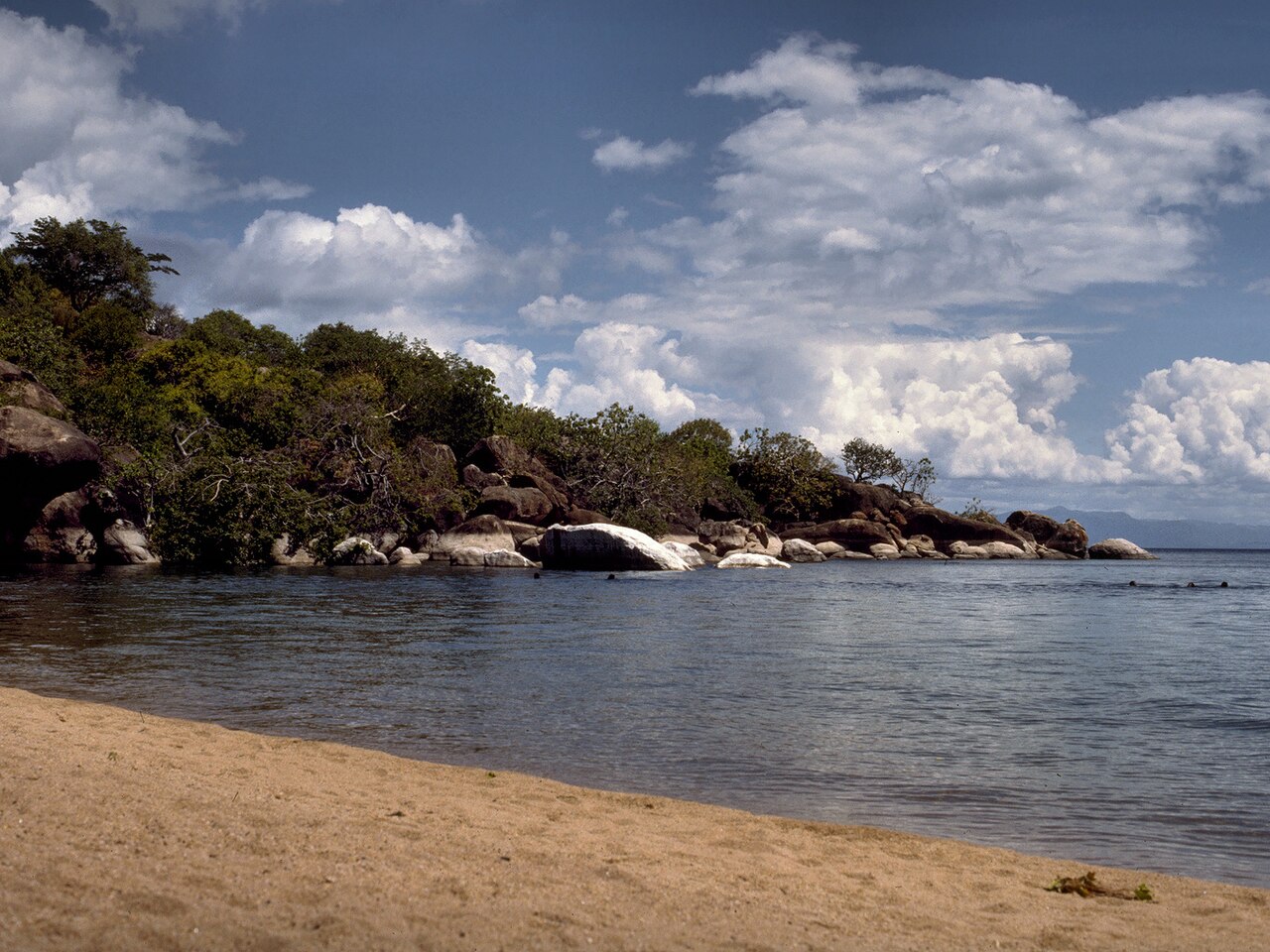
Lake Malawi's water is startlingly clear over the rocky shores where the mbuna live, which is why the fish are visible from the surface — the endemic cichlids are a snorkeling sight here rather than a diving one.
The easily missed detail
Lake Chilwa, Malawi's other great water body, works on the opposite principle from the deep lake: Ramsar describes it as shallow and saline, with marked seasonal variation in water level. Anyone timing a trip around water — birds, fishing, boat access — needs to treat the two lakes as separate calendars rather than one.
A practical rhythm
- May to August — The settled months; nights on the plateau are cool while the lakeshore stays mild.
- September and October — Hot and still dry, with the highest temperatures in the low-lying valleys rather than at the lake.
- November onward — Watch the met service's onset threshold rather than the date; in 2025 it had not been crossed by the tenth of the month.
What could complicate the plan
The IUCN assessment is a list of live pressures, not a historical note: it rates overall threats to Lake Malawi National Park as High and judges protection and management to be of serious concern. Rain onset is genuinely variable, so a November trip is a gamble on a threshold rather than on an average. Temperatures in the Lower Shire approached 100°F in early November 2025, which makes low-altitude travel at the end of the dry season demanding. Entry is its own errand whichever month is chosen: a visa is required, single and multiple entry visas can be obtained on arrival, and the posted amounts are $50 for a single entry, $150 for a 6-month multiple entry and $250 for a year, paid in US dollars in cash — with a passport whose expiry date falls at least 6 months after the day of arrival.
What to do next
The Malawi places answer in this group covers Chongoni's rock art and Lake Chilwa's wetland; the trip-planning answer deals with routing between the lake, the plateau and the Mulanje massif.
Sources
- Malawi Department of Climate Change and Meteorological Services — onset definition, 10 November 2025 onset status, November forecast totals, early-November temperature ranges
- UNESCO World Heritage Centre — Lake Malawi National Park inscription year and criteria
- IUCN World Heritage Outlook — 2025 conservation outlook rating, threat and management ratings, fish species estimates
- Ramsar Sites Information Service, Lake Chilwa — shallow, saline character and seasonal water-level variation
- UK Foreign, Commonwealth and Development Office — visa required and obtainable on arrival, the single-entry, 6-month and one-year visa amounts, and the 6-month passport validity rule (retrieved November 5, 2026)